
324 citations
Cite
SaveGo to paper →
Wiley
Congenital Anomalies Template
Write in a clean editor, then format for Congenital Anomalies in one click — DocuGuru applies the official Wiley template with author–year references and exports a submission-ready PDF plus the editable LaTeX source. Free to start.
About the Congenital Anomalies format
Congenital Anomalies is a peer-reviewed journal published by Wiley, covering Legal and Regulatory Analysis, Linguistic, Cultural, and Literary Studies, Military Technology and Strategies.
| Publisher | Wiley |
|---|---|
| Reference style | Author–year (Chicago) Author–year — (Smith, 2023) in the text Smith, Ada, Ben Jones, and Cara Lee. 2023. "A Representative Article Title." Congenital Anomalies 12 (3): 45–58.
Formats any DOI in Congenital Anomalies style. No sign-up. |
| Publishes research in | Legal and Regulatory Analysis Linguistic, Cultural, and Literary Studies Military Technology and Strategies Prenatal Screening and Diagnostics Cleft Lip and Palate Research |
| ISSN | 0914-3505 |
| Citation impact (2-yr) | 0.85 |
| h-index | 45 |
| i10-index | 399 |
| Total citations | 14,254 |
| Article processing charge | $2,830 |
| Top institutions publishing here | Kyoto University |
| Journal website | onlinelibrary.wiley.com |
| You get | A submission-ready PDF and the editable LaTeX source — ready to submit. |
Papers published in Congenital Anomalies per year
Citation impact of Congenital Anomalies by publication year
Citations each year’s papers have accumulated so far — the most recent years are still building up.
Most-cited papers in Congenital Anomalies
Spina bifida, anencephaly, and encephalocele are commonly grouped together and termed neural tube defects (NTD). Failure of closure of the neural tube during development results in anencephaly or spina bifida aperta but encephaloceles are possibly post-closure defects. NTD are associated with a number of other central nervous system (CNS) and non-neural malformations. Racial, geographic and…
294 citations
Cite
SaveGo to paper →
With the high cost and the long-term assessment of developmental toxicity testing in mammals, the vertebrate zebrafish has become a useful alternative model organism for high-throughput developmental toxicity testing. Zebrafish is also very favorable for the 3R perspective in toxicology; however, the methodologies used by research groups vary greatly, posing considerable challenges to integrative analysis.…
198 citations
Cite
SaveGo to paper →
The developing brain is extremely sensitive to many chemicals. Exposure to neurotoxicants during development has been implicated in various neuropsychiatric and neurological disorders, including autism spectrum disorder, attention deficit hyperactive disorder, schizophrenia, Parkinson's disease, and Alzheimer's disease. Although rodents have been widely used for developmental neurotoxicity testing, experiments using large numbers of rodents are time-consuming,…
197 citations
Cite
SaveGo to paper →
Moderate hyperhomocysteinemia-induced low folate status is an independent risk factor for cardiovascular disease, dementia, and depression. Folate is an essential cofactor in the one-carbon metabolism pathway and is necessary in amino acid metabolism, purine and thymidylate synthesis, and DNA methylation. In the folate cycle and homocysteine metabolism, folate, vitamin B12, vitamin B6, and vitamin B2…
177 citations
Cite
SaveGo to paper →
Related journal templates
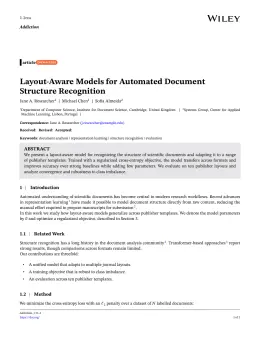
Congenital Anomalies template — frequently asked questions
How do I write a paper in the Congenital Anomalies format?
In DocuGuru you write your manuscript in a normal editor — no LaTeX setup required — and select the Congenital Anomalies template. When you export, DocuGuru compiles the paper into the official Wiley format and hands you a submission-ready PDF along with the editable LaTeX source.
What reference style does Congenital Anomalies use?
Congenital Anomalies uses Author–year (Chicago) references, shown as author–year markers such as (Smith, 2023) in the text. DocuGuru formats every in-text citation and the reference list in this exact style automatically. A reference appears like this: Smith, Ada, Ben Jones, and Cara Lee. 2023. "A Representative Article Title." Congenital Anomalies 12 (3): 45–58.
Do I need to know LaTeX to submit to Congenital Anomalies?
No. DocuGuru generates the USG LaTeX class and compiles the PDF for you in the background, so you get a Wiley-ready Congenital Anomalies document without writing any LaTeX. If you do want it, the LaTeX source is included in the export.
Can I import an existing draft into the Congenital Anomalies template?
Yes. Paste or upload your current manuscript — Word, LaTeX, Markdown, or plain text — and DocuGuru reflows it into the Congenital Anomalies format with correct headings, figures, tables, and author–year citations.
Who publishes Congenital Anomalies?
Congenital Anomalies is a multidisciplinary journal published by Wiley. DocuGuru's Congenital Anomalies template matches Wiley's official submission format.
Can I export a submission-ready Congenital Anomalies PDF?
Yes — DocuGuru produces a PDF built with the official Congenital Anomalies template (the USG class) that is ready to submit to Wiley, together with the matching LaTeX source files.
How much does the Congenital Anomalies template cost?
You can start writing in the Congenital Anomalies template for free. Exporting the final submission-ready Congenital Anomalies PDF and LaTeX source is part of DocuGuru's paid plans — see the app for current pricing.