Wiley

Applied AI Letters Template

Write in a clean editor, then format for Applied AI Letters in one click — DocuGuru applies the official Wiley template with author–year references and exports a submission-ready PDF plus the editable LaTeX source. Free to start.

About the Applied AI Letters format

Applied AI Letters is a peer-reviewed journal published by Wiley, covering Explainable Artificial Intelligence (XAI), Diverse Scientific and Economic Studies, Human auditory perception and evaluation.

PublisherWiley
Reference styleAuthor–year (Chicago)
Author–year — (Smith, 2023) in the text
Smith, Ada, Ben Jones, and Cara Lee. 2023. "A Representative Article Title." Applied AI Letters 12 (3): 45–58.

Formats any DOI in Applied AI Letters style. No sign-up.

Publishes research inExplainable Artificial Intelligence (XAI) Diverse Scientific and Economic Studies Human auditory perception and evaluation Educational Robotics and Engineering Topic Modeling
ISSN2689-5595
Citation impact (2-yr)1.56
h-index16
i10-index29
Total citations980
Article processing charge$2,100
Open accessYes
Top institutions publishing hereMakerere University
Journal websiteonlinelibrary.wiley.com
You getA submission-ready PDF and the editable LaTeX source — ready to submit.

Papers published in Applied AI Letters per year

12
2020
43
2021
16
2022
16
2023
20
2024
40
2025

Citation impact of Applied AI Letters by publication year

81
2020
620
2021
95
2022
45
2023
36
2024
77
2025

Citations each year’s papers have accumulated so far — the most recent years are still building up.

Most-cited papers in Applied AI Letters

Adapting natural language processing for technical text

Alden Dima, Sarah Lukens, Melinda Hodkiewicz et al. · 2 Jun 2021

Despite recent dramatic successes, Natural Language Processing (NLP) is not ready to address a variety of real-world problems. Its reliance on large standard corpora, a training and evaluation paradigm that favors the learning of shallow heuristics, and large computational resource requirements, makes domain-specific application of even the most successful NLP techniques difficult. This paper proposes…

Applying machine learning for large scale field calibration of low‐cost PM<sub>2.5</sub>and PM<sub>10</sub>air pollution sensors

Priscilla Adong, Engineer Bainomugisha, Deo Okure et al. · 1 Aug 2022

Abstract Low‐cost air quality monitoring networks can potentially increase the availability of high‐resolution monitoring to inform analytic and evidence‐informed approaches to better manage air quality. This is particularly relevant in low and middle‐income settings where access to traditional reference‐grade monitoring networks remains a challenge. However, low‐cost air quality sensors are impacted by ambient conditions which…

Methods and standards for research on explainable artificial intelligence: Lessons from intelligent tutoring systems

William J. Clancey, Robert R. Hoffman · 13 Nov 2021

Abstract The DARPA Explainable Artificial Intelligence (AI) (XAI) Program focused on generating explanations for AI programs that use machine learning techniques. This article highlights progress during the DARPA Program (2017‐2021) relative to research since the 1970s in the field of intelligent tutoring systems (ITSs). ITS researchers learned a great deal about explanation that is directly…

Tiny Video Networks

AJ Piergiovanni, Anelia Angelova, Michael S. Ryoo · 13 Oct 2021

Abstract Automatic video understanding is becoming more important for applications where real‐time performance is crucial and compute is limited: for example, automated video tagging, robot perception, activity recognition for mobile devices. Yet, accurate solutions so far have been computationally intensive. We propose efficient models for videos—Tiny Video Networks—which are video architectures, automatically designed to comply…

Practical notes on building molecular graph generative models

Rocío Mercado, Tobias Rastemo, Edvard Lindelöf et al. · 1 Dec 2020

Abstract Here are presented technical notes and tips on developing graph generative models for molecular design. Although this work stems from the development of GraphINVENT, a Python platform for iterative molecular generation using graph neural networks, this work is relevant to researchers studying other architectures for graph‐based molecular design. In this work, technical details that…

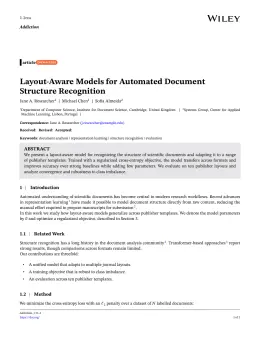
Applied AI Letters template — frequently asked questions

How do I write a paper in the Applied AI Letters format?
In DocuGuru you write your manuscript in a normal editor — no LaTeX setup required — and select the Applied AI Letters template. When you export, DocuGuru compiles the paper into the official Wiley format and hands you a submission-ready PDF along with the editable LaTeX source.
What reference style does Applied AI Letters use?
Applied AI Letters uses Author–year (Chicago) references, shown as author–year markers such as (Smith, 2023) in the text. DocuGuru formats every in-text citation and the reference list in this exact style automatically. A reference appears like this: Smith, Ada, Ben Jones, and Cara Lee. 2023. "A Representative Article Title." Applied AI Letters 12 (3): 45–58.
Do I need to know LaTeX to submit to Applied AI Letters?
No. DocuGuru generates the USG LaTeX class and compiles the PDF for you in the background, so you get a Wiley-ready Applied AI Letters document without writing any LaTeX. If you do want it, the LaTeX source is included in the export.
Can I import an existing draft into the Applied AI Letters template?
Yes. Paste or upload your current manuscript — Word, LaTeX, Markdown, or plain text — and DocuGuru reflows it into the Applied AI Letters format with correct headings, figures, tables, and author–year citations.
Who publishes Applied AI Letters?
Applied AI Letters is a multidisciplinary journal published by Wiley. DocuGuru's Applied AI Letters template matches Wiley's official submission format.
Can I export a submission-ready Applied AI Letters PDF?
Yes — DocuGuru produces a PDF built with the official Applied AI Letters template (the USG class) that is ready to submit to Wiley, together with the matching LaTeX source files.
How much does the Applied AI Letters template cost?
You can start writing in the Applied AI Letters template for free. Exporting the final submission-ready Applied AI Letters PDF and LaTeX source is part of DocuGuru's paid plans — see the app for current pricing.
Use the Applied AI Letters template