Taylor & Francis

Visual Impairment Research Template

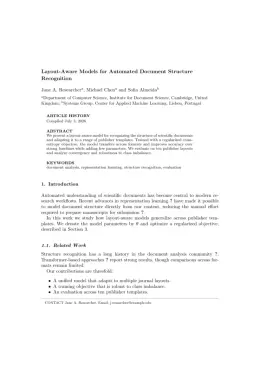
Write in a clean editor, then format for Visual Impairment Research in one click — DocuGuru applies the official Taylor & Francis template with author–year references and exports a submission-ready PDF plus the editable LaTeX source. Free to start.

About the Visual Impairment Research format

Visual Impairment Research is a peer-reviewed journal published by Taylor & Francis, covering Ophthalmology and Visual Impairment Studies, Tactile and Sensory Interactions, Visual perception and processing mechanisms.

PublisherTaylor & Francis
Reference styleAuthor–year (Chicago, T&F)
Author–year — (Smith, 2023) in the text
Smith, Ada, Ben Jones, and Cara Lee. 2023. "A Representative Article Title." Visual Impairment Research 12 (3): 45–58.

Formats any DOI in Visual Impairment Research style. No sign-up.

Publishes research inOphthalmology and Visual Impairment Studies Tactile and Sensory Interactions Visual perception and processing mechanisms Ophthalmology and Visual Health Research Retinal Diseases and Treatments
ISSN1388-235X
h-index22
i10-index54
Total citations1,862
Top institutions publishing hereUniversity of Groningen
Journal websitewww.tandfonline.com
You getA submission-ready PDF and the editable LaTeX source — ready to submit.

Papers published in Visual Impairment Research per year

26
1999
18
2000
16
2001
16
2002
14
2003
12
2004
10
2005
8
2006
10
2007
8
2008

Citation impact of Visual Impairment Research by publication year

301
1999
134
2000
107
2001
339
2002
330
2003
106
2004
205
2005
61
2006
160
2007
113
2008

Citations each year’s papers have accumulated so far — the most recent years are still building up.

Most-cited papers in Visual Impairment Research

Emotional and social consequences of age-related low vision

David Burmedi, Stefanie Becker, Vera Heyl et al. · 1 Jan 2002

\n\t\t\t\t\tThe aim of this work is to narratively review findings on emotional and social adjustment among visually impaired older adults. The definition of emotional adjustment employed here includes a decline in mental health, especially the occurrence of depression, as well as less severe manifestations of emotional disturbance, such as lower well-being. Empirical research on these…

The Benefits of Guide Dog Ownership

Lorraine Whitmarsh · 1 Jan 2005

There is an apparent discrepancy between the actual number of guide dog owners and the proportion of visually impaired people who might benefit from a guide dog. This research aimed to provide an understanding of the reasons why many visually impaired people have not applied for a guide dog, the range of benefits offered by…

Behavioral consequences of age-related low vision

David Burmedi, Stefanie Becker, Vera Heyl et al. · 1 Jan 2002

\n\t\t\t\t\tThis review article focuses on the impact of age-related low vision on behavioral competence, including activities of daily living, mobility, and leisure pursuits. Empirical findings are used to illustrate that vision impairment leads to a significant decline in behavioral competence among the elderly. In particular, age-related low vision is shown to be a significant and…

Measuring Braille reading speed with the MNREAD test

Gordon E. Legge, Cindee Madison, J. Stephen Mansfield · 1 Jan 1999

Braille is an important form of written communication for many visually disabled people. Perceptual factors limiting Braille reading speed are poorly understood, partly because of the lack of accurate, standardized testing methods. In this paper, we describe a new, standardized method for measuring Braille reading speed, adapted from the MNREAD test for print reading speed.…

Aspects of vision loss – visual functions and functional vision

August Colenbrander · 1 Jan 2003

To promote consistency in terminology, this paper explores the distinction between Visual Functions, which describe how the eye functions, and Functional Vision, which describes how the person functions in vision-related activities. Adequate assessment of Functional Vision is essential to measure outcomes of vision rehabilitation. Consistent measurement will require the development of a unified set of…

Visual Impairment Research template — frequently asked questions

How do I write a paper in the Visual Impairment Research format?
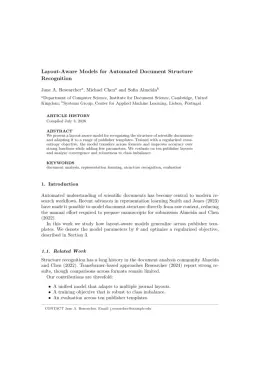
In DocuGuru you write your manuscript in a normal editor — no LaTeX setup required — and select the Visual Impairment Research template. When you export, DocuGuru compiles the paper into the official Taylor & Francis format and hands you a submission-ready PDF along with the editable LaTeX source.
What reference style does Visual Impairment Research use?
Visual Impairment Research uses Author–year (Chicago, T&F) references, shown as author–year markers such as (Smith, 2023) in the text. DocuGuru formats every in-text citation and the reference list in this exact style automatically. A reference appears like this: Smith, Ada, Ben Jones, and Cara Lee. 2023. "A Representative Article Title." Visual Impairment Research 12 (3): 45–58.
Do I need to know LaTeX to submit to Visual Impairment Research?
No. DocuGuru generates the interact LaTeX class and compiles the PDF for you in the background, so you get a Taylor & Francis-ready Visual Impairment Research document without writing any LaTeX. If you do want it, the LaTeX source is included in the export.
Can I import an existing draft into the Visual Impairment Research template?
Yes. Paste or upload your current manuscript — Word, LaTeX, Markdown, or plain text — and DocuGuru reflows it into the Visual Impairment Research format with correct headings, figures, tables, and author–year citations.
Who publishes Visual Impairment Research?
Visual Impairment Research is a multidisciplinary journal published by Taylor & Francis. DocuGuru's Visual Impairment Research template matches Taylor & Francis's official submission format.
Can I export a submission-ready Visual Impairment Research PDF?
Yes — DocuGuru produces a PDF built with the official Visual Impairment Research template (the interact class) that is ready to submit to Taylor & Francis, together with the matching LaTeX source files.
How much does the Visual Impairment Research template cost?
You can start writing in the Visual Impairment Research template for free. Exporting the final submission-ready Visual Impairment Research PDF and LaTeX source is part of DocuGuru's paid plans — see the app for current pricing.
Use the Visual Impairment Research template