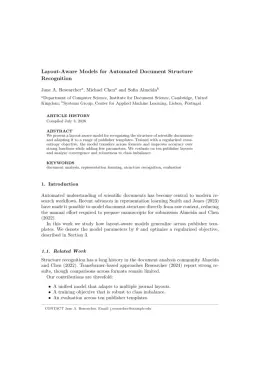
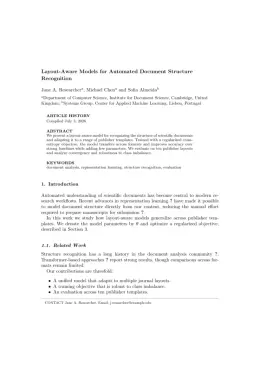
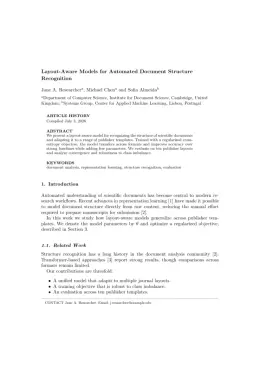
Taylor & Francis

The Journal of Horticultural Science and Biotechnology Template

Write in a clean editor, then format for The Journal of Horticultural Science and Biotechnology in one click — DocuGuru applies the official Taylor & Francis template with author–year references and exports a submission-ready PDF plus the editable LaTeX source. Free to start.

About the The Journal of Horticultural Science and Biotechnology format

The Journal of Horticultural Science and Biotechnology is a peer-reviewed journal published by Taylor & Francis, covering Plant Physiology and Cultivation Studies, Postharvest Quality and Shelf Life Management, Horticultural and Viticultural Research.

PublisherTaylor & Francis
Reference styleAuthor–year (Chicago, T&F)
Author–year — (Smith, 2023) in the text
Smith, Ada, Ben Jones, and Cara Lee. 2023. "A Representative Article Title." The Journal of Horticultural Science and Biotechnology 12 (3): 45–58.

Formats any DOI in The Journal of Horticultural Science and Biotechnology style. No sign-up.

Publishes research inPlant Physiology and Cultivation Studies Postharvest Quality and Shelf Life Management Horticultural and Viticultural Research Plant tissue culture and regeneration Plant Reproductive Biology
ISSN1462-0316
Citation impact (2-yr)2.55
h-index76
i10-index1,717
Total citations56,842
Top institutions publishing hereAgricultural Research Organization
Journal websitewww.tandfonline.com
You getA submission-ready PDF and the editable LaTeX source — ready to submit.

Papers published in The Journal of Horticultural Science and Biotechnology per year

105
2014
122
2015
115
2016
114
2017
69
2018
91
2019
71
2020
61
2021
81
2022
55
2023
66
2024
74
2025

Citation impact of The Journal of Horticultural Science and Biotechnology by publication year

1.5K
2014
1.6K
2015
1.6K
2016
1.6K
2017
771
2018
1.7K
2019
876
2020
766
2021
697
2022
279
2023
275
2024
94
2025

Citations each year’s papers have accumulated so far — the most recent years are still building up.

Most-cited papers in The Journal of Horticultural Science and Biotechnology

Vertical farming: a summary of approaches to growing skywards

Andrew M Beacham, Laura H. Vickers, James Monaghan · 14 Feb 2019

Pressure on agricultural land from a rising global population is necessitating the maximisation of food production per unit area of cultivation. Attention is increasingly turning to Vertical Farming (VF) approaches in an attempt to provide a greater crop yield per square meter of land. However, this term has been used to cover a broad range…

Irrigation with saline water improves carotenoids content and antioxidant activity of tomato

Stefania De Pascale, Albino Maggio, Vincenzo Fogliano et al. · 1 Jan 2001

SummaryThe combined effect of increasing concentrations of NaCl in the irrigation water and fertilization with different nitrogen sources on the chemical composition of tomato (Lycopersicon esculentum Mill.) fruit was investigated. Increasing water salinity from 0.5.dS m-1 (non-salinized control) to 15.7.dS m-1 resulted in both reduced fruit size and fruit water content, whereas it caused an…

<i>Review Article</i>:Root development in horticultural plants grown under abiotic stress conditions – a review

J.A. Franco, S. Bañón, M. J. Vicente et al. · 1 Jan 2011

SummaryRoots usually suffer greater exposure to multiple abiotic stresses than shoots. Therefore, the root system can be as affected, or even more affected, than the aerial parts of a plant by such stresses. Despite this, the influence of abiotic stresses on root development has been considerably less studied than on shoots because of limited accessibility…

Influence of sub-optimal temperature on tomato growth and yield: a review

Der Van Ploeg, E. Heuvelink · 1 Jan 2005

SummaryThe effects of temperature on growth, development and yield of tomato (Lycopersicon esculentum) are reviewed with special emphasis on cultivar differences. The focus is on sub-optimal temperatures, above the level where chilling injury occurs. Temperature has a large effect on all aspects of development. Leaf and truss initiation rates decrease linearly with decreasing temperature. Although…

Changes in chlorophyll, ribulose bisphosphate carboxylase-oxygenase, glycine betaine content, photosynthesis and transpiration in<i>Amaranthus tricolor</i>leaves during salt stress

Y. Wang, Naosuke Nii · 1 Jan 2000

SummaryWe examined changes in leaf growth and chemical composition, including chlorophyll content, ribulose bisphosphate carboxylase-oxygenase (RuBisCO), and glycine betaine (GB) in relation to photosynthesis and transpiration responses to salt stress in Amaranthus tricolor leaves. To induce salt stress, plants were transferred to a growth medium containing 300 mM NaCl for 7 d followed by 7…

The Journal of Horticultural Science and Biotechnology template — frequently asked questions

How do I write a paper in the The Journal of Horticultural Science and Biotechnology format?
In DocuGuru you write your manuscript in a normal editor — no LaTeX setup required — and select the The Journal of Horticultural Science and Biotechnology template. When you export, DocuGuru compiles the paper into the official Taylor & Francis format and hands you a submission-ready PDF along with the editable LaTeX source.
What reference style does The Journal of Horticultural Science and Biotechnology use?
The Journal of Horticultural Science and Biotechnology uses Author–year (Chicago, T&F) references, shown as author–year markers such as (Smith, 2023) in the text. DocuGuru formats every in-text citation and the reference list in this exact style automatically. A reference appears like this: Smith, Ada, Ben Jones, and Cara Lee. 2023. "A Representative Article Title." The Journal of Horticultural Science and Biotechnology 12 (3): 45–58.
Do I need to know LaTeX to submit to The Journal of Horticultural Science and Biotechnology?
No. DocuGuru generates the interact LaTeX class and compiles the PDF for you in the background, so you get a Taylor & Francis-ready The Journal of Horticultural Science and Biotechnology document without writing any LaTeX. If you do want it, the LaTeX source is included in the export.
Can I import an existing draft into the The Journal of Horticultural Science and Biotechnology template?
Yes. Paste or upload your current manuscript — Word, LaTeX, Markdown, or plain text — and DocuGuru reflows it into the The Journal of Horticultural Science and Biotechnology format with correct headings, figures, tables, and author–year citations.
Who publishes The Journal of Horticultural Science and Biotechnology?
The Journal of Horticultural Science and Biotechnology is a multidisciplinary journal published by Taylor & Francis. DocuGuru's The Journal of Horticultural Science and Biotechnology template matches Taylor & Francis's official submission format.
Can I export a submission-ready The Journal of Horticultural Science and Biotechnology PDF?
Yes — DocuGuru produces a PDF built with the official The Journal of Horticultural Science and Biotechnology template (the interact class) that is ready to submit to Taylor & Francis, together with the matching LaTeX source files.
How much does the The Journal of Horticultural Science and Biotechnology template cost?
You can start writing in the The Journal of Horticultural Science and Biotechnology template for free. Exporting the final submission-ready The Journal of Horticultural Science and Biotechnology PDF and LaTeX source is part of DocuGuru's paid plans — see the app for current pricing.

Use the The Journal of Horticultural Science and Biotechnology template