Taylor & Francis

The IES Journal Part A Civil & Structural Engineering Template

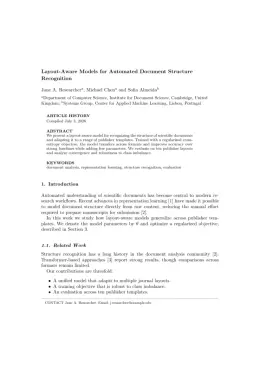
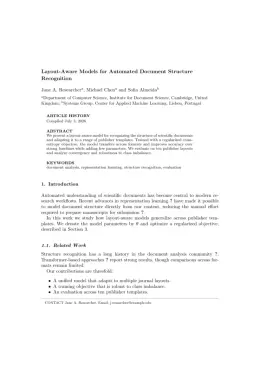
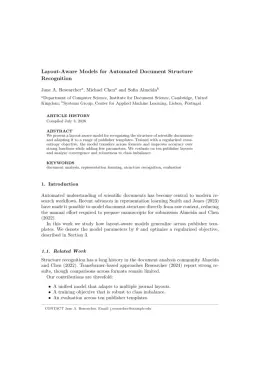
Write in a clean editor, then format for The IES Journal Part A Civil & Structural Engineering in one click — DocuGuru applies the official Taylor & Francis template with author–year references and exports a submission-ready PDF plus the editable LaTeX source. Free to start.

About the The IES Journal Part A Civil & Structural Engineering format

The IES Journal Part A Civil & Structural Engineering is a peer-reviewed journal published by Taylor & Francis, covering Structural Load-Bearing Analysis, Composite Structure Analysis and Optimization, Structural Engineering and Vibration Analysis.

PublisherTaylor & Francis
Reference styleAuthor–year (Chicago, T&F)
Author–year — (Smith, 2023) in the text
Smith, Ada, Ben Jones, and Cara Lee. 2023. "A Representative Article Title." The IES Journal Part A Civil & Structural Engineering 12 (3): 45–58.

Formats any DOI in The IES Journal Part A Civil & Structural Engineering style. No sign-up.

Publishes research inStructural Load-Bearing Analysis Composite Structure Analysis and Optimization Structural Engineering and Vibration Analysis Structural Behavior of Reinforced Concrete Seismic Performance and Analysis
ISSN1937-3260
h-index24
i10-index55
Total citations2,553
Top institutions publishing hereNational University of Singapore
You getA submission-ready PDF and the editable LaTeX source — ready to submit.

Papers published in The IES Journal Part A Civil & Structural Engineering per year

8
2007
22
2008
27
2009
26
2010
30
2011
31
2012
28
2013
20
2014
23
2015

Citation impact of The IES Journal Part A Civil & Structural Engineering by publication year

84
2007
246
2008
373
2009
723
2010
522
2011
155
2012
137
2013
170
2014
138
2015

Citations each year’s papers have accumulated so far — the most recent years are still building up.

Most-cited papers in The IES Journal Part A Civil & Structural Engineering

Effect of seawater for mixing and curing on structural concrete

Falah M. Wegian · 21 Oct 2010

In this article, the effects of mixing and curing concrete with seawater on the compressive, tensile, flexural and bond strengths of concrete are investigated. Concrete mixes were prepared by varying coarse aggregates, cement proportions and types. Six groups of concrete mixes were mixed and cured in fresh water, six groups were mixed and cured in…

Carbon nanotube–cement composites: A retrospect

Shu-Jian Chen, Frank Collins, Alastair J.N. MacLeod et al. · 20 Sep 2011

Although ordinary Portland cement (OPC) is widely used in the construction industry, its weak tensile strength, to some extent, limits its application. A carbon nanotube (CNT), on the other hand, has outstanding mechanical properties with a tensile strength of 63 GPa and Young's modulus of 1 TPa, making it a candidate as nano-scale reinforcements in…

Research on floating wind turbines: a literature survey

C.M. Wang, Tomoaki Utsunomiya, Sin‐Tho Wee et al. · 20 Oct 2010

This article presents a literature survey of research and development on floating wind turbines. The various, proposed conceptual designs for floating platforms used for floating wind turbines are described and the working principles of these various floater concepts are outlined. This is followed by an overview of the research work that has been undertaken pertaining…

Implementation of self-healing in concrete – Proof of concept

Tran Diep Phuoc Thao, Tay Jang Shen Johnson, Quek Ser Tong et al. · 22 Apr 2009

Triggered by newly formed defects (such as cracks) in the host materials, self-healing systems have the ability to effect healing automatically and thereby delay or prevent subsequent damage. Self-healing materials have been conceptualised and researched upon in recent years but the difficulty in implementation has delayed its prevalent usage. One difficult medium in which self-healing…

Responses of interconnected floating bodies

Liang Sun, R. Eatock Taylor, Y.S. Choo · 22 Jul 2011

This article describes an investigation of the wave induced responses of constrained multiple bodies. The hydrodynamic analysis is based on linear diffraction theory, and the constraints in the connections between the bodies are imposed by the Lagrange multiplier technique. Results are given for two cases of two rectangular boxes connected by a hinge and by…

The IES Journal Part A Civil & Structural Engineering template — frequently asked questions

How do I write a paper in the The IES Journal Part A Civil & Structural Engineering format?
In DocuGuru you write your manuscript in a normal editor — no LaTeX setup required — and select the The IES Journal Part A Civil & Structural Engineering template. When you export, DocuGuru compiles the paper into the official Taylor & Francis format and hands you a submission-ready PDF along with the editable LaTeX source.
What reference style does The IES Journal Part A Civil & Structural Engineering use?
The IES Journal Part A Civil & Structural Engineering uses Author–year (Chicago, T&F) references, shown as author–year markers such as (Smith, 2023) in the text. DocuGuru formats every in-text citation and the reference list in this exact style automatically. A reference appears like this: Smith, Ada, Ben Jones, and Cara Lee. 2023. "A Representative Article Title." The IES Journal Part A Civil & Structural Engineering 12 (3): 45–58.
Do I need to know LaTeX to submit to The IES Journal Part A Civil & Structural Engineering?
No. DocuGuru generates the interact LaTeX class and compiles the PDF for you in the background, so you get a Taylor & Francis-ready The IES Journal Part A Civil & Structural Engineering document without writing any LaTeX. If you do want it, the LaTeX source is included in the export.
Can I import an existing draft into the The IES Journal Part A Civil & Structural Engineering template?
Yes. Paste or upload your current manuscript — Word, LaTeX, Markdown, or plain text — and DocuGuru reflows it into the The IES Journal Part A Civil & Structural Engineering format with correct headings, figures, tables, and author–year citations.
Who publishes The IES Journal Part A Civil & Structural Engineering?
The IES Journal Part A Civil & Structural Engineering is a multidisciplinary journal published by Taylor & Francis. DocuGuru's The IES Journal Part A Civil & Structural Engineering template matches Taylor & Francis's official submission format.
Can I export a submission-ready The IES Journal Part A Civil & Structural Engineering PDF?
Yes — DocuGuru produces a PDF built with the official The IES Journal Part A Civil & Structural Engineering template (the interact class) that is ready to submit to Taylor & Francis, together with the matching LaTeX source files.
How much does the The IES Journal Part A Civil & Structural Engineering template cost?
You can start writing in the The IES Journal Part A Civil & Structural Engineering template for free. Exporting the final submission-ready The IES Journal Part A Civil & Structural Engineering PDF and LaTeX source is part of DocuGuru's paid plans — see the app for current pricing.
Use the The IES Journal Part A Civil & Structural Engineering template