Taylor & Francis

Structural Equation Modeling A Multidisciplinary Journal Template

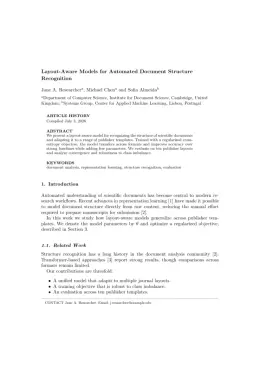
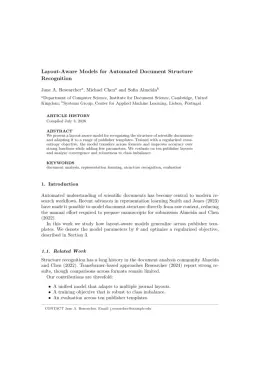
Write in a clean editor, then format for Structural Equation Modeling A Multidisciplinary Journal in one click — DocuGuru applies the official Taylor & Francis template with author–year references and exports a submission-ready PDF plus the editable LaTeX source. Free to start.

About the Structural Equation Modeling A Multidisciplinary Journal format

Structural Equation Modeling A Multidisciplinary Journal is a peer-reviewed journal published by Taylor & Francis, covering Psychometric Methodologies and Testing, Statistical Methods and Bayesian Inference, Advanced Statistical Modeling Techniques.

PublisherTaylor & Francis
Reference styleAuthor–year (Chicago, T&F)
Author–year — (Smith, 2023) in the text
Smith, Ada, Ben Jones, and Cara Lee. 2023. "A Representative Article Title." Structural Equation Modeling A Multidisciplinary Journal 12 (3): 45–58.

Formats any DOI in Structural Equation Modeling A Multidisciplinary Journal style. No sign-up.

Publishes research inPsychometric Methodologies and Testing Statistical Methods and Bayesian Inference Advanced Statistical Modeling Techniques Mental Health Research Topics Advanced Causal Inference Techniques
ISSN1070-5511
Citation impact (2-yr)3
h-index165
i10-index986
Total citations284,465
Top institutions publishing hereArizona State University
Journal websitewww.tandfonline.com
You getA submission-ready PDF and the editable LaTeX source — ready to submit.

Papers published in Structural Equation Modeling A Multidisciplinary Journal per year

83
2014
61
2015
62
2016
81
2017
66
2018
81
2019
57
2020
70
2021
98
2022
69
2023
77
2024
56
2025

Citation impact of Structural Equation Modeling A Multidisciplinary Journal by publication year

10.2K
2014
4.5K
2015
3.7K
2016
5.2K
2017
3K
2018
4K
2019
3.2K
2020
1K
2021
1.7K
2022
680
2023
397
2024
83
2025

Citations each year’s papers have accumulated so far — the most recent years are still building up.

Most-cited papers in Structural Equation Modeling A Multidisciplinary Journal

Cutoff criteria for fit indexes in covariance structure analysis: Conventional criteria versus new alternatives

Li‐tze Hu, Peter M. Bentler · 1 Jan 1999

This article examines the adequacy of the “rules of thumb” conventional cutoff criteria and several new alternatives for various fit indexes used to evaluate model fit in practice. Using a 2‐index presentation strategy, which includes using the maximum likelihood (ML)‐based standardized root mean squared residual (SRMR) and supplementing it with either Tucker‐Lewis Index (TLI), Bollen's…

106,261 citations Cite SaveGo to paper →
Evaluating Goodness-of-Fit Indexes for Testing Measurement Invariance

Gordon W. Cheung, Roger B. Rensvold · 1 Apr 2002

Abstract Measurement invariance is usually tested using Multigroup Confirmatory Factor Analysis, which examines the change in the goodness-of-fit index (GFI) when cross-group constraints are imposed on a measurement model. Although many studies have examined the properties of GFI as indicators of overall model fit for single-group data, there have been none to date that examine…

15,788 citations Cite SaveGo to paper →
Sensitivity of Goodness of Fit Indexes to Lack of Measurement Invariance

Fangfang Chen · 31 Jul 2007

Two Monte Carlo studies were conducted to examine the sensitivity of goodness of fit indexes to lack of measurement invariance at 3 commonly tested levels: factor loadings, intercepts, and residual variances. Standardized root mean square residual (SRMR) appears to be more sensitive to lack of invariance in factor loadings than in intercepts or residual variances.…

11,520 citations Cite SaveGo to paper →
Deciding on the Number of Classes in Latent Class Analysis and Growth Mixture Modeling: A Monte Carlo Simulation Study

Karen Nylund‐Gibson, Tihomir Asparouhov, Bengt Muthén · 23 Oct 2007

Abstract Mixture modeling is a widely applied data analysis technique used to identify unobserved heterogeneity in a population. Despite mixture models' usefulness in practice, one unresolved issue in the application of mixture models is that there is not one commonly accepted statistical indicator for deciding on the number of classes in a study population. This…

11,020 citations Cite SaveGo to paper →
In Search of Golden Rules: Comment on Hypothesis-Testing Approaches to Setting Cutoff Values for Fit Indexes and Dangers in Overgeneralizing Hu and Bentler's (1999) Findings

Herbert W. Marsh, Kit‐Tai Hau, Zhonglin Wen · 2 Jun 2004

Goodness-of-fit (GOF) indexes provide "rules of thumb" - recommended cutoff values for assessing fit in structural equation modeling. Hu and Bender (1999) proposed a more rigorous approach to evaluating decision rules based on GOF indexes and, on this basis, proposed new and more stringent cutoff values for many indexes. This article discusses potential problems underlying…

6,499 citations Cite SaveGo to paper →

Structural Equation Modeling A Multidisciplinary Journal template — frequently asked questions

How do I write a paper in the Structural Equation Modeling A Multidisciplinary Journal format?
In DocuGuru you write your manuscript in a normal editor — no LaTeX setup required — and select the Structural Equation Modeling A Multidisciplinary Journal template. When you export, DocuGuru compiles the paper into the official Taylor & Francis format and hands you a submission-ready PDF along with the editable LaTeX source.
What reference style does Structural Equation Modeling A Multidisciplinary Journal use?
Structural Equation Modeling A Multidisciplinary Journal uses Author–year (Chicago, T&F) references, shown as author–year markers such as (Smith, 2023) in the text. DocuGuru formats every in-text citation and the reference list in this exact style automatically. A reference appears like this: Smith, Ada, Ben Jones, and Cara Lee. 2023. "A Representative Article Title." Structural Equation Modeling A Multidisciplinary Journal 12 (3): 45–58.
Do I need to know LaTeX to submit to Structural Equation Modeling A Multidisciplinary Journal?
No. DocuGuru generates the interact LaTeX class and compiles the PDF for you in the background, so you get a Taylor & Francis-ready Structural Equation Modeling A Multidisciplinary Journal document without writing any LaTeX. If you do want it, the LaTeX source is included in the export.
Can I import an existing draft into the Structural Equation Modeling A Multidisciplinary Journal template?
Yes. Paste or upload your current manuscript — Word, LaTeX, Markdown, or plain text — and DocuGuru reflows it into the Structural Equation Modeling A Multidisciplinary Journal format with correct headings, figures, tables, and author–year citations.
Who publishes Structural Equation Modeling A Multidisciplinary Journal?
Structural Equation Modeling A Multidisciplinary Journal is a multidisciplinary journal published by Taylor & Francis. DocuGuru's Structural Equation Modeling A Multidisciplinary Journal template matches Taylor & Francis's official submission format.
Can I export a submission-ready Structural Equation Modeling A Multidisciplinary Journal PDF?
Yes — DocuGuru produces a PDF built with the official Structural Equation Modeling A Multidisciplinary Journal template (the interact class) that is ready to submit to Taylor & Francis, together with the matching LaTeX source files.
How much does the Structural Equation Modeling A Multidisciplinary Journal template cost?
You can start writing in the Structural Equation Modeling A Multidisciplinary Journal template for free. Exporting the final submission-ready Structural Equation Modeling A Multidisciplinary Journal PDF and LaTeX source is part of DocuGuru's paid plans — see the app for current pricing.

Use the Structural Equation Modeling A Multidisciplinary Journal template