Taylor & Francis

Science and Technology for the Built Environment Template

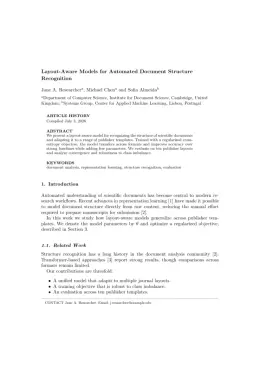
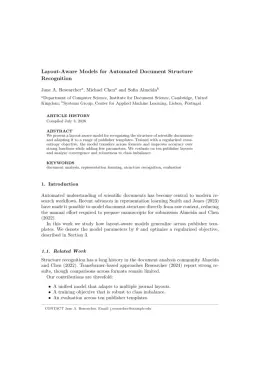
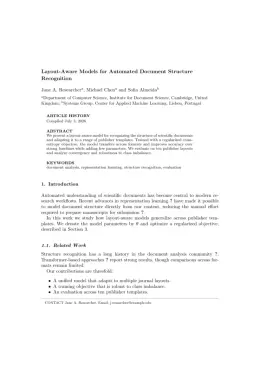
Write in a clean editor, then format for Science and Technology for the Built Environment in one click — DocuGuru applies the official Taylor & Francis template with author–year references and exports a submission-ready PDF plus the editable LaTeX source. Free to start.

About the Science and Technology for the Built Environment format

Science and Technology for the Built Environment is a peer-reviewed journal published by Taylor & Francis, covering Building Energy and Comfort Optimization, Refrigeration and Air Conditioning Technologies, Heat Transfer and Optimization.

PublisherTaylor & Francis
Reference styleAuthor–year (Chicago, T&F)
Author–year — (Smith, 2023) in the text
Smith, Ada, Ben Jones, and Cara Lee. 2023. "A Representative Article Title." Science and Technology for the Built Environment 12 (3): 45–58.

Formats any DOI in Science and Technology for the Built Environment style. No sign-up.

Publishes research inBuilding Energy and Comfort Optimization Refrigeration and Air Conditioning Technologies Heat Transfer and Optimization Wind and Air Flow Studies Urban Heat Island Mitigation
ISSN2374-4731
Citation impact (2-yr)1.54
h-index42
i10-index443
Total citations13,088
Top institutions publishing hereCarleton University
Journal websitewww.tandfonline.com
You getA submission-ready PDF and the editable LaTeX source — ready to submit.

Papers published in Science and Technology for the Built Environment per year

3
2014
139
2015
156
2016
99
2017
102
2018
125
2019
121
2020
93
2021
81
2022
73
2023
79
2024
71
2025

Citation impact of Science and Technology for the Built Environment by publication year

43
2014
2.2K
2015
2.7K
2016
1.6K
2017
1.2K
2018
1.7K
2019
1.3K
2020
910
2021
579
2022
376
2023
201
2024
97
2025

Citations each year’s papers have accumulated so far — the most recent years are still building up.

Most-cited papers in Science and Technology for the Built Environment

A review of fault detection and diagnostics methods for building systems

Woohyun Kim, Srinivas Katipamula · 27 Apr 2017

The current article provides a summary of automated fault detection and diagnostics studies published since 2004 that are relevant to the commercial buildings sector. The review updates a previous review conducted in 2004 and published in 2005, and it categorizes automated fault detection and diagnostics methods into three groups. The examples of automated fault detection…

Design and optimization of form and facade of an office building using the genetic algorithm

Zahra Jalali, Esmatullah Noorzai, Shahin Heidari · 28 May 2019

One of the most important sustainable building design goals is energy performance throughout the life cycle of the building. In this article, the optimization of an office building facade has been performed using a genetic algorithm with the sustainability approach. Multi-objective optimization using an The Strength Pareto Evolutionary Algorithm (SPEA-2) algorithm gives the amount of…

Design of a hydraulically driven compressive elastocaloric cooling system

Suxin Qian, Yunlong Geng, Yi Wang et al. · 31 Mar 2016

This article presents the design of elastocaloric cooling system driven by hydraulic actuators. Ni-Ti tubes under axial compressive loading mode are used in the system to provide cooling and heating. Those Ni-Ti tubes are enclosed in four identical beds, which are driven by two one-way hydraulic cylinders. Operated under the single-stage reverse Brayton cycle, the…

Smart grid energy flexible buildings through the use of heat pumps and building thermal mass as energy storage in the Belgian context

Gabrielle Masy, Emeline Georges, Clara Verhelst et al. · 18 Aug 2015

The management of electricity grids requires the supply and demand of electricity to be in balance at any point in time. To this end, electricity suppliers have to nominate their electricity bids on the day-ahead electricity market so that the forecast supply and demand are in balance. One way to reduce the cost of electricity…

Application of deep Q-networks for model-free optimal control balancing between different HVAC systems

Ki Uhn Ahn, Cheol Soo Park · 15 Oct 2019

A deep Q-network (DQN) was applied for model-free optimal control balancing between different HVAC systems. The DQN was coupled to a reference office building: an EnergyPlus simulation model provided by the U.S. Department of Energy. The building was air-conditioned with four air-handling units (AHUs), two electric chillers, a cooling tower, and two pumps. EnergyPlus simulation…

Science and Technology for the Built Environment template — frequently asked questions

How do I write a paper in the Science and Technology for the Built Environment format?
In DocuGuru you write your manuscript in a normal editor — no LaTeX setup required — and select the Science and Technology for the Built Environment template. When you export, DocuGuru compiles the paper into the official Taylor & Francis format and hands you a submission-ready PDF along with the editable LaTeX source.
What reference style does Science and Technology for the Built Environment use?
Science and Technology for the Built Environment uses Author–year (Chicago, T&F) references, shown as author–year markers such as (Smith, 2023) in the text. DocuGuru formats every in-text citation and the reference list in this exact style automatically. A reference appears like this: Smith, Ada, Ben Jones, and Cara Lee. 2023. "A Representative Article Title." Science and Technology for the Built Environment 12 (3): 45–58.
Do I need to know LaTeX to submit to Science and Technology for the Built Environment?
No. DocuGuru generates the interact LaTeX class and compiles the PDF for you in the background, so you get a Taylor & Francis-ready Science and Technology for the Built Environment document without writing any LaTeX. If you do want it, the LaTeX source is included in the export.
Can I import an existing draft into the Science and Technology for the Built Environment template?
Yes. Paste or upload your current manuscript — Word, LaTeX, Markdown, or plain text — and DocuGuru reflows it into the Science and Technology for the Built Environment format with correct headings, figures, tables, and author–year citations.
Who publishes Science and Technology for the Built Environment?
Science and Technology for the Built Environment is a multidisciplinary journal published by Taylor & Francis. DocuGuru's Science and Technology for the Built Environment template matches Taylor & Francis's official submission format.
Can I export a submission-ready Science and Technology for the Built Environment PDF?
Yes — DocuGuru produces a PDF built with the official Science and Technology for the Built Environment template (the interact class) that is ready to submit to Taylor & Francis, together with the matching LaTeX source files.
How much does the Science and Technology for the Built Environment template cost?
You can start writing in the Science and Technology for the Built Environment template for free. Exporting the final submission-ready Science and Technology for the Built Environment PDF and LaTeX source is part of DocuGuru's paid plans — see the app for current pricing.

Use the Science and Technology for the Built Environment template