Taylor & Francis

Sarsia Template

Write in a clean editor, then format for Sarsia in one click — DocuGuru applies the official Taylor & Francis template with author–year references and exports a submission-ready PDF plus the editable LaTeX source. Free to start.

About the Sarsia format

Sarsia is a peer-reviewed journal published by Taylor & Francis, covering Marine Biology and Ecology Research, Marine and fisheries research, Marine and coastal ecosystems.

PublisherTaylor & Francis
Reference styleAuthor–year (Chicago, T&F)
Author–year — (Smith, 2023) in the text
Smith, Ada, Ben Jones, and Cara Lee. 2023. "A Representative Article Title." Sarsia 12 (3): 45–58.

Formats any DOI in Sarsia style. No sign-up.

Publishes research inMarine Biology and Ecology Research Marine and fisheries research Marine and coastal ecosystems Marine and coastal plant biology Marine Bivalve and Aquaculture Studies
ISSN0036-4827
h-index74
i10-index855
Total citations31,593
Top institutions publishing hereUniversity of Bergen
Journal websitewww.tandfonline.com
You getA submission-ready PDF and the editable LaTeX source — ready to submit.

Papers published in Sarsia per year

32
1994
24
1995
34
1996
31
1997
43
1998
42
1999
45
2000
46
2001
48
2002
45
2003
42
2004
1
2011

Citation impact of Sarsia by publication year

1.1K
1994
690
1995
1K
1996
1.1K
1997
1.8K
1998
1.2K
1999
1.3K
2000
1.2K
2001
777
2002
766
2003
755
2004
0
2011

Citations each year’s papers have accumulated so far — the most recent years are still building up.

Most-cited papers in Sarsia

Nematodes from some Norwegian marine fishes

B. Berland · 15 Apr 1961

Abstract The present paper deals with nematode parasites from some Norwegian marine fishes. The major part of the material was collected personally from fishes caught in the fjords near Bergen and Tromsø; the minor part of the material was obtained from the zoological museums in Oslo and Bergen and from other sources. 260 specimens of…

The use and abuse of fish otoliths in studies of feeding habits of marine piscivores

Malcolm Jobling, Anne Breiby · 15 Oct 1986

Abstract The form and structure of fish otoliths are species specific, allowing them to be used as an aid in identification of prey species consumed by piscivores. Otholith length-fish length relationships can have application in the estimation of the size of fish prey consumed by squid, but, because otoliths are relatively rapidly attacked by acidic…

The distribution of the scleractinian coral<i>Lophelia pertusa</i>around the Faroe islands and the relation to internal tidal mixing

Rune Frederiksen, Andreas Kryger Jensen, Håkan Westerberg · 10 Sep 1992

Abstract A list of 138 positions with records of Lophelia pertusa is compiled from all published and unpublished investigations in the area including material from the BIOFAR research programme. In addition, Solenosmilia variabilis, another species of branching coral new to the area is reported. The Lophelia records are from areas that are dominated by the…

The population biology and exploitation of capelin (<i>Mallotus villosus</i>) in the barents sea

Harald Gjøsæter · 30 Dec 1998

Abstract The life history of the Barents Sea capelin stock through the various phases from egg to maturity is reviewed, including distribution, feeding, growth, mortality at the different life stages. The ecological role of the capelin is discussed, as well as its population dynamics. The stock history, its abundance and exploitation is dealt with, together…

Recruitment of Atlantic cod stocks in relation to temperature and advectlon of copepod populations

Svein Sundby · 15 Nov 2000

Abstract The recruitment of Atlantic cod stocks shows different responses to temperature changes. Cod stocks inhabiting the lower temperature range show generally an increase in recruitment with increasing temperature, while cod stocks inhabiting the uppermost part of the temperature range show a decrease in recruitment with increasing temperature. In the present paper possible functional relationships…

Sarsia template — frequently asked questions

How do I write a paper in the Sarsia format?
In DocuGuru you write your manuscript in a normal editor — no LaTeX setup required — and select the Sarsia template. When you export, DocuGuru compiles the paper into the official Taylor & Francis format and hands you a submission-ready PDF along with the editable LaTeX source.
What reference style does Sarsia use?
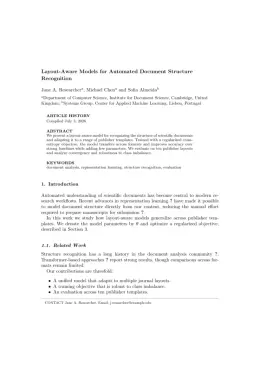
Sarsia uses Author–year (Chicago, T&F) references, shown as author–year markers such as (Smith, 2023) in the text. DocuGuru formats every in-text citation and the reference list in this exact style automatically. A reference appears like this: Smith, Ada, Ben Jones, and Cara Lee. 2023. "A Representative Article Title." Sarsia 12 (3): 45–58.
Do I need to know LaTeX to submit to Sarsia?
No. DocuGuru generates the interact LaTeX class and compiles the PDF for you in the background, so you get a Taylor & Francis-ready Sarsia document without writing any LaTeX. If you do want it, the LaTeX source is included in the export.
Can I import an existing draft into the Sarsia template?
Yes. Paste or upload your current manuscript — Word, LaTeX, Markdown, or plain text — and DocuGuru reflows it into the Sarsia format with correct headings, figures, tables, and author–year citations.
Who publishes Sarsia?
Sarsia is a multidisciplinary journal published by Taylor & Francis. DocuGuru's Sarsia template matches Taylor & Francis's official submission format.
Can I export a submission-ready Sarsia PDF?
Yes — DocuGuru produces a PDF built with the official Sarsia template (the interact class) that is ready to submit to Taylor & Francis, together with the matching LaTeX source files.
How much does the Sarsia template cost?
You can start writing in the Sarsia template for free. Exporting the final submission-ready Sarsia PDF and LaTeX source is part of DocuGuru's paid plans — see the app for current pricing.

Use the Sarsia template