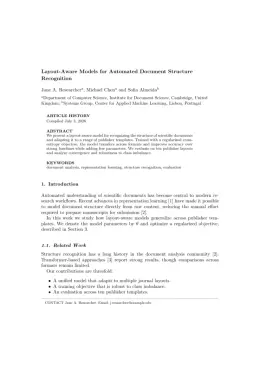
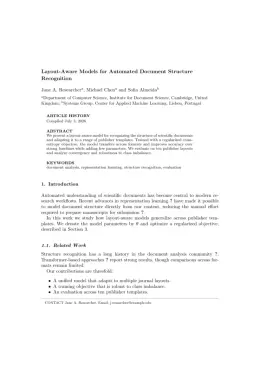
Taylor & Francis

Mineral Processing and Extractive Metallurgy Review Template

Write in a clean editor, then format for Mineral Processing and Extractive Metallurgy Review in one click — DocuGuru applies the official Taylor & Francis template with author–year references and exports a submission-ready PDF plus the editable LaTeX source. Free to start.

About the Mineral Processing and Extractive Metallurgy Review format

Mineral Processing and Extractive Metallurgy Review is a peer-reviewed journal published by Taylor & Francis, covering Minerals Flotation and Separation Techniques, Metal Extraction and Bioleaching, Extraction and Separation Processes.

PublisherTaylor & Francis
Reference styleAuthor–year (Chicago, T&F)
Author–year — (Smith, 2023) in the text
Smith, Ada, Ben Jones, and Cara Lee. 2023. "A Representative Article Title." Mineral Processing and Extractive Metallurgy Review 12 (3): 45–58.

Formats any DOI in Mineral Processing and Extractive Metallurgy Review style. No sign-up.

Publishes research inMinerals Flotation and Separation Techniques Metal Extraction and Bioleaching Extraction and Separation Processes Mineral Processing and Grinding Metallurgical Processes and Thermodynamics
ISSN0882-7508
Citation impact (2-yr)4.36
h-index76
i10-index716
Total citations30,048
Top institutions publishing hereBhabha Atomic Research Centre
Journal websitewww.tandfonline.com
You getA submission-ready PDF and the editable LaTeX source — ready to submit.

Papers published in Mineral Processing and Extractive Metallurgy Review per year

26
2014
23
2015
41
2016
52
2017
44
2018
62
2019
51
2020
60
2021
63
2022
56
2023
62
2024
55
2025

Citation impact of Mineral Processing and Extractive Metallurgy Review by publication year

823
2014
1K
2015
1.3K
2016
1.8K
2017
1.7K
2018
2.3K
2019
2.3K
2020
1.5K
2021
1.5K
2022
698
2023
435
2024
140
2025

Citations each year’s papers have accumulated so far — the most recent years are still building up.

Most-cited papers in Mineral Processing and Extractive Metallurgy Review

The Effect of Bubble Size on Fine Particle Flotation

Roe‐Hoan Yoon, G.H. Luttrell · 2 Feb 1989

Abstract Expressions for the probability of collision (Pc) and adhesion (Pa) have been derived for fine particle flotation by calculating the trajectory of particles as they flow past a bubble in streamline How. Three different flow regimes have been considered in the present work, i.e., Stokes, potential and intermediate. For the intermediate flow conditions in…

Review of Lithium Production and Recovery from Minerals, Brines, and Lithium-Ion Batteries

Fei Meng, James McNeice, Shirin Shafiei Zadeh et al. · 2 Oct 2019

Rechargeable lithium-ion batteries (LIBs) are widely employed in portable electric devices, electric vehicles (EVs), and hybrid electric vehicles (HEVs), indicating a potential increasing demand for LIBs over the next decade. Lithium, a critical element in LIBs, might encounter a potential supply crisis in the future. The irregular distribution of lithium mineral resources in countries and…

TRENDS IN RED MUD UTILIZATION – A REVIEW

R. K. Paramguru, Purna Chandra Rath, V.N. Misra · 16 Dec 2004

Abstract Red mud is the major waste material produced during alumina production following the Bayers process. Depending on the quality of the raw material processed, 1–2.5 tons of red mud is generated per ton of alumina produced. The treatment and disposal of this residue is a major operation in an alumina plant. A lot of…

A Review on Environmental, Economic and Hydrometallurgical Processes of Recycling Spent Lithium-ion Batteries

E. Asadi Dalini, Gholamreza Karimi, Saeed Zandevakili et al. · 13 Jul 2020

The suitable electrochemical performance of lithium-ion batteries (LIBs) led to an increase in demand and the use of LIBs in electrical and electronic equipment. Naturally, increased demand will be accompanied by an enhancement in the supply of metals from mineral resources. On the other hand, the lithium metal supply scenario will not be able to…

Removal of Iron From Aluminum: A Review

Lifeng Zhang, Jianwei Gao, Lucas Nana Wiredu Damoah et al. · 28 May 2011

Abstract In this paper, the Fe-rich phases in and their detrimental effect on aluminum alloys are summarized. The existence of brittle platelet β-Fe-rich phases lowers the mechanical properties of aluminum alloys. The methods to neutralize the detrimental effect of iron are discussed. The use of high cooling rate, solution heat treatment, and addition of elements…

Mineral Processing and Extractive Metallurgy Review template — frequently asked questions

How do I write a paper in the Mineral Processing and Extractive Metallurgy Review format?
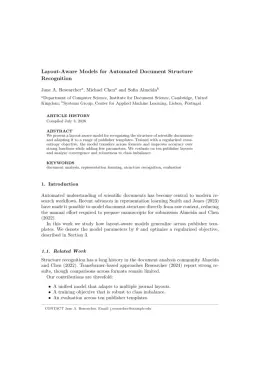
In DocuGuru you write your manuscript in a normal editor — no LaTeX setup required — and select the Mineral Processing and Extractive Metallurgy Review template. When you export, DocuGuru compiles the paper into the official Taylor & Francis format and hands you a submission-ready PDF along with the editable LaTeX source.
What reference style does Mineral Processing and Extractive Metallurgy Review use?
Mineral Processing and Extractive Metallurgy Review uses Author–year (Chicago, T&F) references, shown as author–year markers such as (Smith, 2023) in the text. DocuGuru formats every in-text citation and the reference list in this exact style automatically. A reference appears like this: Smith, Ada, Ben Jones, and Cara Lee. 2023. "A Representative Article Title." Mineral Processing and Extractive Metallurgy Review 12 (3): 45–58.
Do I need to know LaTeX to submit to Mineral Processing and Extractive Metallurgy Review?
No. DocuGuru generates the interact LaTeX class and compiles the PDF for you in the background, so you get a Taylor & Francis-ready Mineral Processing and Extractive Metallurgy Review document without writing any LaTeX. If you do want it, the LaTeX source is included in the export.
Can I import an existing draft into the Mineral Processing and Extractive Metallurgy Review template?
Yes. Paste or upload your current manuscript — Word, LaTeX, Markdown, or plain text — and DocuGuru reflows it into the Mineral Processing and Extractive Metallurgy Review format with correct headings, figures, tables, and author–year citations.
Who publishes Mineral Processing and Extractive Metallurgy Review?
Mineral Processing and Extractive Metallurgy Review is a multidisciplinary journal published by Taylor & Francis. DocuGuru's Mineral Processing and Extractive Metallurgy Review template matches Taylor & Francis's official submission format.
Can I export a submission-ready Mineral Processing and Extractive Metallurgy Review PDF?
Yes — DocuGuru produces a PDF built with the official Mineral Processing and Extractive Metallurgy Review template (the interact class) that is ready to submit to Taylor & Francis, together with the matching LaTeX source files.
How much does the Mineral Processing and Extractive Metallurgy Review template cost?
You can start writing in the Mineral Processing and Extractive Metallurgy Review template for free. Exporting the final submission-ready Mineral Processing and Extractive Metallurgy Review PDF and LaTeX source is part of DocuGuru's paid plans — see the app for current pricing.
Use the Mineral Processing and Extractive Metallurgy Review template