
83 citations
Go to paper →
Taylor & Francis
Lubrication engineering Template
Write in a clean editor, then format for Lubrication engineering in one click — DocuGuru applies the official Taylor & Francis template with author–year references and exports a submission-ready PDF plus the editable LaTeX source. Free to start.
About the Lubrication engineering format
Lubrication engineering is a peer-reviewed journal published by Taylor & Francis, covering Lubricants and Their Additives, Tribology and Lubrication Engineering, Tribology and Wear Analysis.
| Publisher | Taylor & Francis |
|---|---|
| Reference style | Author–year (Chicago, T&F) Author–year — (Smith, 2023) in the text Smith, Ada, Ben Jones, and Cara Lee. 2023. "A Representative Article Title." Lubrication engineering 12 (3): 45–58.
Formats any DOI in Lubrication engineering style. No sign-up. |
| Publishes research in | Lubricants and Their Additives Tribology and Lubrication Engineering Tribology and Wear Analysis Gear and Bearing Dynamics Analysis Metal Alloys Wear and Properties |
| ISSN | 0024-7154 |
| h-index | 22 |
| i10-index | 89 |
| Total citations | 2,348 |
| Top institutions publishing here | Glenn Research Center |
| You get | A submission-ready PDF and the editable LaTeX source — ready to submit. |
Papers published in Lubrication engineering per year
Citation impact of Lubrication engineering by publication year
Citations each year’s papers have accumulated so far — the most recent years are still building up.
Most-cited papers in Lubrication engineering
Fullerene (C{sub 60}-rich) powder is tested as an additive to liquid lubricants and greases to improve their friction and wear characteristics. The coefficient of friction and wear of a 52100 steel ball sliding against a hardened M50 steel disk are measured at the contact in the presence of base petroleum oil with and without fullerene…
71 citations
Go to paper →
Numerous analyses and experiments regarding emulsions have been conducted, and seemingly contradictory notions of emulsion behavior claimed. Theoretical approaches include plate-out, dynamic concentration and mixture theory. Experimental observers report great disparities in film thicknesses and film thickness dependence on emulsion properties such as base oil characteristics and process variables such as rolling speed. This paper…
66 citations
Go to paper →
56 citations
Go to paper →
Microscopic wear particles transported by the lubricant from wear sites carry with them important information relating to the condition of machinery. Quantitative methods for determining the morphological attributes of particles have been established in terms of their size, shape, and surface texture. This paper reviews some of the developments that have taken place and describes…
53 citations
Go to paper →
Related journal templates


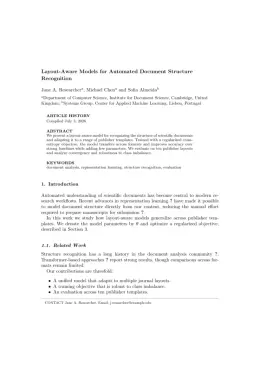
Lubrication engineering template — frequently asked questions
How do I write a paper in the Lubrication engineering format?
In DocuGuru you write your manuscript in a normal editor — no LaTeX setup required — and select the Lubrication engineering template. When you export, DocuGuru compiles the paper into the official Taylor & Francis format and hands you a submission-ready PDF along with the editable LaTeX source.
What reference style does Lubrication engineering use?
Lubrication engineering uses Author–year (Chicago, T&F) references, shown as author–year markers such as (Smith, 2023) in the text. DocuGuru formats every in-text citation and the reference list in this exact style automatically. A reference appears like this: Smith, Ada, Ben Jones, and Cara Lee. 2023. "A Representative Article Title." Lubrication engineering 12 (3): 45–58.
Do I need to know LaTeX to submit to Lubrication engineering?
No. DocuGuru generates the interact LaTeX class and compiles the PDF for you in the background, so you get a Taylor & Francis-ready Lubrication engineering document without writing any LaTeX. If you do want it, the LaTeX source is included in the export.
Can I import an existing draft into the Lubrication engineering template?
Yes. Paste or upload your current manuscript — Word, LaTeX, Markdown, or plain text — and DocuGuru reflows it into the Lubrication engineering format with correct headings, figures, tables, and author–year citations.
Who publishes Lubrication engineering?
Lubrication engineering is a multidisciplinary journal published by Taylor & Francis. DocuGuru's Lubrication engineering template matches Taylor & Francis's official submission format.
Can I export a submission-ready Lubrication engineering PDF?
Yes — DocuGuru produces a PDF built with the official Lubrication engineering template (the interact class) that is ready to submit to Taylor & Francis, together with the matching LaTeX source files.
How much does the Lubrication engineering template cost?
You can start writing in the Lubrication engineering template for free. Exporting the final submission-ready Lubrication engineering PDF and LaTeX source is part of DocuGuru's paid plans — see the app for current pricing.