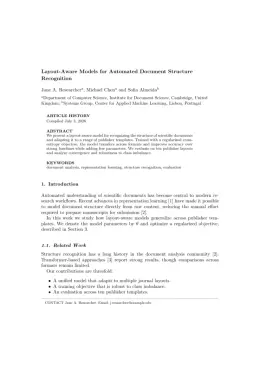
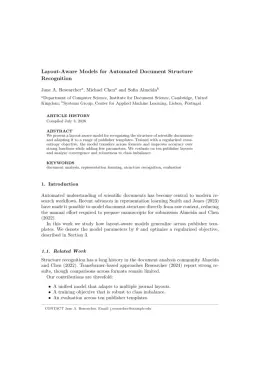
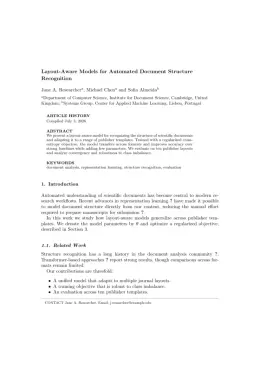
About the Journal of Ecotourism format
Journal of Ecotourism is a peer-reviewed journal published by Taylor & Francis, covering Diverse Aspects of Tourism Research, Recreation, Leisure, Wilderness Management, Tourism, Volunteerism, and Development.
| Publisher | Taylor & Francis |
|---|
| Reference style | Author–year (Chicago, T&F) Author–year — (Smith, 2023) in the text
Smith, Ada, Ben Jones, and Cara Lee. 2023. "A Representative Article Title." Journal of Ecotourism 12 (3): 45–58.
Formats any DOI in Journal of Ecotourism style. No sign-up.
|
|---|
| Publishes research in | Diverse Aspects of Tourism Research Recreation, Leisure, Wilderness Management Tourism, Volunteerism, and Development Cruise Tourism Development and Management Economic and Environmental Valuation |
|---|
| ISSN | 1472-4049 |
|---|
| Citation impact (2-yr) | 2.98 |
|---|
| h-index | 64 |
|---|
| i10-index | 343 |
|---|
| Total citations | 15,612 |
|---|
| Top institutions publishing here | Griffith University |
|---|
| Journal website | www.tandfonline.com |
|---|
| You get | A submission-ready PDF and the editable LaTeX source — ready to submit. |
|---|
Papers published in Journal of Ecotourism per year
Citation impact of Journal of Ecotourism by publication year
Citations each year’s papers have accumulated so far — the most recent years are still building up.
Most-cited papers in Journal of Ecotourism
Ecotourism: The Evolving Contemporary Definition
Holly Donohoe, Roger D. Needham · 15 Nov 2006
Abstract A rise in the popularity of ecotourism has coincided with voluminous definitional discourse. Amongst stakeholders, confusion has resulted from the disparate nature of these definitions. In the absence of a common definition or set of key tenets the challenge has been to ensure operational ecotourism that adheres to the theoretical underpinnings of the concept.…
Wildlife Viewing Preferences of Visitors to Protected Areas in South Africa: Implications for the Role of Ecotourism in Conservation
Peter A. Lindsey, Robert R. Alexander, M. G. L. Mills et al. · 1 May 2007
Ecotourism has a potentially vital role to play in conservation by generating economic incentives for nature conservation. However, some authors contend that this potential may be limited by narrow viewing preferences among visitors to protected areas, suggesting that most tourists are primarily interested in seeing charismatic mega-fauna largely confined to government or privately-owned parks. We…
The Economic Promise of Ecotourism for Conservation
Amanda Stronza · 16 Nov 2007
Many conservationists have promoted ecotourism as a strategy to protect natural resources while also meeting human needs. The purpose of this study was to analyse effects of ecotourism on natural resource use and livelihoods in an indigenous community of 80 families in Peru. Household interviews and participant observation were used to track social and economic…
Local Participation in the Planning and Management of Ecotourism: A Revised Model Approach
Brian Garrod · 1 Mar 2003
Abstract Ecotourism is increasingly being advanced as a strategy to help address economic and social problems in local communities, and as an appropriate and effective tool of environmental conservation. The full and effective participation of local communities in the planning and management of ecotourism is, however, rarely a feature of ecotourism projects. At best, ecotourism…
The Use of Importance–Performance Analysis and Market Segmentation for Tourism Management in Parks and Protected Areas: An Application to Tanzania's National Parks
Derek J. Wade, Paul F.J. Eagles · 1 Dec 2003
This paper presents an application of the IPA technique, coupled with market segmentation, to a sample of visitors to Tanzania's National Parks. The utility of the technique in a protected area context is highlighted, by comparing it with the results from three programme perspectives – non-segmented data (a homogeneous IPA programme), segmented data that look…