Taylor & Francis

Journal of Coordination Chemistry Template

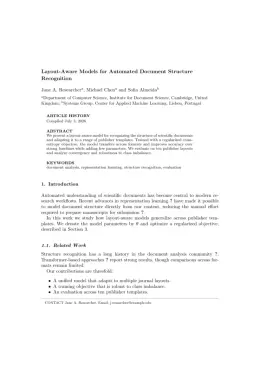
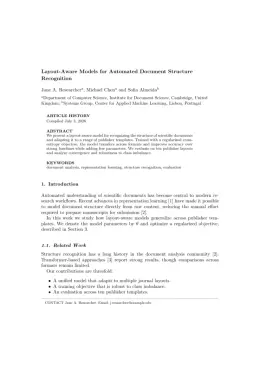
Write in a clean editor, then format for Journal of Coordination Chemistry in one click — DocuGuru applies the official Taylor & Francis template with author–year references and exports a submission-ready PDF plus the editable LaTeX source. Free to start.

About the Journal of Coordination Chemistry format

Journal of Coordination Chemistry is a peer-reviewed journal published by Taylor & Francis, covering Metal complexes synthesis and properties, Magnetism in coordination complexes, Metal-Organic Frameworks: Synthesis and Applications.

PublisherTaylor & Francis
Reference styleAuthor–year (Chicago, T&F)
Author–year — (Smith, 2023) in the text
Smith, Ada, Ben Jones, and Cara Lee. 2023. "A Representative Article Title." Journal of Coordination Chemistry 12 (3): 45–58.

Formats any DOI in Journal of Coordination Chemistry style. No sign-up.

Publishes research inMetal complexes synthesis and properties Magnetism in coordination complexes Metal-Organic Frameworks: Synthesis and Applications Crystal structures of chemical compounds Lanthanide and Transition Metal Complexes
ISSN0095-8972
Citation impact (2-yr)1.78
h-index69
i10-index3,259
Total citations91,376
Top institutions publishing hereNanjing University
Journal websitewww.tandfonline.com
You getA submission-ready PDF and the editable LaTeX source — ready to submit.

Papers published in Journal of Coordination Chemistry per year

361
2014
326
2015
316
2016
237
2017
298
2018
221
2019
248
2020
205
2021
192
2022
162
2023
180
2024
160
2025

Citation impact of Journal of Coordination Chemistry by publication year

4.8K
2014
3.7K
2015
3.3K
2016
2.5K
2017
3K
2018
2.2K
2019
2.5K
2020
1.5K
2021
1.5K
2022
869
2023
472
2024
221
2025

Citations each year’s papers have accumulated so far — the most recent years are still building up.

Most-cited papers in Journal of Coordination Chemistry

Sources and toxicity of hexavalent chromium

Rumpa Saha, Rumki Nandi, Bidyut Saha · 19 May 2011

Chromium exists in oxidation states ranging from −IV to +VI, inclusively. The compounds exhibit a wide range of geometries including square planar, tetrahedral, octahedral, and various distorted geometries. Ore refining, chemical and refractory processing, cement-producing plants, automobile brake lining, catalytic converters for automobiles, leather tanneries, and chrome pigments contribute to the atmospheric burden of chromium.…

Review: Lanthanide coordination chemistry: from old concepts to coordination polymers

Jean‐Claude G. Bünzli · 26 Aug 2014

Because of their remarkable and unmatched optical and magnetic properties, the lanthanides are under the limelight when it comes to high technology. These elements are used in strategic applications such as optical glasses and lasers, telecommunications, lighting and displays, magnetic materials, hard-disk drives, security inks and counterfeiting tags, catalysis, biosciences, and medicine, to name but…

REVIEW: Biomedical applications of Schiff base metal complexes

Mohammad Nasir Uddin, Sayeda Samina Ahmed, S. M. Rahatul Alam · 1 Dec 2020

Metal complexes of Schiff bases synthesized from condensation of an amine with carbonyl compounds are widely used for industrial purposes such as catalysts, pigments and dyes, intermediates in organic synthesis, polymer stabilizers, and corrosion inhibitors. For design and development of various bioactive compounds, Schiff bases carrying imine or azomethine (−C = N–) functional group, are…

Transition metal complexes with Schiff-base ligands: 4-aminoantipyrine based derivatives–a review

Natarajan Raman, S. Johnson Raja, A. Sakthivel · 26 Sep 2008

The survey highlights structural properties and biological studies of transition metal complexes derived from 4-aminoantipyrine. The most important results of extensive studies (syntheses, spectral, magnetic, redox, structural characteristics, antimicrobial and DNA cleavage) of the metal complexes with heterocyclic Schiff bases of 4-aminoantipyrine with some aldehydes and oximes are reviewed.

THE INTERFACE OF MAIN GROUP AND TRANSITION METAL CLUSTER CHEMISTRY

Kenton H. Whitmire · 1 Apr 1988

Abstract The literature concerning cluster complexes which contain both main group element and transition metal vertices is reviewed. Synthetic methods and general reactivity patterns are summarized. Emphasis is placed on structural. Comparisons of cluster geometries for a wide variety of element combinations. Relationships between these mixed clusters and the main group element clusters known as…

Journal of Coordination Chemistry template — frequently asked questions

How do I write a paper in the Journal of Coordination Chemistry format?
In DocuGuru you write your manuscript in a normal editor — no LaTeX setup required — and select the Journal of Coordination Chemistry template. When you export, DocuGuru compiles the paper into the official Taylor & Francis format and hands you a submission-ready PDF along with the editable LaTeX source.
What reference style does Journal of Coordination Chemistry use?
Journal of Coordination Chemistry uses Author–year (Chicago, T&F) references, shown as author–year markers such as (Smith, 2023) in the text. DocuGuru formats every in-text citation and the reference list in this exact style automatically. A reference appears like this: Smith, Ada, Ben Jones, and Cara Lee. 2023. "A Representative Article Title." Journal of Coordination Chemistry 12 (3): 45–58.
Do I need to know LaTeX to submit to Journal of Coordination Chemistry?
No. DocuGuru generates the interact LaTeX class and compiles the PDF for you in the background, so you get a Taylor & Francis-ready Journal of Coordination Chemistry document without writing any LaTeX. If you do want it, the LaTeX source is included in the export.
Can I import an existing draft into the Journal of Coordination Chemistry template?
Yes. Paste or upload your current manuscript — Word, LaTeX, Markdown, or plain text — and DocuGuru reflows it into the Journal of Coordination Chemistry format with correct headings, figures, tables, and author–year citations.
Who publishes Journal of Coordination Chemistry?
Journal of Coordination Chemistry is a multidisciplinary journal published by Taylor & Francis. DocuGuru's Journal of Coordination Chemistry template matches Taylor & Francis's official submission format.
Can I export a submission-ready Journal of Coordination Chemistry PDF?
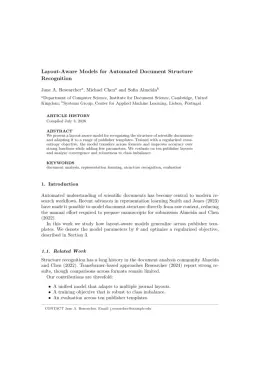
Yes — DocuGuru produces a PDF built with the official Journal of Coordination Chemistry template (the interact class) that is ready to submit to Taylor & Francis, together with the matching LaTeX source files.
How much does the Journal of Coordination Chemistry template cost?
You can start writing in the Journal of Coordination Chemistry template for free. Exporting the final submission-ready Journal of Coordination Chemistry PDF and LaTeX source is part of DocuGuru's paid plans — see the app for current pricing.
Use the Journal of Coordination Chemistry template