Taylor & Francis

Fiber & Integrated Optics Template

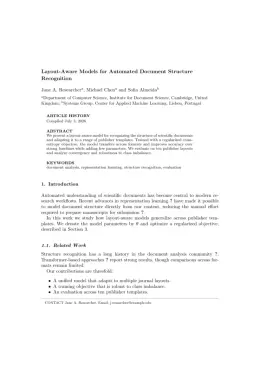
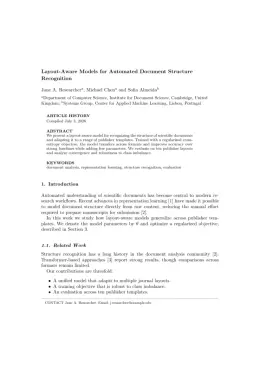
Write in a clean editor, then format for Fiber & Integrated Optics in one click — DocuGuru applies the official Taylor & Francis template with author–year references and exports a submission-ready PDF plus the editable LaTeX source. Free to start.

About the Fiber & Integrated Optics format

Fiber & Integrated Optics is a peer-reviewed journal published by Taylor & Francis, covering Optical Network Technologies, Photonic and Optical Devices, Semiconductor Lasers and Optical Devices.

PublisherTaylor & Francis
Reference styleAuthor–year (Chicago, T&F)
Author–year — (Smith, 2023) in the text
Smith, Ada, Ben Jones, and Cara Lee. 2023. "A Representative Article Title." Fiber & Integrated Optics 12 (3): 45–58.

Formats any DOI in Fiber & Integrated Optics style. No sign-up.

Publishes research inOptical Network Technologies Photonic and Optical Devices Semiconductor Lasers and Optical Devices Advanced Photonic Communication Systems Advanced Fiber Optic Sensors
ISSN0146-8030
Citation impact (2-yr)1.38
h-index34
i10-index226
Total citations8,192
Top institutions publishing hereFondazione "Ugo Bordoni"
Journal websitewww.tandfonline.com
You getA submission-ready PDF and the editable LaTeX source — ready to submit.

Papers published in Fiber & Integrated Optics per year

32
2014
21
2015
29
2016
22
2017
27
2018
19
2019
24
2020
12
2021
9
2022
10
2023
21
2024
29
2025

Citation impact of Fiber & Integrated Optics by publication year

323
2014
215
2015
89
2016
89
2017
181
2018
130
2019
118
2020
189
2021
68
2022
62
2023
54
2024
25
2025

Citations each year’s papers have accumulated so far — the most recent years are still building up.

Most-cited papers in Fiber & Integrated Optics

A Review of IR Transmitting, Hollow Waveguides

James A. Harrington · 1 Jul 2000

IR transmitting hollow waveguides are an attractive alternative to solid-core IR fibers. Hollow guides are made from plastic, metal, or glass tubes that have highly reflective coatings deposited on the inside surface. These guides have losses as low as 0.1 dB/m at 10.6 m and may be bent to radii less than 5 cm. For…

Challenges and Solutions in Fabrication of Silica-Based Photonic Crystal Fibers: An Experimental Study

Ghafour Amouzad Mahdiraji, Desmond M. Chow, S. R. Sandoghchi et al. · 2 Jan 2014

The fabrication process of photonic crystal fibers based on a stack-and-draw method is presented in full detail in this article. In addition, improved techniques of photonic crystal fiber preform preparation and fabrication are highlighted. A new method of connecting a handle to a preform using only a fiber drawing tower is demonstrated, which eliminates the…

Applications of Fiber Optic Grating Technology to Multi-Parameter Measurement

Orlando Frazão, Luís Ferreira, F. M. Araújo et al. · 1 May 2005

Abstract In this article, approaches reported in the literature for multi-parameter measurement relying on fiber grating technology are reviewed. Due to its importance, the particular case of temperature/strain simultaneous measurement is addressed in further detail, as well as the techniques and sensing heads for temperature-independent strain measurement. Specific criteria are also proposed for sensing head…

Arc-Induced Long-Period Gratings

G. Rego, P. V. S. Marques, J. L. Santos et al. · 1 May 2005

Abstract The electric arc technique allows the inscription of long-period gratings (LPGs) virtually in all types of fibers, including non-photosensitive fibers, the case of non-Ge–doped photonic crystal fibers being of particular interest. LPGs written in standard fibers using this technique have shown a high thermal stability. Also, the resistance to γ-radiation of LPGs arc-induced in…

Multiplexing fiber bragg grating sensors

W. W. Morey, James R. Dunphy, G. Meltz · 1 Oct 1991

Abstract Bragg reflection gratings and out-coupling taps for sensors can be written holographically within the core of many commercial fibers available today. The gratings appear to be permanent and have been tested to temperatures in excess of 500°C. Quasi-distributed temperature, strain, pressure, chemical, and interferometric sensors can be made with the wavelength selective, reflection gratings,…

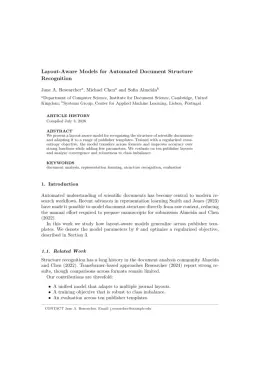
Fiber & Integrated Optics template — frequently asked questions

How do I write a paper in the Fiber & Integrated Optics format?
In DocuGuru you write your manuscript in a normal editor — no LaTeX setup required — and select the Fiber & Integrated Optics template. When you export, DocuGuru compiles the paper into the official Taylor & Francis format and hands you a submission-ready PDF along with the editable LaTeX source.
What reference style does Fiber & Integrated Optics use?
Fiber & Integrated Optics uses Author–year (Chicago, T&F) references, shown as author–year markers such as (Smith, 2023) in the text. DocuGuru formats every in-text citation and the reference list in this exact style automatically. A reference appears like this: Smith, Ada, Ben Jones, and Cara Lee. 2023. "A Representative Article Title." Fiber & Integrated Optics 12 (3): 45–58.
Do I need to know LaTeX to submit to Fiber & Integrated Optics?
No. DocuGuru generates the interact LaTeX class and compiles the PDF for you in the background, so you get a Taylor & Francis-ready Fiber & Integrated Optics document without writing any LaTeX. If you do want it, the LaTeX source is included in the export.
Can I import an existing draft into the Fiber & Integrated Optics template?
Yes. Paste or upload your current manuscript — Word, LaTeX, Markdown, or plain text — and DocuGuru reflows it into the Fiber & Integrated Optics format with correct headings, figures, tables, and author–year citations.
Who publishes Fiber & Integrated Optics?
Fiber & Integrated Optics is a multidisciplinary journal published by Taylor & Francis. DocuGuru's Fiber & Integrated Optics template matches Taylor & Francis's official submission format.
Can I export a submission-ready Fiber & Integrated Optics PDF?
Yes — DocuGuru produces a PDF built with the official Fiber & Integrated Optics template (the interact class) that is ready to submit to Taylor & Francis, together with the matching LaTeX source files.
How much does the Fiber & Integrated Optics template cost?
You can start writing in the Fiber & Integrated Optics template for free. Exporting the final submission-ready Fiber & Integrated Optics PDF and LaTeX source is part of DocuGuru's paid plans — see the app for current pricing.
Use the Fiber & Integrated Optics template