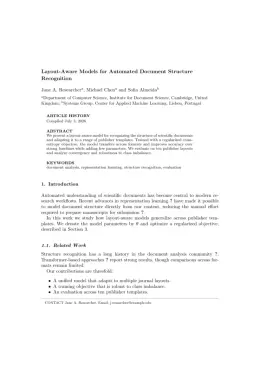
Taylor & Francis

Critical Reviews in Analytical Chemistry Template

Write in a clean editor, then format for Critical Reviews in Analytical Chemistry in one click — DocuGuru applies the official Taylor & Francis template with author–year references and exports a submission-ready PDF plus the editable LaTeX source. Free to start.

About the Critical Reviews in Analytical Chemistry format

Critical Reviews in Analytical Chemistry is a peer-reviewed journal published by Taylor & Francis, covering Analytical Chemistry and Chromatography, Analytical chemistry methods development, Advanced biosensing and bioanalysis techniques.

PublisherTaylor & Francis
Reference styleAuthor–year (Chicago, T&F)
Author–year — (Smith, 2023) in the text
Smith, Ada, Ben Jones, and Cara Lee. 2023. "A Representative Article Title." Critical Reviews in Analytical Chemistry 12 (3): 45–58.

Formats any DOI in Critical Reviews in Analytical Chemistry style. No sign-up.

Publishes research inAnalytical Chemistry and Chromatography Analytical chemistry methods development Advanced biosensing and bioanalysis techniques Electrochemical Analysis and Applications Electrochemical sensors and biosensors
ISSN1040-8347
Citation impact (2-yr)4.69
h-index108
i10-index999
Total citations59,294
Top institutions publishing hereGdańsk University of Technology
Journal websitewww.tandfonline.com
You getA submission-ready PDF and the editable LaTeX source — ready to submit.

Papers published in Critical Reviews in Analytical Chemistry per year

32
2014
38
2015
35
2016
34
2017
43
2018
60
2019
96
2020
105
2021
130
2022
97
2023
83
2024
155
2025

Citation impact of Critical Reviews in Analytical Chemistry by publication year

1.4K
2014
3.2K
2015
2.9K
2016
1.8K
2017
2.2K
2018
3.1K
2019
4K
2020
2.5K
2021
3.3K
2022
2.1K
2023
961
2024
544
2025

Citations each year’s papers have accumulated so far — the most recent years are still building up.

Most-cited papers in Critical Reviews in Analytical Chemistry

The Correlation Coefficient: An Overview

Agustín G. Asuero, Ana Sayago, Antonio G. González · 1 Jan 2006

Correlation and regression are different, but not mutually exclusive, techniques. Roughly, regression is used for prediction (which does not extrapolate beyond the data used in the analysis) whereas correlation is used to determine the degree of association. There situations in which the x variable is not fixed or readily chosen by the experimenter, but instead…

1,509 citations Cite SaveGo to paper →
FTIR Spectroscopy for Carbon Family Study

Vasilica Țucureanu, Alina Matei, Andrei Avram · 3 Mar 2016

Fourier transform Infrared (FTIR) spectroscopy is a versatile technique for the characterization of materials belonging to the carbon family. Based on the interaction of the IR radiation with matter this technique may be used for the identification and characterization of chemical structures. Most important features of this method are: non-destructive, real-time measurement and relatively easy…

1,388 citations Cite SaveGo to paper →
X-Ray Diffraction: Instrumentation and Applications

Andrei A. Bunaciu, Elena Gabriela Udriştioiu, Hassan Y. Aboul‐Enein · 1 Apr 2015

X-ray diffraction (XRD) is a powerful nondestructive technique for characterizing crystalline materials. It provides information on structures, phases, preferred crystal orientations (texture), and other structural parameters, such as average grain size, crystallinity, strain, and crystal defects. X-ray diffraction peaks are produced by constructive interference of a monochromatic beam of X-rays scattered at specific angles from…

A Critical Review of Surfactant-Mediated Phase Separations (Cloud-Point Extractions): Theory and Applications

Willie L. Hinze, Edmondo Pramauro · 1 Jan 1993

Abstract The general concept of using the unique phase separation behavior of some surfactant micelle solutions as a means for extractive separation is outlined and described. Next, the specific micellar parameters and phase separation behavior of nonionic and zwitterionic charge-type surfactant solutions are summarized. In addition, the phase behavior of some derivatized B-cyclodextrin solutions is…

Green Chemistry and the Role of Analytical Methodology Development

Paul T. Anastas · 1 Sep 1999

Green Chemistry has emerged in the 1990s as a way that the skills, knowledge, and talents of chemists can be used avoid threats to human health and the environment in all types of chemical processes. One of the most active areas of Green Chemistry research and development is in analytical methodology development. New methods and…

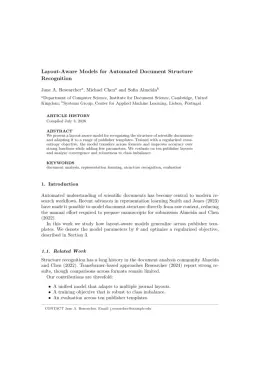
Critical Reviews in Analytical Chemistry template — frequently asked questions

How do I write a paper in the Critical Reviews in Analytical Chemistry format?
In DocuGuru you write your manuscript in a normal editor — no LaTeX setup required — and select the Critical Reviews in Analytical Chemistry template. When you export, DocuGuru compiles the paper into the official Taylor & Francis format and hands you a submission-ready PDF along with the editable LaTeX source.
What reference style does Critical Reviews in Analytical Chemistry use?
Critical Reviews in Analytical Chemistry uses Author–year (Chicago, T&F) references, shown as author–year markers such as (Smith, 2023) in the text. DocuGuru formats every in-text citation and the reference list in this exact style automatically. A reference appears like this: Smith, Ada, Ben Jones, and Cara Lee. 2023. "A Representative Article Title." Critical Reviews in Analytical Chemistry 12 (3): 45–58.
Do I need to know LaTeX to submit to Critical Reviews in Analytical Chemistry?
No. DocuGuru generates the interact LaTeX class and compiles the PDF for you in the background, so you get a Taylor & Francis-ready Critical Reviews in Analytical Chemistry document without writing any LaTeX. If you do want it, the LaTeX source is included in the export.
Can I import an existing draft into the Critical Reviews in Analytical Chemistry template?
Yes. Paste or upload your current manuscript — Word, LaTeX, Markdown, or plain text — and DocuGuru reflows it into the Critical Reviews in Analytical Chemistry format with correct headings, figures, tables, and author–year citations.
Who publishes Critical Reviews in Analytical Chemistry?
Critical Reviews in Analytical Chemistry is a multidisciplinary journal published by Taylor & Francis. DocuGuru's Critical Reviews in Analytical Chemistry template matches Taylor & Francis's official submission format.
Can I export a submission-ready Critical Reviews in Analytical Chemistry PDF?
Yes — DocuGuru produces a PDF built with the official Critical Reviews in Analytical Chemistry template (the interact class) that is ready to submit to Taylor & Francis, together with the matching LaTeX source files.
How much does the Critical Reviews in Analytical Chemistry template cost?
You can start writing in the Critical Reviews in Analytical Chemistry template for free. Exporting the final submission-ready Critical Reviews in Analytical Chemistry PDF and LaTeX source is part of DocuGuru's paid plans — see the app for current pricing.
Use the Critical Reviews in Analytical Chemistry template