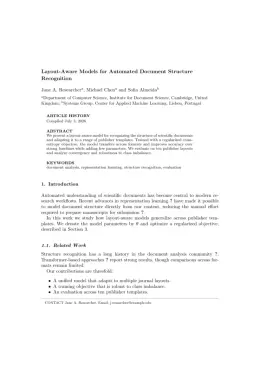
Taylor & Francis

Cogent Psychology Template

Write in a clean editor, then format for Cogent Psychology in one click — DocuGuru applies the official Taylor & Francis template with author–year references and exports a submission-ready PDF plus the editable LaTeX source. Free to start.

About the Cogent Psychology format

Cogent Psychology is a peer-reviewed journal published by Taylor & Francis, covering Child and Adolescent Psychosocial and Emotional Development, Behavioral Health and Interventions, Anxiety, Depression, Psychometrics, Treatment, Cognitive Processes.

PublisherTaylor & Francis
Reference styleAuthor–year (Chicago, T&F)
Author–year — (Smith, 2023) in the text
Smith, Ada, Ben Jones, and Cara Lee. 2023. "A Representative Article Title." Cogent Psychology 12 (3): 45–58.

Formats any DOI in Cogent Psychology style. No sign-up.

Publishes research inChild and Adolescent Psychosocial and Emotional Development Behavioral Health and Interventions Anxiety, Depression, Psychometrics, Treatment, Cognitive Processes Job Satisfaction and Organizational Behavior Psychological Well-being and Life Satisfaction
ISSN2331-1908
Citation impact (2-yr)1.6
h-index48
i10-index341
Total citations11,922
Article processing charge$1,134
Open accessYes
Top institutions publishing hereNorwegian University of Science and Technology
Journal websitewww.tandfonline.com
You getA submission-ready PDF and the editable LaTeX source — ready to submit.

Papers published in Cogent Psychology per year

6
2014
35
2015
82
2016
87
2017
98
2018
103
2019
91
2020
55
2021
83
2022
62
2023
85
2024
133
2025

Citation impact of Cogent Psychology by publication year

94
2014
880
2015
1.7K
2016
1.6K
2017
1.7K
2018
1.7K
2019
1.5K
2020
819
2021
982
2022
340
2023
244
2024
158
2025

Citations each year’s papers have accumulated so far — the most recent years are still building up.

Most-cited papers in Cogent Psychology

How much compliance is too much compliance: Is long-term ABA therapy abuse?

Aileen H. Sandoval-Norton, Gary Shkedy, Dalia Shkedy · 1 Jan 2019

This article discusses the prevalence of ASD with specific regard to the most ubiquitous current treatment, Applied Behavior Analysis (ABA). A discussion of some of the issues with the underlying theory of ABA in its current application is conducted, especially with regard to “lower functioning” and nonverbal autistic individuals; namely, the curtailing of soothing “stimming”…

Interpreting Kendall’s Tau and Tau-<i>U</i> for single-case experimental designs

Daniel F. Brossart, Vanessa Laird, Trey W. Armstrong · 4 Sep 2018

Tau (τ), a nonparametric rank order correlation statistic, has been applied to single-case experimental designs with promising results. Tau-U, a family of related coefficients, partitions variance associated with changes in trend and level. By examining within-phase trend and across-phase differences separately with Tau-U, single-case investigators may gain useful descriptive and inferential insights about their data.…

Carpe diem instead of losing your social mind: Beyond digital addiction and why we all suffer from digital overuse

Christian Montag, Peter Walla · 3 Mar 2016

It is not too late, but about time to realize how damaging IT overuse can be. The present paper discusses why it is of tremendous importance to study the effect of the Internet, smartphone, and other new digital technologies on individuals’ productivity and well-being. Besides its recognized addictive nature, it also becomes clear that such…

Emotion regulation strategies and psychosocial well-being in adolescence

Chiara Verzeletti, Vanda Zammuner, Cristina Galli et al. · 10 Jun 2016

To study whether and how emotion regulation (EmR) strategies are associated with adolescents' well-being, 633 Italian adolescents completed a survey that measured, using the emotion regulation questionnaire (ERQ), the strategies of cognitive reappraisal (CR) and expressive suppression (ES), and their relationship with several well-being measures. Factor analysis and reliability results confirmed the validity of ERQ…

Customer perceived value—Conceptualization and avenues for future research

Alexander Zauner, Monika Koller, Isabella Hatak · 27 Jul 2015

Given the present dynamic consumption environment due to technological innovations as well as interlinked economic developments on the macro-, micro-, and societal-level, researchers and managers have been increasingly showing interest in the concept of customer perceived value. However, especially given its vast empirical application, surprisingly little effort has been paid to synthesize various perspectives on…


Cogent Psychology template — frequently asked questions

How do I write a paper in the Cogent Psychology format?
In DocuGuru you write your manuscript in a normal editor — no LaTeX setup required — and select the Cogent Psychology template. When you export, DocuGuru compiles the paper into the official Taylor & Francis format and hands you a submission-ready PDF along with the editable LaTeX source.
What reference style does Cogent Psychology use?
Cogent Psychology uses Author–year (Chicago, T&F) references, shown as author–year markers such as (Smith, 2023) in the text. DocuGuru formats every in-text citation and the reference list in this exact style automatically. A reference appears like this: Smith, Ada, Ben Jones, and Cara Lee. 2023. "A Representative Article Title." Cogent Psychology 12 (3): 45–58.
Do I need to know LaTeX to submit to Cogent Psychology?
No. DocuGuru generates the interact LaTeX class and compiles the PDF for you in the background, so you get a Taylor & Francis-ready Cogent Psychology document without writing any LaTeX. If you do want it, the LaTeX source is included in the export.
Can I import an existing draft into the Cogent Psychology template?
Yes. Paste or upload your current manuscript — Word, LaTeX, Markdown, or plain text — and DocuGuru reflows it into the Cogent Psychology format with correct headings, figures, tables, and author–year citations.
Who publishes Cogent Psychology?
Cogent Psychology is a multidisciplinary journal published by Taylor & Francis. DocuGuru's Cogent Psychology template matches Taylor & Francis's official submission format.
Can I export a submission-ready Cogent Psychology PDF?
Yes — DocuGuru produces a PDF built with the official Cogent Psychology template (the interact class) that is ready to submit to Taylor & Francis, together with the matching LaTeX source files.
How much does the Cogent Psychology template cost?
You can start writing in the Cogent Psychology template for free. Exporting the final submission-ready Cogent Psychology PDF and LaTeX source is part of DocuGuru's paid plans — see the app for current pricing.
Use the Cogent Psychology template