Taylor & Francis

Advances in Applied Ceramics Structural Functional and Bioceramics Template

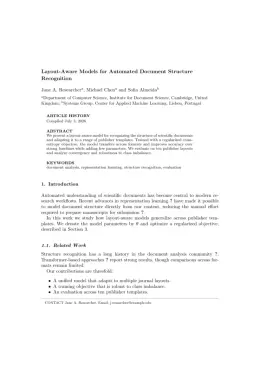
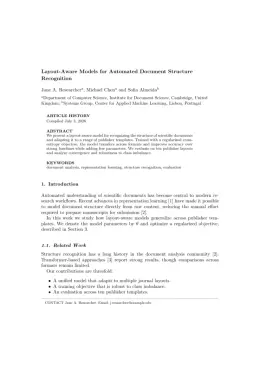
Write in a clean editor, then format for Advances in Applied Ceramics Structural Functional and Bioceramics in one click — DocuGuru applies the official Taylor & Francis template with author–year references and exports a submission-ready PDF plus the editable LaTeX source. Free to start.

About the Advances in Applied Ceramics Structural Functional and Bioceramics format

Advances in Applied Ceramics Structural Functional and Bioceramics is a peer-reviewed journal published by Taylor & Francis, covering Advanced ceramic materials synthesis, Advanced materials and composites, Ferroelectric and Piezoelectric Materials.

PublisherTaylor & Francis
Reference styleAuthor–year (Chicago, T&F)
Author–year — (Smith, 2023) in the text
Smith, Ada, Ben Jones, and Cara Lee. 2023. "A Representative Article Title." Advances in Applied Ceramics Structural Functional and Bioceramics 12 (3): 45–58.

Formats any DOI in Advances in Applied Ceramics Structural Functional and Bioceramics style. No sign-up.

Publishes research inAdvanced ceramic materials synthesis Advanced materials and composites Ferroelectric and Piezoelectric Materials Bone Tissue Engineering Materials Recycling and utilization of industrial and municipal waste in materials production
ISSN1743-6753
Citation impact (2-yr)1
h-index59
i10-index587
Total citations20,876
Top institutions publishing hereChinese Academy of Sciences
Journal websitewww.tandfonline.com
You getA submission-ready PDF and the editable LaTeX source — ready to submit.

Papers published in Advances in Applied Ceramics Structural Functional and Bioceramics per year

103
2014
63
2015
72
2016
87
2017
68
2018
63
2019
43
2020
37
2021
27
2022
34
2023
16
2024
16
2025

Citation impact of Advances in Applied Ceramics Structural Functional and Bioceramics by publication year

1.4K
2014
1.3K
2015
1.5K
2016
1.2K
2017
1K
2018
1.1K
2019
657
2020
388
2021
108
2022
158
2023
27
2024
10
2025

Citations each year’s papers have accumulated so far — the most recent years are still building up.

Most-cited papers in Advances in Applied Ceramics Structural Functional and Bioceramics

Review of flash sintering: Materials, mechanisms and modelling

Min Yu, Salvatore Grasso, Ruth McKinnon et al. · 9 Dec 2016

Flash sintering (FS) is an energy efficient sintering technique involving electrical Joule heating, which allows very rapid densification (<60 s) of particulate materials. Since the first publication on flash-sintered zirconia (3YSZ) in 2010, it has been intensively researched and applied to a wide range of materials. Going back more than a century ago, we have…

Immobilisation of radioactive waste in glasses, glass composite materials and ceramics

William Lee, Michael I. Ojovan, Martin C. Stennett et al. · 2 Dec 2005

The basic principles of incorporating high level radioactive waste into glasses, ceramics (Synroc type) and glass composites including glass ceramics are described. Current UK technology uses glass wasteforms for the products of reprocessing, although many countries are temporarily storing the ceramic spent fuel for eventual disposal. Some waste streams may be incorporated into ceramics, but…

Review of graphene–ceramic matrix composites

Harshit Porwal, Salvatore Grasso, Mike Reece · 1 Oct 2013

Graphene has remarkable mechanical properties, which makes it potentially a good reinforcement in ceramic composites. It also has unique electrical and thermal properties, which makes it an attractive filler for producing multifunctional ceramics for a wide range of applications. In the past few years, relatively little attention has been focused on graphene ceramic matrix composites…

Sintering and densification of nanocrystalline ceramic oxide powders: a review

R. Chaim, M. Levin, A. Shlayer et al. · 22 Apr 2008

Observation of the unconventional properties and material behaviour expected in the nanometre grain size range necessitates the fabrication of fully dense bulk nanostructured ceramics. This is achieved by the application of ceramic nanoparticles and suitable densification conditions, both for the green and sintered compacts. Various sintering and densification strategies were adopted, including pressureless sintering, hot…

A review of cold sintering processes

Salvatore Grasso, Mattia Biesuz, Luca Zoli et al. · 16 Jan 2020

The need to reduce the energy consumed and the carbon footprint generated by firing ceramics has stimulated research to develop consolidation techniques operating at lower temperatures, ideally not exceeding 300 °C. This has been realised in Ultra Low Energy Sintering (ULES) using high pressure (hundreds of MPa) in the presence of a transient liquid phase,…

Advances in Applied Ceramics Structural Functional and Bioceramics template — frequently asked questions

How do I write a paper in the Advances in Applied Ceramics Structural Functional and Bioceramics format?
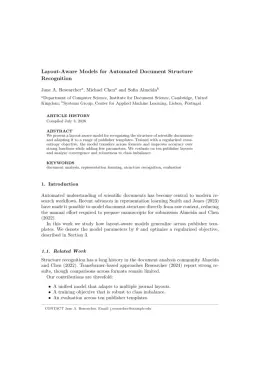
In DocuGuru you write your manuscript in a normal editor — no LaTeX setup required — and select the Advances in Applied Ceramics Structural Functional and Bioceramics template. When you export, DocuGuru compiles the paper into the official Taylor & Francis format and hands you a submission-ready PDF along with the editable LaTeX source.
What reference style does Advances in Applied Ceramics Structural Functional and Bioceramics use?
Advances in Applied Ceramics Structural Functional and Bioceramics uses Author–year (Chicago, T&F) references, shown as author–year markers such as (Smith, 2023) in the text. DocuGuru formats every in-text citation and the reference list in this exact style automatically. A reference appears like this: Smith, Ada, Ben Jones, and Cara Lee. 2023. "A Representative Article Title." Advances in Applied Ceramics Structural Functional and Bioceramics 12 (3): 45–58.
Do I need to know LaTeX to submit to Advances in Applied Ceramics Structural Functional and Bioceramics?
No. DocuGuru generates the interact LaTeX class and compiles the PDF for you in the background, so you get a Taylor & Francis-ready Advances in Applied Ceramics Structural Functional and Bioceramics document without writing any LaTeX. If you do want it, the LaTeX source is included in the export.
Can I import an existing draft into the Advances in Applied Ceramics Structural Functional and Bioceramics template?
Yes. Paste or upload your current manuscript — Word, LaTeX, Markdown, or plain text — and DocuGuru reflows it into the Advances in Applied Ceramics Structural Functional and Bioceramics format with correct headings, figures, tables, and author–year citations.
Who publishes Advances in Applied Ceramics Structural Functional and Bioceramics?
Advances in Applied Ceramics Structural Functional and Bioceramics is a multidisciplinary journal published by Taylor & Francis. DocuGuru's Advances in Applied Ceramics Structural Functional and Bioceramics template matches Taylor & Francis's official submission format.
Can I export a submission-ready Advances in Applied Ceramics Structural Functional and Bioceramics PDF?
Yes — DocuGuru produces a PDF built with the official Advances in Applied Ceramics Structural Functional and Bioceramics template (the interact class) that is ready to submit to Taylor & Francis, together with the matching LaTeX source files.
How much does the Advances in Applied Ceramics Structural Functional and Bioceramics template cost?
You can start writing in the Advances in Applied Ceramics Structural Functional and Bioceramics template for free. Exporting the final submission-ready Advances in Applied Ceramics Structural Functional and Bioceramics PDF and LaTeX source is part of DocuGuru's paid plans — see the app for current pricing.
Use the Advances in Applied Ceramics Structural Functional and Bioceramics template