SAGE

The Journal of Computational Multiphase Flows Template

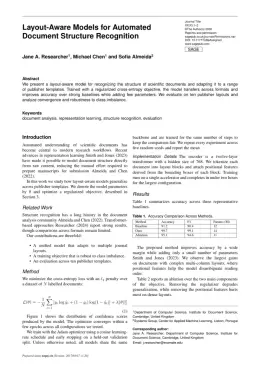
Write in a clean editor, then format for The Journal of Computational Multiphase Flows in one click — DocuGuru applies the official SAGE template with author–year references and exports a submission-ready PDF plus the editable LaTeX source. Free to start.

About the The Journal of Computational Multiphase Flows format

The Journal of Computational Multiphase Flows is a peer-reviewed journal published by SAGE, covering Fluid Dynamics and Heat Transfer, Fluid Dynamics and Mixing, Lattice Boltzmann Simulation Studies.

PublisherSAGE
Reference styleAuthor–year (Harvard)
Author–year — (Smith, 2023) in the text
Smith, A., Jones, B. and Lee, C. (2023) 'A representative article title', The Journal of Computational Multiphase Flows, 12(3), pp. 45–58.

Formats any DOI in The Journal of Computational Multiphase Flows style. No sign-up.

Publishes research inFluid Dynamics and Heat Transfer Fluid Dynamics and Mixing Lattice Boltzmann Simulation Studies Particle Dynamics in Fluid Flows Cyclone Separators and Fluid Dynamics
ISSN1757-482X
h-index23
i10-index78
Total citations2,560
Top institutions publishing hereRMIT University
Journal websitewww.ingentaconnect.com
You getA submission-ready PDF and the editable LaTeX source — ready to submit.

Papers published in The Journal of Computational Multiphase Flows per year

18
2009
20
2010
17
2011
30
2012
19
2013
32
2014
17
2015
18
2016
21
2017
13
2018

Citation impact of The Journal of Computational Multiphase Flows by publication year

301
2009
416
2010
359
2011
220
2012
140
2013
435
2014
135
2015
168
2016
246
2017
129
2018

Citations each year’s papers have accumulated so far — the most recent years are still building up.

Most-cited papers in The Journal of Computational Multiphase Flows

Parallel Resolved Open Source CFD-DEM: Method, Validation and Application

Alice Hager, Christoph Kloss, Stefan Pirker et al. · 1 Mar 2014

In the following paper the authors present a fully parallelized Open Source method for calculating the interaction of immersed bodies and surrounding fluid. A combination of computational fluid dynamics (CFD) and a discrete element method (DEM) accounts for the physics of both the fluid and the particles. The objects considered are relatively big compared to…

Taylor Flow in Microchannels: A Review of Experimental and Computational Work

Raghvendra Gupta, David F. Fletcher, Brian S. Haynes · 1 Mar 2010

Over the past few decades an enormous interest in two-phase flow in microchannels has developed because of their application in a wide range of new technologies, ranging from lab-on-a-chip devices used in medical and pharmaceutical applications to micro-structured process equipment used in many modern chemical plants. Taylor flow, in which gas bubbles are surrounded by…

Experiments and Numerical Simulations of Horizontal Two-Phase Flow Regimes Using an Interfacial Area Density Model

Thomas Höhne, C. Vallée · 1 Sep 2010

Stratified two-phase flow regimes can occur in the main cooling lines of Pressurized Water Reactors, Chemical plants and Oil pipelines. A relevant problem occurring is the development of wavy stratified flows, which can lead to slug generation. In the last decade, stratified flows have increasingly been modelled with computational fluid dynamics (CFD) codes. In CFD,…

Grid Generation Issues in the CFD Modelling of Two-Phase Flow in a Pipe

V. Hernández-Pérez, M. Abdulkadir, B.J. Azzopardi · 1 Mar 2011

The grid generation issues found in the 3D simulation of two-phase flow in a pipe using Computational Fluid Dynamics (CFD) are discussed in this paper. Special attention is given to the effect of the element type and structure of the mesh. The simulations were carried out using the commercial software package STAR-CCM+, which is designed…

Modelling of Break-up and Coalescence in Bubbly Two-Phase Flows

Simon Lo, Dongsheng Zhang · 1 Jan 2009

Numerical simulations of gas-liquid two-phase flow with high superficial velocity in a vertical pipe were conducted with the use of the commercial software package STAR-CD 3.27. The change in bubble size due to breakup and coalescence was modelled by the S γ model. The applicability and performance of the S γ model in modelling of…

The Journal of Computational Multiphase Flows template — frequently asked questions

How do I write a paper in the The Journal of Computational Multiphase Flows format?
In DocuGuru you write your manuscript in a normal editor — no LaTeX setup required — and select the The Journal of Computational Multiphase Flows template. When you export, DocuGuru compiles the paper into the official SAGE format and hands you a submission-ready PDF along with the editable LaTeX source.
What reference style does The Journal of Computational Multiphase Flows use?
The Journal of Computational Multiphase Flows uses Author–year (Harvard) references, shown as author–year markers such as (Smith, 2023) in the text. DocuGuru formats every in-text citation and the reference list in this exact style automatically. A reference appears like this: Smith, A., Jones, B. and Lee, C. (2023) 'A representative article title', The Journal of Computational Multiphase Flows, 12(3), pp. 45–58.
Do I need to know LaTeX to submit to The Journal of Computational Multiphase Flows?
No. DocuGuru generates the sagej LaTeX class and compiles the PDF for you in the background, so you get a SAGE-ready The Journal of Computational Multiphase Flows document without writing any LaTeX. If you do want it, the LaTeX source is included in the export.
Can I import an existing draft into the The Journal of Computational Multiphase Flows template?
Yes. Paste or upload your current manuscript — Word, LaTeX, Markdown, or plain text — and DocuGuru reflows it into the The Journal of Computational Multiphase Flows format with correct headings, figures, tables, and author–year citations.
Who publishes The Journal of Computational Multiphase Flows?
The Journal of Computational Multiphase Flows is a multidisciplinary journal published by SAGE. DocuGuru's The Journal of Computational Multiphase Flows template matches SAGE's official submission format.
Can I export a submission-ready The Journal of Computational Multiphase Flows PDF?
Yes — DocuGuru produces a PDF built with the official The Journal of Computational Multiphase Flows template (the sagej class) that is ready to submit to SAGE, together with the matching LaTeX source files.
How much does the The Journal of Computational Multiphase Flows template cost?
You can start writing in the The Journal of Computational Multiphase Flows template for free. Exporting the final submission-ready The Journal of Computational Multiphase Flows PDF and LaTeX source is part of DocuGuru's paid plans — see the app for current pricing.

Use the The Journal of Computational Multiphase Flows template