SAGE

High Performance Polymers Template

Write in a clean editor, then format for High Performance Polymers in one click — DocuGuru applies the official SAGE template with author–year references and exports a submission-ready PDF plus the editable LaTeX source. Free to start.

About the High Performance Polymers format

High Performance Polymers is a peer-reviewed journal published by SAGE, covering Synthesis and properties of polymers, Epoxy Resin Curing Processes, Silicone and Siloxane Chemistry.

PublisherSAGE
Reference styleAuthor–year (Harvard)
Author–year — (Smith, 2023) in the text
Smith, A., Jones, B. and Lee, C. (2023) 'A representative article title', High Performance Polymers, 12(3), pp. 45–58.

Formats any DOI in High Performance Polymers style. No sign-up.

Publishes research inSynthesis and properties of polymers Epoxy Resin Curing Processes Silicone and Siloxane Chemistry Polymer Nanocomposites and Properties Tribology and Wear Analysis
ISSN0954-0083
Citation impact (2-yr)1.59
h-index53
i10-index1,123
Total citations31,820
Top institutions publishing hereJilin University
Journal websitewww.sagepub.com
You getA submission-ready PDF and the editable LaTeX source — ready to submit.

Papers published in High Performance Polymers per year

169
2014
165
2015
131
2016
129
2017
107
2018
77
2019
125
2020
77
2021
118
2022
55
2023
40
2024
55
2025

Citation impact of High Performance Polymers by publication year

2.1K
2014
1.9K
2015
1.8K
2016
1.6K
2017
1.6K
2018
1K
2019
1.5K
2020
814
2021
760
2022
224
2023
114
2024
58
2025

Citations each year’s papers have accumulated so far — the most recent years are still building up.

Most-cited papers in High Performance Polymers

The Use, Design, Synthesis, and Properties of High Performance/High Temperature Polymers: An Overview

P. M. Hergenrother · 1 Mar 2003

An overview of the definition and development of, factors that contribute to, applications and markets for and the design of high performance/high temperature polymers is presented. Of the many families of high performance/high temperature polymers known, the most popular families consisting of polyimides, polyarylene ethers and phenylethynyl-terninated oligomers are used to demonstrate the basic principles…

Molecular Design of Heat Resistant Polyimides Having Excellent Processability and High Glass Transition Temperature

Rikio Yokota, Syougo Yamamoto, Shoichiro Yano et al. · 1 Jun 2001

The relationship between the imide structures and morphology are discussed in order to develop heat resistant polyimides having excellent processability and toughness. Addition-type imide oligomers consisting of asymmetric 2,3,3′,4′-biphenyltetracarboxylic dianhydride (a-BPDA) and 3,4′-oxydianiline (3,4′-ODA) and/or 4,4′-oxydianiline (4,4′-ODA) with 4-phenylethynyl phthalic anhydride (PEPA) were synthesized and characterized. The imide oligomers derived from 3,4′-ODA; 4,4′-ODA (50:50) comonomer…

Synthesis and Characterization of Polyimides Based on 3,6-Diphenylpyromellitic Dianhydride

Frank W. Harris, Steve Lien‐Chung Hsu · 1 Feb 1989

3,6-Diphenylpyromellitic dianhydride (DPPMDA) has been synthesized from 2,5-diphenyl-3,4-bis(4-methoxyphenyl)cyclopentadiene-1-one and dimethyl acetylenedicarboxylate. The monomer was polymerized with 11 aromatic diamines in refluxing m-cresol containing isoquinoline to afford two new series of phenylated polyimides. The polymers containing flexible ether or methylene linkages, meta-catenation, or cardo linkages were soluble in m-cresol, N-methylpyrrolidinone, and symtetrachloroethane. Their intrinsic viscosities ranged…

Low-melting Phthalonitrile Oligomers: Preparation, Polymerization and Polymer Properties

Dawn D. Dominguez, Teddy M. Keller · 1 Jun 2006

A series of low-melting phthalonitrile oligomers were prepared in which variable-length multiple aromatic ether linkages interconnect the terminal phthalonitrile units. These materials were designed to address the need for a processable resin system with good high-temperature properties. The melt-processable oligomers are obtained using a modified-Ullman ether reaction between a bisphenol and a dihalobenzene to form…

Polyimide Foams for Aerospace Vehicles

Erik S. Weiser, Theodore F. Johnson, Terry L. St. Clair et al. · 1 Mar 2000

Due to a demand by the aerospace industry, NASA has begun developing the next generation of polyimide foams which could be utilized to reduce vehicle weight for the X-33 and Reusable Launch Vehicle (RLV) programmes. The activity at NASA Langley Research Center focuses on developing polyimide foam and foam structures which are made using monomeric…

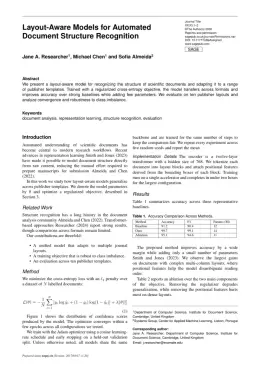
High Performance Polymers template — frequently asked questions

How do I write a paper in the High Performance Polymers format?
In DocuGuru you write your manuscript in a normal editor — no LaTeX setup required — and select the High Performance Polymers template. When you export, DocuGuru compiles the paper into the official SAGE format and hands you a submission-ready PDF along with the editable LaTeX source.
What reference style does High Performance Polymers use?
High Performance Polymers uses Author–year (Harvard) references, shown as author–year markers such as (Smith, 2023) in the text. DocuGuru formats every in-text citation and the reference list in this exact style automatically. A reference appears like this: Smith, A., Jones, B. and Lee, C. (2023) 'A representative article title', High Performance Polymers, 12(3), pp. 45–58.
Do I need to know LaTeX to submit to High Performance Polymers?
No. DocuGuru generates the sagej LaTeX class and compiles the PDF for you in the background, so you get a SAGE-ready High Performance Polymers document without writing any LaTeX. If you do want it, the LaTeX source is included in the export.
Can I import an existing draft into the High Performance Polymers template?
Yes. Paste or upload your current manuscript — Word, LaTeX, Markdown, or plain text — and DocuGuru reflows it into the High Performance Polymers format with correct headings, figures, tables, and author–year citations.
Who publishes High Performance Polymers?
High Performance Polymers is a multidisciplinary journal published by SAGE. DocuGuru's High Performance Polymers template matches SAGE's official submission format.
Can I export a submission-ready High Performance Polymers PDF?
Yes — DocuGuru produces a PDF built with the official High Performance Polymers template (the sagej class) that is ready to submit to SAGE, together with the matching LaTeX source files.
How much does the High Performance Polymers template cost?
You can start writing in the High Performance Polymers template for free. Exporting the final submission-ready High Performance Polymers PDF and LaTeX source is part of DocuGuru's paid plans — see the app for current pricing.
Use the High Performance Polymers template