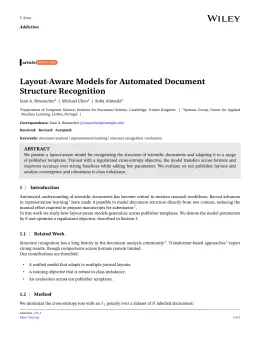
About the Gender & Society format
Gender & Society is a peer-reviewed journal published by SAGE, covering Gender Politics and Representation, Gender Roles and Identity Studies, Gender, Feminism, and Media. Over its lifetime it has published 3,098 papers, which have received 147,305 citations.
| Publisher | SAGE |
|---|
| Reference style | Author–year (Harvard) Author–year — (Smith, 2023) in the text
Smith, A., Jones, B. and Lee, C. (2023) 'A representative article title', Gender & Society, 12(3), pp. 45–58.
Formats any DOI in Gender & Society style. No sign-up.
|
|---|
| Publishes research in | Gender Politics and Representation Gender Roles and Identity Studies Gender, Feminism, and Media Work-Family Balance Challenges Gender Diversity and Inequality |
|---|
| ISSN | 0891-2432 |
|---|
| Citation impact (2-yr) | 1.02 |
|---|
| h-index | 173 |
|---|
| i10-index | 1,151 |
|---|
| Top institutions publishing here | The University of Texas at Austin |
|---|
| Journal website | gas.sagepub.com |
|---|
| You get | A submission-ready PDF and the editable LaTeX source — ready to submit. |
|---|
Papers published in Gender & Society per year
Citation impact of Gender & Society by publication year
Citations each year’s papers have accumulated so far — the most recent years are still building up.
Most-cited papers in Gender & Society
Hegemonic Masculinity
Raewyn Connell, James W. Messerschmidt · 28 Oct 2005
The concept of hegemonic masculinity has influenced gender studies across many academic fields but has also attracted serious criticism. The authors trace the origin of the concept in a convergence of ideas in the early 1980s and map the ways it was applied when research on men and masculinities expanded. Evaluating the principal criticisms, the…
Doing Gender
Candace West, Don H. Zimmerman · 1 Jun 1987
The purpose of this article is to advance a new understanding of gender as a routine accomplishment embedded in everyday interaction. To do so entails a critical assessment of existing perspectives on sex and gender and the introduction of important distinctions among sex, sex category, and gender. We argue that recognition of the analytical independence…
HIERARCHIES, JOBS, BODIES:
Joan Acker · 1 Jun 1990
In spite of feminist recognition that hierarchical organizations are an important location of male dominance, most feminists writing about organizations assume that organizational structure is gender neutral. This article argues that organizational structure is not gender neutral; on the contrary, assumptions about gender underlie the documents and contracts used to construct organizations and to provide…
Inequality Regimes
Joan Acker · 30 Jun 2006
In this article, the author addresses two feminist issues: first, how to conceptualize intersectionality, the mutual reproduction of class, gender, and racial relations of inequality, and second, how to identify barriers to creating equality in work organizations. She develops one answer to both issues, suggesting the idea of “inequality regimes” as an analytic approach to…
BARGAINING WITH PATRIARCHY
Deniz Kandiyoti · 1 Sep 1988
This article argues that systematic comparative analyses of women's strategies and coping mechanisms lead to a more culturally and temporally grounded understanding of patriarchal systems than the unqualified, abstract notion of patriarchy encountered in contemporary feminist theory. Women strategize within a set of concrete constraints, which I identify as patriarchal bargains. Different forms of patriarchy…