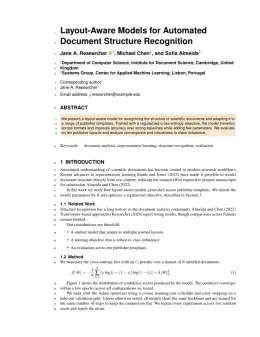
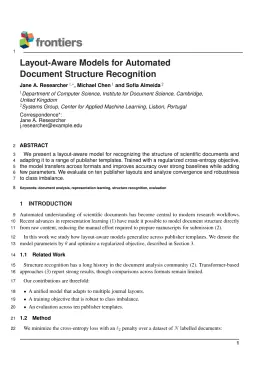
About the PeerJ Computer Science format
PeerJ Computer Science is a peer-reviewed journal published by PeerJ, covering Topic Modeling, Advanced Neural Network Applications, Sentiment Analysis and Opinion Mining. Over its lifetime it has published 3,894 papers, which have received 57,689 citations.
| Publisher | PeerJ |
|---|
| Reference style | Author–year (APA) Author–year — (Smith, 2023) in the text
Smith, A., Jones, B., & Lee, C. (2023). A representative article title. PeerJ Computer Science, 12(3), 45–58.
Formats any DOI in PeerJ Computer Science style. No sign-up.
|
|---|
| Publishes research in | Topic Modeling Advanced Neural Network Applications Sentiment Analysis and Opinion Mining Network Security and Intrusion Detection Anomaly Detection Techniques and Applications |
|---|
| ISSN | 2376-5992 |
|---|
| Citation impact (2-yr) | 4.01 |
|---|
| h-index | 85 |
|---|
| i10-index | 1,096 |
|---|
| Article processing charge | $1,395 |
|---|
| Open access | Yes — indexed in DOAJ |
|---|
| Top institutions publishing here | Princess Nourah bint Abdulrahman University |
|---|
| Journal website | peerj.com |
|---|
| You get | A submission-ready PDF and the editable LaTeX source — ready to submit. |
|---|
Papers published in PeerJ Computer Science per year
Citation impact of PeerJ Computer Science by publication year
Citations each year’s papers have accumulated so far — the most recent years are still building up.
Most-cited papers in PeerJ Computer Science
The coefficient of determination R-squared is more informative than SMAPE, MAE, MAPE, MSE and RMSE in regression analysis evaluation
Davide Chicco, Matthijs J. Warrens, Giuseppe Jurman · 5 Jul 2021
Regression analysis makes up a large part of supervised machine learning, and consists of the prediction of a continuous independent target from a set of other predictor variables. The difference between binary classification and regression is in the target range: in binary classification, the target can have only two values (usually encoded as 0 and…
Probabilistic programming in Python using PyMC3
John Salvatier, Thomas V. Wiecki, Christopher Fonnesbeck · 6 Apr 2016
Probabilistic programming allows for automatic Bayesian inference on user-defined probabilistic models. Recent advances in Markov chain Monte Carlo (MCMC) sampling allow inference on increasingly complex models. This class of MCMC, known as Hamiltonian Monte Carlo, requires gradient information which is often not readily available. PyMC3 is a new open source probabilistic programming framework written in…
Bracken: estimating species abundance in metagenomics data
Jennifer Lu, Florian P. Breitwieser, Peter Thielen et al. · 2 Jan 2017
Metagenomic experiments attempt to characterize microbial communities using high-throughput DNA sequencing. Identification of the microorganisms in a sample provides information about the genetic profile, population structure, and role of microorganisms within an environment. Until recently, most metagenomics studies focused on high-level characterization at the level of phyla, or alternatively sequenced the 16S ribosomal RNA gene…
SymPy: symbolic computing in Python
Aaron Meurer, Christopher P. Smith, Mateusz Paprocki et al. · 2 Jan 2017
SymPy is an open source computer algebra system written in pure Python. It is built with a focus on extensibility and ease of use, through both interactive and programmatic applications. These characteristics have led SymPy to become a popular symbolic library for the scientific Python ecosystem. This paper presents the architecture of SymPy, a description…
PyMC: a modern, and comprehensive probabilistic programming framework in Python
Oriol Abril, Virgile Andreani, Colin Carroll et al. · 1 Sep 2023
PyMC is a probabilistic programming library for Python that provides tools for constructing and fitting Bayesian models. It offers an intuitive, readable syntax that is close to the natural syntax statisticians use to describe models. PyMC leverages the symbolic computation library PyTensor, allowing it to be compiled into a variety of computational backends, such as…