MDPI

Lubricants Template

Write in a clean editor, then format for Lubricants in one click — DocuGuru applies the official MDPI template with numbered references and exports a submission-ready PDF plus the editable LaTeX source. Free to start.

About the Lubricants format

Lubricants is a peer-reviewed journal published by MDPI, covering Lubricants and Their Additives, Tribology and Lubrication Engineering, Gear and Bearing Dynamics Analysis. Over its lifetime it has published 2,812 papers, which have received 31,514 citations.

PublisherMDPI
Reference styleNumbered (MDPI)
Numbered — [1], [2] in the text
1. Smith, A.; Jones, B.; Lee, C. A Representative Article Title. Lubricants 2023, 12, 45–58.

Formats any DOI in Lubricants style. No sign-up.

Publishes research inLubricants and Their Additives Tribology and Lubrication Engineering Gear and Bearing Dynamics Analysis Tribology and Wear Analysis Adhesion, Friction, and Surface Interactions
ISSN2075-4442
Citation impact (2-yr)3.92
h-index61
i10-index936
Article processing charge$1,949
Open accessYes — indexed in DOAJ
Top institutions publishing hereChinese Academy of Sciences
Journal websitewww.mdpi.com
You getA submission-ready PDF and the editable LaTeX source — ready to submit.

Papers published in Lubricants per year

26
2014
40
2015
39
2016
49
2017
111
2018
114
2019
109
2020
125
2021
378
2022
531
2023
462
2024
562
2025

Citation impact of Lubricants by publication year

1K
2014
1.3K
2015
1.3K
2016
975
2017
2.2K
2018
2.6K
2019
2.3K
2020
2.6K
2021
5.2K
2022
5.7K
2023
3.2K
2024
1.4K
2025

Citations each year’s papers have accumulated so far — the most recent years are still building up.

Most-cited papers in Lubricants

A Review of Ionic Liquid Lubricants

Anthony E. Somers, Patrick C. Howlett, Douglas R. MacFarlane et al. · 21 Jan 2013

Due to ever increasing demands on lubricants, such as increased service intervals, reduced volumes and reduced emissions, there is a need to develop new lubricants and improved wear additives. Ionic liquids (ILs) are room temperature molten salts that have recently been shown to offer many advantages in this area. The application of ILs as lubricants…

Chemically Modifying Vegetable Oils to Prepare Green Lubricants

Gobinda Karmakar, Pranab Ghosh, Brajendra K. Sharma · 7 Nov 2017

Chemically modifying vegetable oils to produce an alternative to petroleum-based materials is one of the most important emerging industrial research areas today because of the adverse effects of petroleum products on the environment and the shortage of petroleum resources. Biolubricants, bioplasticizers, non-isocyanate polyurethanes, biofuel, coating materials, biocomposites, and other value-added chemicals can easily be produced…

Dispersion of Nanoparticles in Lubricating Oil: A Critical Review

Yan Chen, Peter Renner, Hong Liang · 10 Jan 2019

Nanolubricants have attracted great interest due to the promise of friction and wear reduction by introducing nanoparticles. To date, the foremost challenge for developing a new nanolubricant is particle suspension. To understand the mechanisms of nanoparticle dispersion and identify bottlenecks, we conducted a comprehensive review of published literature and carried out an analysis of dispersion…

Corrosion Inhibitors: Natural and Synthetic Organic Inhibitors

Ahmed A. Al‐Amiery, Wan Nor Roslam Wan Isahak, Waleed Khalid Al‐Azzawi · 11 Apr 2023

Corrosion is a major challenge in various industries and can cause significant damage to metal structures. Organic corrosion inhibitors are compounds that are used to reduce or prevent corrosion by forming a protective film on metal surfaces. The present review article focuses on natural and synthetic organic corrosion inhibitors and their classifications, active functional groups,…

Lubricants in Pharmaceutical Solid Dosage Forms

Jinjiang Li, Yongmei Wu · 25 Feb 2014

Lubrication plays a key role in successful manufacturing of pharmaceutical solid dosage forms; lubricants are essential ingredients in robust formulations to achieve this. Although many failures in pharmaceutical manufacturing operations are caused by issues related to lubrication, in general, lubricants do not gain adequate attention in the development of pharmaceutical formulations. In this paper, the…


Lubricants template — frequently asked questions

How do I write a paper in the Lubricants format?
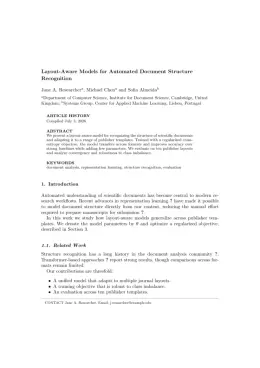
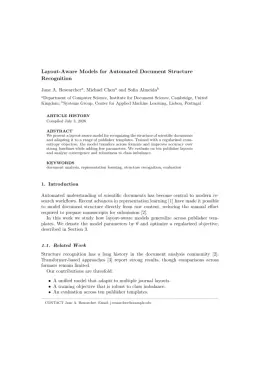
In DocuGuru you write your manuscript in a normal editor — no LaTeX setup required — and select the Lubricants template. When you export, DocuGuru compiles the paper into the official MDPI format and hands you a submission-ready PDF along with the editable LaTeX source.
What reference style does Lubricants use?
Lubricants uses Numbered (MDPI) references, shown as numbered [1], [2] markers in the text. DocuGuru formats every in-text citation and the reference list in this exact style automatically. A reference appears like this: 1. Smith, A.; Jones, B.; Lee, C. A Representative Article Title. Lubricants 2023, 12, 45–58.
Do I need to know LaTeX to submit to Lubricants?
No. DocuGuru generates the mdpi LaTeX class and compiles the PDF for you in the background, so you get a MDPI-ready Lubricants document without writing any LaTeX. If you do want it, the LaTeX source is included in the export.
Can I import an existing draft into the Lubricants template?
Yes. Paste or upload your current manuscript — Word, LaTeX, Markdown, or plain text — and DocuGuru reflows it into the Lubricants format with correct headings, figures, tables, and numbered citations.
What is Lubricants?
Lubricants - MDPI Journal. It is a multidisciplinary journal, published by MDPI.
Can I export a submission-ready Lubricants PDF?
Yes — DocuGuru produces a PDF built with the official Lubricants template (the mdpi class) that is ready to submit to MDPI, together with the matching LaTeX source files.
How much does the Lubricants template cost?
You can start writing in the Lubricants template for free. Exporting the final submission-ready Lubricants PDF and LaTeX source is part of DocuGuru's paid plans — see the app for current pricing.
Use the Lubricants template