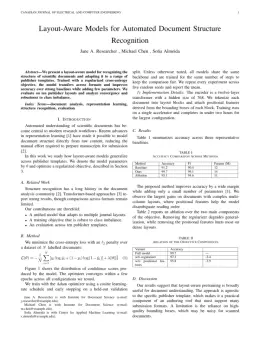
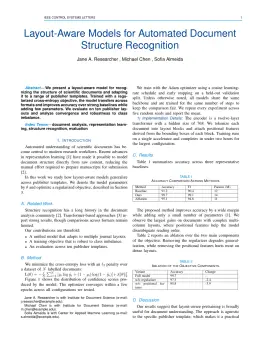
How do I write a paper in the IRE Transactions on Information Theory format?
In DocuGuru you write your manuscript in a normal editor — no LaTeX setup required — and select the IRE Transactions on Information Theory template. When you export, DocuGuru compiles the paper into the official IEEE format and hands you a submission-ready PDF along with the editable LaTeX source.
What reference style does IRE Transactions on Information Theory use?
IRE Transactions on Information Theory uses Numbered (IEEE) references, shown as numbered [1], [2] markers in the text. DocuGuru formats every in-text citation and the reference list in this exact style automatically. A reference appears like this: [1] A. Smith, B. Jones, and C. Lee, "A representative article title," IRE Transactions on Information Theory, vol. 12, no. 3, pp. 45–58, 2023.
Do I need to know LaTeX to submit to IRE Transactions on Information Theory?
No. DocuGuru generates the IEEEtran LaTeX class and compiles the PDF for you in the background, so you get a IEEE-ready IRE Transactions on Information Theory document without writing any LaTeX. If you do want it, the LaTeX source is included in the export.
Can I import an existing draft into the IRE Transactions on Information Theory template?
Yes. Paste or upload your current manuscript — Word, LaTeX, Markdown, or plain text — and DocuGuru reflows it into the IRE Transactions on Information Theory format with correct headings, figures, tables, and numbered citations.
Who publishes IRE Transactions on Information Theory?
IRE Transactions on Information Theory is a engineering and computer science journal published by IEEE. DocuGuru's IRE Transactions on Information Theory template matches IEEE's official submission format.
Can I export a submission-ready IRE Transactions on Information Theory PDF?
Yes — DocuGuru produces a PDF built with the official IRE Transactions on Information Theory template (the IEEEtran class) that is ready to submit to IEEE, together with the matching LaTeX source files.
How much does the IRE Transactions on Information Theory template cost?
You can start writing in the IRE Transactions on Information Theory template for free. Exporting the final submission-ready IRE Transactions on Information Theory PDF and LaTeX source is part of DocuGuru's paid plans — see the app for current pricing.