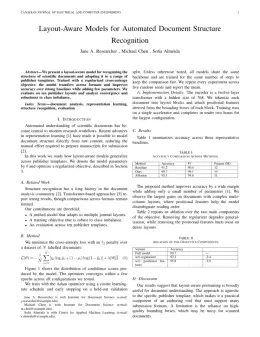
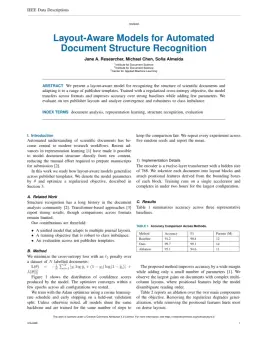
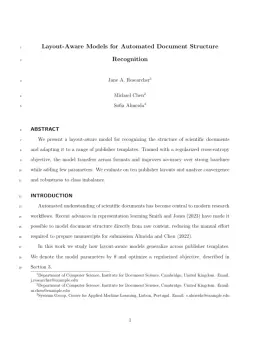
About the IEEE Transactions on Fuzzy Systems format
IEEE Transactions on Fuzzy Systems is a peer-reviewed journal published by IEEE, covering Fuzzy Logic and Control Systems, Multi-Criteria Decision Making, Stability and Control of Uncertain Systems. Over its lifetime it has published 6,277 papers, which have received 393,640 citations.
| Publisher | IEEE |
|---|
| Reference style | Numbered (IEEE) Numbered — [1], [2] in the text
[1] A. Smith, B. Jones, and C. Lee, "A representative article title," IEEE Transactions on Fuzzy Systems, vol. 12, no. 3, pp. 45–58, 2023.
Formats any DOI in IEEE Transactions on Fuzzy Systems style. No sign-up.
|
|---|
| Abbreviation (ISO-4) | TFS |
|---|
| Publishes research in | Fuzzy Logic and Control Systems Multi-Criteria Decision Making Stability and Control of Uncertain Systems Adaptive Control of Nonlinear Systems Fuzzy Systems and Optimization |
|---|
| ISSN | 1063-6706 |
|---|
| Citation impact (2-yr) | 8.87 |
|---|
| h-index | 255 |
|---|
| i10-index | 4,300 |
|---|
| Top institutions publishing here | Northeastern University |
|---|
| Journal website | cis.ieee.org |
|---|
| You get | A submission-ready PDF and the editable LaTeX source — ready to submit. |
|---|
Papers published in IEEE Transactions on Fuzzy Systems per year
Citation impact of IEEE Transactions on Fuzzy Systems by publication year
Citations each year’s papers have accumulated so far — the most recent years are still building up.
Most-cited papers in IEEE Transactions on Fuzzy Systems
Fuzzy logic = computing with words
Lotfi A. Zadeh · 1 May 1996
As its name suggests, computing with words (CW) is a methodology in which words are used in place of numbers for computing and reasoning. The point of this note is that fuzzy logic plays a pivotal role in CW and vice-versa. Thus, as an approximation, fuzzy logic may be equated to CW. There are two…
Pythagorean Membership Grades in Multicriteria Decision Making
Ronald R. Yager · 20 Aug 2013
We first look at some nonstandard fuzzy sets, intuitionistic, and interval-valued fuzzy sets. We note both these allow a degree of commitment of less then one in assigning membership. We look at the formulation of the negation for these sets and show its expression in terms of the standard complement with respect to the degree…
Intuitionistic Fuzzy Aggregation Operators
Zeshui Xu · 1 Dec 2007
An intuitionistic fuzzy set, characterized by a membership function and a non-membership function, is a generalization of fuzzy set. In this paper, based on score function and accuracy function, we introduce a method for the comparison between two intuitionistic fuzzy values and then develop some aggregation operators, such as the intuitionistic fuzzy weighted averaging operator,…
A 2-tuple fuzzy linguistic representation model for computing with words
Luis Martı́nez, Francisco Herrera · 1 Jan 2000
The fuzzy linguistic approach has been applied successfully to many problems. However, there is a limitation of this approach imposed by its information representation model and the computation methods used when fusion processes are performed on linguistic values. This limitation is the loss of information; this loss of information implies a lack of precision in…
Type-2 fuzzy sets made simple
Jerry M. Mendel, Robert John · 1 Apr 2002
Type-2 fuzzy sets let us model and minimize the effects of uncertainties in rule-base fuzzy logic systems. However, they are difficult to understand for a variety of reasons which we enunciate. In this paper, we strive to overcome the difficulties by: (1) establishing a small set of terms that let us easily communicate about type-2…