IEEE

IEEE Transactions on Audio, Speech and Language Processing Template

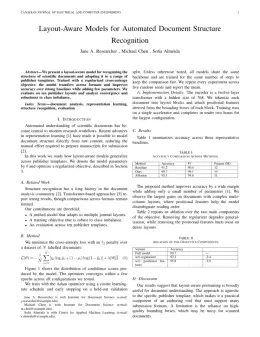
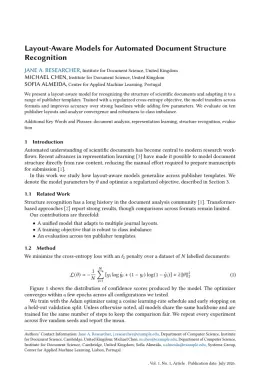
Write in a clean editor, then format for IEEE Transactions on Audio, Speech and Language Processing in one click — DocuGuru applies the official IEEE template with numbered references and exports a submission-ready PDF plus the editable LaTeX source. Free to start.

About the IEEE Transactions on Audio, Speech and Language Processing format

IEEE Transactions on Audio, Speech and Language Processing is a peer-reviewed journal published by IEEE, covering Speech and Audio Processing, Speech Recognition and Synthesis, Music and Audio Processing. Over its lifetime it has published 2,101 papers, which have received 109,564 citations.

PublisherIEEE
Reference styleNumbered (IEEE)
Numbered — [1], [2] in the text
[1] A. Smith, B. Jones, and C. Lee, "A representative article title," IEEE Transactions on Audio, Speech and Language Processing, vol. 12, no. 3, pp. 45–58, 2023.

Formats any DOI in IEEE Transactions on Audio, Speech and Language Processing style. No sign-up.

Abbreviation (ISO-4)TASLP
Publishes research inSpeech and Audio Processing Speech Recognition and Synthesis Music and Audio Processing Advanced Adaptive Filtering Techniques Blind Source Separation Techniques
ISSN1558-7916
h-index143
i10-index1,356
Top institutions publishing hereCentre National de la Recherche Scientifique
Journal websiteieeexplore.ieee.org
You getA submission-ready PDF and the editable LaTeX source — ready to submit.

Papers published in IEEE Transactions on Audio, Speech and Language Processing per year

35
2005
263
2006
277
2007
173
2008
334
2009
275
2010
239
2011
251
2012
253
2013
1
2023

Citation impact of IEEE Transactions on Audio, Speech and Language Processing by publication year

3.1K
2005
17.3K
2006
17.2K
2007
8.7K
2008
14.4K
2009
16.2K
2010
16.2K
2011
9.4K
2012
6.6K
2013
211
2023

Citations each year’s papers have accumulated so far — the most recent years are still building up.

Most-cited papers in IEEE Transactions on Audio, Speech and Language Processing

Front-End Factor Analysis for Speaker Verification

Najim Dehak, Patrick Kenny, Réda Dehak et al. · 10 Aug 2010

This paper presents an extension of our previous work which proposes a new speaker representation for speaker verification. In this modeling, a new low-dimensional speaker- and channel-dependent space is defined using a simple factor analysis. This space is named the total variability space because it models both speaker and channel variabilities. Two speaker verification systems…

3,587 citations Cite SaveGo to paper →
Context-Dependent Pre-Trained Deep Neural Networks for Large-Vocabulary Speech Recognition

George E. Dahl, Dong Yu, Li Deng et al. · 6 Apr 2011

We propose a novel context-dependent (CD) model for large-vocabulary speech recognition (LVSR) that leverages recent advances in using deep belief networks for phone recognition. We describe a pre-trained deep neural network hidden Markov model (DNN-HMM) hybrid architecture that trains the DNN to produce a distribution over senones (tied triphone states) as its output. The deep…

3,079 citations Cite SaveGo to paper →
Performance measurement in blind audio source separation

Emmanuel Vincent, Rémi Gribonval, Cédric Févotte · 21 Jun 2006

In this paper, we discuss the evaluation of blind audio source separation (BASS) algorithms. Depending on the exact application, different distortions can be allowed between an estimated source and the wanted true source. We consider four different sets of such allowed distortions, from time-invariant gains to time-varying filters. In each case, we decompose the estimated…

2,953 citations Cite SaveGo to paper →
An Algorithm for Intelligibility Prediction of Time–Frequency Weighted Noisy Speech

Cees Taal, Richard C. Hendriks, Richard Heusdens et al. · 16 Feb 2011

In the development process of noise-reduction algorithms, an objective machine-driven intelligibility measure which shows high correlation with speech intelligibility is of great interest. Besides reducing time and costs compared to real listening experiments, an objective intelligibility measure could also help provide answers on how to improve the intelligibility of noisy unprocessed speech. In this paper,…

2,285 citations Cite SaveGo to paper →
Evaluation of Objective Quality Measures for Speech Enhancement

Yi Hu, Philipos C. Loizou · 20 Dec 2007

In this paper, we evaluate the performance of several objective measures in terms of predicting the quality of noisy speech enhanced by noise suppression algorithms. The objective measures considered a wide range of distortions introduced by four types of real-world noise at two signal-to-noise ratio levels by four classes of speech enhancement algorithms: spectral subtractive,…

1,844 citations Cite SaveGo to paper →

IEEE Transactions on Audio, Speech and Language Processing template — frequently asked questions

How do I write a paper in the IEEE Transactions on Audio, Speech and Language Processing format?
In DocuGuru you write your manuscript in a normal editor — no LaTeX setup required — and select the IEEE Transactions on Audio, Speech and Language Processing template. When you export, DocuGuru compiles the paper into the official IEEE format and hands you a submission-ready PDF along with the editable LaTeX source.
What reference style does IEEE Transactions on Audio, Speech and Language Processing use?
IEEE Transactions on Audio, Speech and Language Processing uses Numbered (IEEE) references, shown as numbered [1], [2] markers in the text. DocuGuru formats every in-text citation and the reference list in this exact style automatically. A reference appears like this: [1] A. Smith, B. Jones, and C. Lee, "A representative article title," IEEE Transactions on Audio, Speech and Language Processing, vol. 12, no. 3, pp. 45–58, 2023.
Do I need to know LaTeX to submit to IEEE Transactions on Audio, Speech and Language Processing?
No. DocuGuru generates the IEEEtran LaTeX class and compiles the PDF for you in the background, so you get a IEEE-ready IEEE Transactions on Audio, Speech and Language Processing document without writing any LaTeX. If you do want it, the LaTeX source is included in the export.
Can I import an existing draft into the IEEE Transactions on Audio, Speech and Language Processing template?
Yes. Paste or upload your current manuscript — Word, LaTeX, Markdown, or plain text — and DocuGuru reflows it into the IEEE Transactions on Audio, Speech and Language Processing format with correct headings, figures, tables, and numbered citations.
Who publishes IEEE Transactions on Audio, Speech and Language Processing?
IEEE Transactions on Audio, Speech and Language Processing is a engineering and computer science journal published by IEEE. DocuGuru's IEEE Transactions on Audio, Speech and Language Processing template matches IEEE's official submission format.
Can I export a submission-ready IEEE Transactions on Audio, Speech and Language Processing PDF?
Yes — DocuGuru produces a PDF built with the official IEEE Transactions on Audio, Speech and Language Processing template (the IEEEtran class) that is ready to submit to IEEE, together with the matching LaTeX source files.
How much does the IEEE Transactions on Audio, Speech and Language Processing template cost?
You can start writing in the IEEE Transactions on Audio, Speech and Language Processing template for free. Exporting the final submission-ready IEEE Transactions on Audio, Speech and Language Processing PDF and LaTeX source is part of DocuGuru's paid plans — see the app for current pricing.
Use the IEEE Transactions on Audio, Speech and Language Processing template