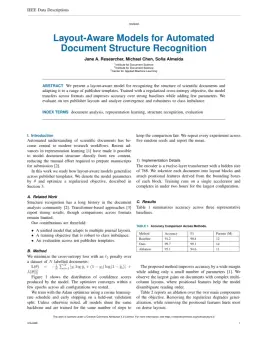
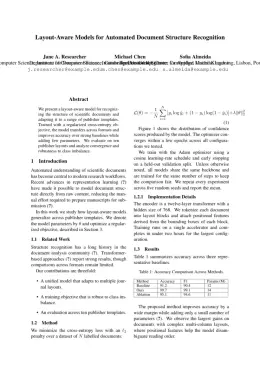
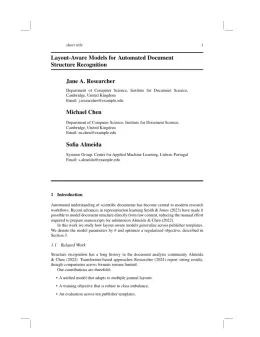
About the IEEE Journal of Solid-State Circuits format
IEEE Journal of Solid-State Circuits is a peer-reviewed journal published by IEEE, covering Analog and Mixed-Signal Circuit Design, Radio Frequency Integrated Circuit Design, Advancements in Semiconductor Devices and Circuit Design. Over its lifetime it has published 16,577 papers, which have received 713,175 citations.
| Publisher | IEEE |
|---|
| Reference style | Numbered (IEEE) Numbered — [1], [2] in the text
[1] A. Smith, B. Jones, and C. Lee, "A representative article title," IEEE Journal of Solid-State Circuits, vol. 12, no. 3, pp. 45–58, 2023.
Formats any DOI in IEEE Journal of Solid-State Circuits style. No sign-up.
|
|---|
| Abbreviation (ISO-4) | JSSC |
|---|
| Publishes research in | Analog and Mixed-Signal Circuit Design Radio Frequency Integrated Circuit Design Advancements in Semiconductor Devices and Circuit Design Advancements in PLL and VCO Technologies Low-power high-performance VLSI design |
|---|
| ISSN | 0018-9200 |
|---|
| Citation impact (2-yr) | 3.11 |
|---|
| h-index | 302 |
|---|
| i10-index | 9,641 |
|---|
| Top institutions publishing here | Intel (United States) |
|---|
| You get | A submission-ready PDF and the editable LaTeX source — ready to submit. |
|---|
Papers published in IEEE Journal of Solid-State Circuits per year
Citation impact of IEEE Journal of Solid-State Circuits by publication year
Citations each year’s papers have accumulated so far — the most recent years are still building up.
Most-cited papers in IEEE Journal of Solid-State Circuits
Design of ion-implanted MOSFET's with very small physical dimensions
R.H. Dennard, F.H. Gaensslen, Hwa-Nien Yu et al. · 1 Oct 1974
This paper considers the design, fabrication, and characterization of very small Mosfet switching devices suitable for digital integrated circuits, using dimensions of the order of 1 /spl mu/. Scaling relationships are presented which show how a conventional MOSFET can be reduced in size. An improved small device structure is presented that uses ion implantation, to…
Matching properties of MOS transistors
Marcel Pelgrom, Aad C.J. Duinmaijer, A.P.G. Welbers · 1 Oct 1989
The matching properties of the threshold voltage, substrate factor, and current factor of MOS transistors have been analyzed and measured. Improvements to the existing theory are given, as well as extensions for long-distance matching and rotation of devices. Matching parameters of several processes are compared. The matching results have been verified by measurements and calculations…
Eyeriss: An Energy-Efficient Reconfigurable Accelerator for Deep Convolutional Neural Networks
Yu-Hsin Chen, Tushar Krishna, Joel Emer et al. · 8 Nov 2016
Eyeriss is an accelerator for state-of-the-art deep convolutional neural networks (CNNs). It optimizes for the energy efficiency of the entire system, including the accelerator chip and off-chip DRAM, for various CNN shapes by reconfiguring the architecture. CNNs are widely used in modern AI systems but also bring challenges on throughput and energy efficiency to the…
A 128$\times$128 120 dB 15 $\mu$s Latency Asynchronous Temporal Contrast Vision Sensor
P. Lichtsteiner, C. Posch, Tobi Delbrück · 1 Jan 2008
This paper describes a 128 times 128 pixel CMOS vision sensor. Each pixel independently and in continuous time quantizes local relative intensity changes to generate spike events. These events appear at the output of the sensor as an asynchronous stream of digital pixel addresses. These address-events signify scene reflectance change and have sub-millisecond timing precision.…
A general theory of phase noise in electrical oscillators
Ali Hajimiri, T.H. Lee · 1 Jan 1998
A general model is introduced which is capable of making accurate, quantitative predictions about the phase noise of different types of electrical oscillators by acknowledging the true periodically time-varying nature of all oscillators. This new approach also elucidates several previously unknown design criteria for reducing close-in phase noise by identifying the mechanisms by which intrinsic…