IEEE

IEEE Microwave and Wireless Technology Letters Template

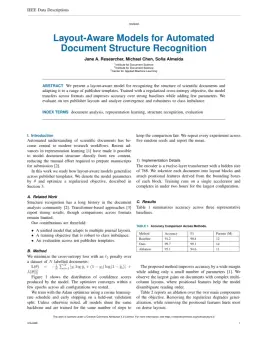
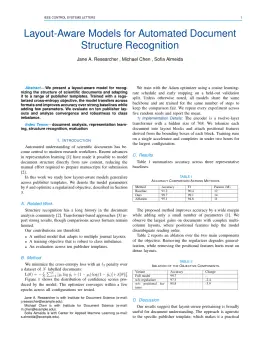
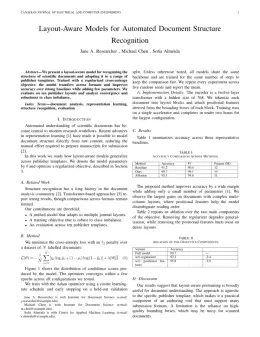
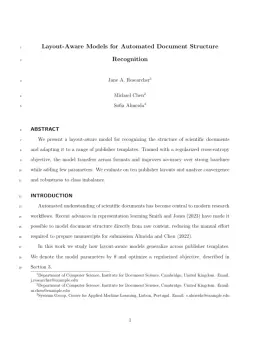
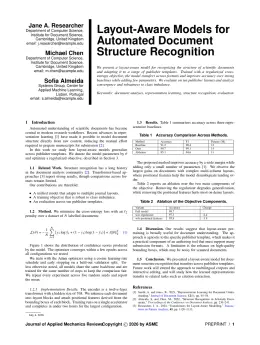
Write in a clean editor, then format for IEEE Microwave and Wireless Technology Letters in one click — DocuGuru applies the official IEEE template with numbered references and exports a submission-ready PDF plus the editable LaTeX source. Free to start.

About the IEEE Microwave and Wireless Technology Letters format

IEEE Microwave and Wireless Technology Letters is a peer-reviewed journal published by IEEE, covering Radio Frequency Integrated Circuit Design, Microwave Engineering and Waveguides, Advanced Power Amplifier Design. Over its lifetime it has published 1,993 papers, which have received 7,609 citations.

PublisherIEEE
Reference styleNumbered (IEEE)
Numbered — [1], [2] in the text
[1] A. Smith, B. Jones, and C. Lee, "A representative article title," IEEE Microwave and Wireless Technology Letters, vol. 12, no. 3, pp. 45–58, 2023.

Formats any DOI in IEEE Microwave and Wireless Technology Letters style. No sign-up.

Publishes research inRadio Frequency Integrated Circuit Design Microwave Engineering and Waveguides Advanced Power Amplifier Design Photonic and Optical Devices GaN-based semiconductor devices and materials
ISSN2771-957X
Citation impact (2-yr)1.85
h-index26
i10-index265
Top institutions publishing hereUniversity of Electronic Science and Technology of China
You getA submission-ready PDF and the editable LaTeX source — ready to submit.

Papers published in IEEE Microwave and Wireless Technology Letters per year

87
2022
443
2023
416
2024
670
2025

Citation impact of IEEE Microwave and Wireless Technology Letters by publication year

1.1K
2022
3.7K
2023
1.9K
2024
624
2025

Citations each year’s papers have accumulated so far — the most recent years are still building up.

Most-cited papers in IEEE Microwave and Wireless Technology Letters

<i>W</i>-Band Graded-Channel GaN HEMTs With Record 45% Power-Added-Efficiency at 94 GHz

Jeong‐Sun Moon, Bob Grabar, Joel Wong et al. · 3 Oct 2022

We report the <inline-formula xmlns:mml="http://www.w3.org/1998/Math/MathML" xmlns:xlink="http://www.w3.org/1999/xlink"> <tex-math notation="LaTeX">$W$ </tex-math></inline-formula> -band large-signal power and efficiency performance of Ga-polar graded-channel (GC) AlGaN/GaN high-electron-mobility transistors (HEMTs) with a 50-nm gate-length mini-field-plate (FP) T-gate. The pre-matched GC GaN HEMT devices with on-chip pre-matching networks show a peak power-added efficiency (PAE) of 45% at 94 GHz at 2.1 W/mm associated…

A mm-Wave Trilayer AlN/ScAlN/AlN Higher Order Mode FBAR

Suhyun Nam, Wenhao Peng, Ping Wang et al. · 12 May 2023

Modern wireless communication systems are increasingly complex with greater functionality and impose new challenges on the radio frequency (RF) front-end design. One of the major challenges involves filtering beyond the sub-6-GHz regime with increased fractional bandwidth (FBW). To the best of our knowledge, this work presents the first demonstration of a film bulk acoustic wave…

A Dual-Band Rectifier Using Half-Wave Transmission Line Matching for 5G and Wi-Fi Bands RFEH/MPT Applications

Md. Ahsan Halimi, Taimoor Khan, Shiban K. Koul et al. · 15 Aug 2022

A dual-band rectifier is presented for RF energy harvesting (RFEH) and microwave power transfer (MPT) applications. Starting with a single-band rectifier, the second band is added by utilizing a half-wavelength transmission line (HWTL) in the matching network (MN). A series diode topology using HSMS-2860 Schottky diode is used for power conversion. The rectifier simultaneously harvests…

Design of Dual-Band Inverse Class-F Rectifier for Wireless Power Transfer and Energy Harvesting

Dang‐An Nguyen, Gia Thang Bui, Hyungseok Nam et al. · 7 Nov 2022

This letter presents a novel methodology for designing high-efficiency dual-band (DB) inverse class F (class <inline-formula xmlns:mml="http://www.w3.org/1998/Math/MathML" xmlns:xlink="http://www.w3.org/1999/xlink"> <tex-math notation="LaTeX">$\text {F}^{-1}$ </tex-math></inline-formula> ) rectifier for wireless power transfer (WPT) and energy harvesting (EH). Specifically, a proposed DB class <inline-formula xmlns:mml="http://www.w3.org/1998/Math/MathML" xmlns:xlink="http://www.w3.org/1999/xlink"> <tex-math notation="LaTeX">$\text {F}^{-1}$ </tex-math></inline-formula> harmonic termination network is employed based on transmission lines (TLINs)…

5.9 GHz Longitudinal Leaky SAW Filter With FBW of 9.2% and IL of 1.8 dB Using LN/Quartz Structure

Rongxuan Su, Sulei Fu, Huiping Xu et al. · 11 Aug 2023

Improving frequency and bandwidth is the essential path for the surface acoustic wave (SAW) filter to keep its leadership in the 5G or sub-6G system. In this work, we present high frequency longitudinal leaky SAW (LLSAW) devices based on 128° <inline-formula xmlns:mml="http://www.w3.org/1998/Math/MathML" xmlns:xlink="http://www.w3.org/1999/xlink"> <tex-math notation="LaTeX">${Y}$ </tex-math></inline-formula> -90° <inline-formula xmlns:mml="http://www.w3.org/1998/Math/MathML" xmlns:xlink="http://www.w3.org/1999/xlink"> <tex-math notation="LaTeX">${X}$ </tex-math></inline-formula> LiNbO3/160° <inline-formula…

IEEE Microwave and Wireless Technology Letters template — frequently asked questions

How do I write a paper in the IEEE Microwave and Wireless Technology Letters format?
In DocuGuru you write your manuscript in a normal editor — no LaTeX setup required — and select the IEEE Microwave and Wireless Technology Letters template. When you export, DocuGuru compiles the paper into the official IEEE format and hands you a submission-ready PDF along with the editable LaTeX source.
What reference style does IEEE Microwave and Wireless Technology Letters use?
IEEE Microwave and Wireless Technology Letters uses Numbered (IEEE) references, shown as numbered [1], [2] markers in the text. DocuGuru formats every in-text citation and the reference list in this exact style automatically. A reference appears like this: [1] A. Smith, B. Jones, and C. Lee, "A representative article title," IEEE Microwave and Wireless Technology Letters, vol. 12, no. 3, pp. 45–58, 2023.
Do I need to know LaTeX to submit to IEEE Microwave and Wireless Technology Letters?
No. DocuGuru generates the IEEEtran LaTeX class and compiles the PDF for you in the background, so you get a IEEE-ready IEEE Microwave and Wireless Technology Letters document without writing any LaTeX. If you do want it, the LaTeX source is included in the export.
Can I import an existing draft into the IEEE Microwave and Wireless Technology Letters template?
Yes. Paste or upload your current manuscript — Word, LaTeX, Markdown, or plain text — and DocuGuru reflows it into the IEEE Microwave and Wireless Technology Letters format with correct headings, figures, tables, and numbered citations.
What is IEEE Microwave and Wireless Technology Letters?
IEEE Microwave and Wireless Technology Letters, published by IEEE. It is a engineering and computer science journal, published by IEEE.
Can I export a submission-ready IEEE Microwave and Wireless Technology Letters PDF?
Yes — DocuGuru produces a PDF built with the official IEEE Microwave and Wireless Technology Letters template (the IEEEtran class) that is ready to submit to IEEE, together with the matching LaTeX source files.
How much does the IEEE Microwave and Wireless Technology Letters template cost?
You can start writing in the IEEE Microwave and Wireless Technology Letters template for free. Exporting the final submission-ready IEEE Microwave and Wireless Technology Letters PDF and LaTeX source is part of DocuGuru's paid plans — see the app for current pricing.
Use the IEEE Microwave and Wireless Technology Letters template