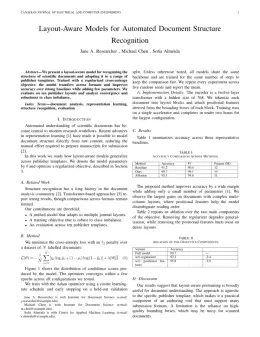
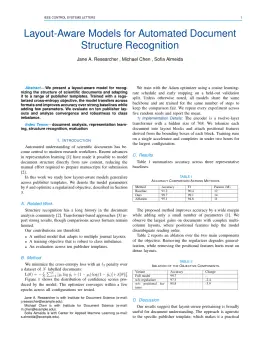
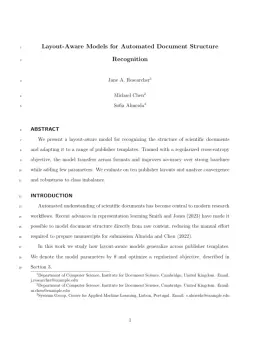
IEEE

IEEE Journal of Photovoltaics Template

Write in a clean editor, then format for IEEE Journal of Photovoltaics in one click — DocuGuru applies the official IEEE template with numbered references and exports a submission-ready PDF plus the editable LaTeX source. Free to start.

About the IEEE Journal of Photovoltaics format

IEEE Journal of Photovoltaics is a peer-reviewed journal published by IEEE, covering Silicon and Solar Cell Technologies, solar cell performance optimization, Photovoltaic System Optimization Techniques. Over its lifetime it has published 3,501 papers, which have received 85,611 citations.

PublisherIEEE
Reference styleNumbered (IEEE)
Numbered — [1], [2] in the text
[1] A. Smith, B. Jones, and C. Lee, "A representative article title," IEEE Journal of Photovoltaics, vol. 12, no. 3, pp. 45–58, 2023.

Formats any DOI in IEEE Journal of Photovoltaics style. No sign-up.

Abbreviation (ISO-4)JPV
Publishes research inSilicon and Solar Cell Technologies solar cell performance optimization Photovoltaic System Optimization Techniques Thin-Film Transistor Technologies Chalcogenide Semiconductor Thin Films
ISSN2156-3381
Citation impact (2-yr)2.59
h-index115
i10-index1,862
Top institutions publishing hereNational Laboratory of the Rockies
Journal websiteieeexplore.ieee.org
You getA submission-ready PDF and the editable LaTeX source — ready to submit.

Papers published in IEEE Journal of Photovoltaics per year

305
2014
278
2015
296
2016
326
2017
291
2018
303
2019
253
2020
238
2021
200
2022
187
2023
145
2024
146
2025

Citation impact of IEEE Journal of Photovoltaics by publication year

11.6K
2014
9.2K
2015
7K
2016
7.6K
2017
7.4K
2018
8.3K
2019
4.7K
2020
3.5K
2021
2K
2022
1.6K
2023
694
2024
183
2025

Citations each year’s papers have accumulated so far — the most recent years are still building up.

Most-cited papers in IEEE Journal of Photovoltaics

Cd-Free Cu(In,Ga)(Se,S)<sub>2</sub> Thin-Film Solar Cell With Record Efficiency of 23.35%

Motoshi Nakamura, Koji Yamaguchi, Yoshinori Kimoto et al. · 5 Sep 2019

In this article, the excellent properties of state-of-the-art Cd-free Cu(In,Ga)(Se,S) <sub xmlns:mml="http://www.w3.org/1998/Math/MathML" xmlns:xlink="http://www.w3.org/1999/xlink">2</sub> (CIGSSe) solar cells with Zn(O,S,OH) <sub xmlns:mml="http://www.w3.org/1998/Math/MathML" xmlns:xlink="http://www.w3.org/1999/xlink">x</sub> /Zn <sub xmlns:mml="http://www.w3.org/1998/Math/MathML" xmlns:xlink="http://www.w3.org/1999/xlink">0.8</sub> Mg <sub xmlns:mml="http://www.w3.org/1998/Math/MathML" xmlns:xlink="http://www.w3.org/1999/xlink">0.2</sub> O double buffer layers, deposited by a combination of chemical bath deposition and atomic layer deposition techniques, are presented. By the replacement of conventional CdS buffer…

1,293 citations Cite SaveGo to paper →
Achievement of More Than 25% Conversion Efficiency With Crystalline Silicon Heterojunction Solar Cell

K. Masuko, Masato Shigematsu, Taiki Hashiguchi et al. · 10 Sep 2014

The crystalline silicon heterojunction structure adopted in photovoltaic modules commercialized as Panasonic's HIT has significantly reduced recombination loss, resulting in greater conversion efficiency. The structure of an interdigitated back contact was adopted with our crystalline silicon heterojunction solar cells to reduce optical loss from a front grid electrode, a transparent conducting oxide (TCO) layer, and…

1,219 citations Cite SaveGo to paper →
24.7% Record Efficiency HIT Solar Cell on Thin Silicon Wafer

Mikio Taguchi, Ayumu Yano, Satoshi Tohoda et al. · 4 Oct 2013

A new record conversion efficiency of 24.7% was attained at the research level by using a heterojunction with intrinsic thin-layer structure of practical size (101.8 cm <sup xmlns:mml="http://www.w3.org/1998/Math/MathML" xmlns:xlink="http://www.w3.org/1999/xlink">2</sup> , total area) at a 98-μm thickness. This is a world height record for any crystalline silicon-based solar cell of practical size (100 cm <sup xmlns:mml="http://www.w3.org/1998/Math/MathML"…

1,108 citations Cite SaveGo to paper →
Reassessment of the Limiting Efficiency for Crystalline Silicon Solar Cells

Armin Richter, Martin Hermle, Stefan W. Glunz · 10 Jul 2013

Recently, several parameters relevant for modeling crystalline silicon solar cells were improved or revised, e.g., the international standard solar spectrum or properties of silicon such as the intrinsic recombination rate and the intrinsic carrier concentration. In this study, we analyzed the influence of these improved state-of-the-art parameters on the limiting efficiency for crystalline silicon solar…

1,056 citations Cite SaveGo to paper →
Strong Internal and External Luminescence as Solar Cells Approach the Shockley–Queisser Limit

Owen D. Miller, Eli Yablonovitch, Sarah Kurtz · 6 Jun 2012

Absorbed sunlight in a solar cell produces electrons and holes. However, at the open-circuit condition, the carriers have no place to go. They build up in density, and ideally, they emit external luminescence that exactly balances the incoming sunlight. Any additional nonradiative recombination impairs the carrier density buildup, limiting the open-circuit voltage. At open circuit,…

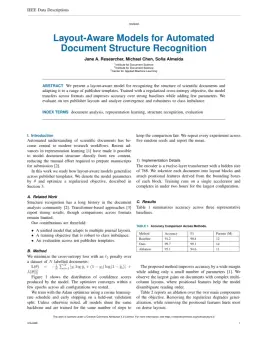
IEEE Journal of Photovoltaics template — frequently asked questions

How do I write a paper in the IEEE Journal of Photovoltaics format?
In DocuGuru you write your manuscript in a normal editor — no LaTeX setup required — and select the IEEE Journal of Photovoltaics template. When you export, DocuGuru compiles the paper into the official IEEE format and hands you a submission-ready PDF along with the editable LaTeX source.
What reference style does IEEE Journal of Photovoltaics use?
IEEE Journal of Photovoltaics uses Numbered (IEEE) references, shown as numbered [1], [2] markers in the text. DocuGuru formats every in-text citation and the reference list in this exact style automatically. A reference appears like this: [1] A. Smith, B. Jones, and C. Lee, "A representative article title," IEEE Journal of Photovoltaics, vol. 12, no. 3, pp. 45–58, 2023.
Do I need to know LaTeX to submit to IEEE Journal of Photovoltaics?
No. DocuGuru generates the IEEEtran LaTeX class and compiles the PDF for you in the background, so you get a IEEE-ready IEEE Journal of Photovoltaics document without writing any LaTeX. If you do want it, the LaTeX source is included in the export.
Can I import an existing draft into the IEEE Journal of Photovoltaics template?
Yes. Paste or upload your current manuscript — Word, LaTeX, Markdown, or plain text — and DocuGuru reflows it into the IEEE Journal of Photovoltaics format with correct headings, figures, tables, and numbered citations.
Who publishes IEEE Journal of Photovoltaics?
IEEE Journal of Photovoltaics is a engineering and computer science journal published by IEEE. DocuGuru's IEEE Journal of Photovoltaics template matches IEEE's official submission format.
Can I export a submission-ready IEEE Journal of Photovoltaics PDF?
Yes — DocuGuru produces a PDF built with the official IEEE Journal of Photovoltaics template (the IEEEtran class) that is ready to submit to IEEE, together with the matching LaTeX source files.
How much does the IEEE Journal of Photovoltaics template cost?
You can start writing in the IEEE Journal of Photovoltaics template for free. Exporting the final submission-ready IEEE Journal of Photovoltaics PDF and LaTeX source is part of DocuGuru's paid plans — see the app for current pricing.
Use the IEEE Journal of Photovoltaics template