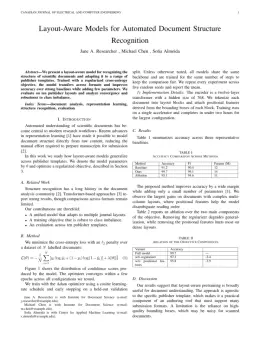
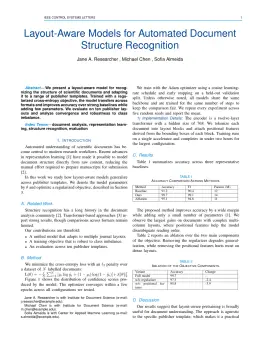
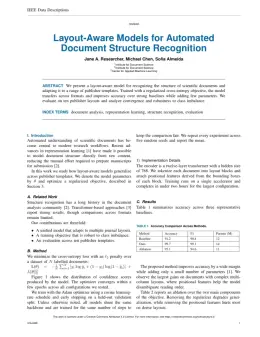
IEEE

IEEE/ACM Transactions on Computational Biology and Bioinformatics Template

Write in a clean editor, then format for IEEE/ACM Transactions on Computational Biology and Bioinformatics in one click — DocuGuru applies the official IEEE template with numbered references and exports a submission-ready PDF plus the editable LaTeX source. Free to start.

About the IEEE/ACM Transactions on Computational Biology and Bioinformatics format

IEEE/ACM Transactions on Computational Biology and Bioinformatics is a peer-reviewed journal published by IEEE, covering Bioinformatics and Genomic Networks, Gene expression and cancer classification, Machine Learning in Bioinformatics.

PublisherIEEE
Reference styleNumbered (IEEE)
Numbered — [1], [2] in the text
[1] A. Smith, B. Jones, and C. Lee, "A representative article title," IEEE/ACM Transactions on Computational Biology and Bioinformatics, vol. 12, no. 3, pp. 45–58, 2023.

Formats any DOI in IEEE/ACM Transactions on Computational Biology and Bioinformatics style. No sign-up.

Publishes research inBioinformatics and Genomic Networks Gene expression and cancer classification Machine Learning in Bioinformatics Genomics and Phylogenetic Studies Computational Drug Discovery Methods
ISSN1545-5963
Citation impact (2-yr)5.01
h-index113
i10-index1,888
Total citations85,981
Top institutions publishing hereCentral South University
Journal websitewww.computer.org
You getA submission-ready PDF and the editable LaTeX source — ready to submit.

Papers published in IEEE/ACM Transactions on Computational Biology and Bioinformatics per year

175
2013
223
2014
221
2015
199
2016
186
2017
259
2018
247
2019
250
2020
281
2021
244
2022
177
2023
154
2024

Citation impact of IEEE/ACM Transactions on Computational Biology and Bioinformatics by publication year

3.7K
2013
5.6K
2014
5.8K
2015
5K
2016
4.2K
2017
6.5K
2018
6.2K
2019
5.9K
2020
5.8K
2021
4.5K
2022
2.6K
2023
745
2024

Citations each year’s papers have accumulated so far — the most recent years are still building up.

Most-cited papers in IEEE/ACM Transactions on Computational Biology and Bioinformatics

Biclustering algorithms for biological data analysis: a survey

Sara C. Madeira, Arlindo L. Oliveira · 1 Jan 2004

A large number of clustering approaches have been proposed for the analysis of gene expression data obtained from microarray experiments. However, the results from the application of standard clustering methods to genes are limited. This limitation is imposed by the existence of a number of experimental conditions where the activity of genes is uncorrelated. A…

2,069 citations Cite SaveGo to paper →
Deep Learning Enables Accurate Diagnosis of Novel Coronavirus (COVID-19) With CT Images

Ying Song, Shuangjia Zheng, Liang Li et al. · 11 Mar 2021

A novel coronavirus (COVID-19) recently emerged as an acute respiratory syndrome, and has caused a pneumonia outbreak world-widely. As the COVID-19 continues to spread rapidly across the world, computed tomography (CT) has become essentially important for fast diagnoses. Thus, it is urgent to develop an accurate computer-aided method to assist clinicians to identify COVID-19-infected patients…

XGBoost Model for Chronic Kidney Disease Diagnosis

Adeola Ogunleye, Qing‐Guo Wang · 17 Apr 2019

Chronic Kidney Disease (CKD) is a menace that is affecting 10 percent of the world population and 15 percent of the South African population. The early and cheap diagnosis of this disease with accuracy and reliability will save 20,000 lives in South Africa per year. Scientists are developing smart solutions with Artificial Intelligence (AI). In…

Supervised, Unsupervised, and Semi-Supervised Feature Selection: A Review on Gene Selection

Jun Chin Ang, Andri Mirzal, Habibollah Haron et al. · 14 Sep 2015

Recently, feature selection and dimensionality reduction have become fundamental tools for many data mining tasks, especially for processing high-dimensional data such as gene expression microarray data. Gene expression microarray data comprises up to hundreds of thousands of features with relatively small sample size. Because learning algorithms usually do not work well with this kind of…

A Survey on Filter Techniques for Feature Selection in Gene Expression Microarray Analysis

Cosmin Lazar, Jonatan Taminau, Stijn Meganck et al. · 14 Feb 2012

A plenitude of feature selection (FS) methods is available in the literature, most of them rising as a need to analyze data of very high dimension, usually hundreds or thousands of variables. Such data sets are now available in various application areas like combinatorial chemistry, text mining, multivariate imaging, or bioinformatics. As a general accepted…

IEEE/ACM Transactions on Computational Biology and Bioinformatics template — frequently asked questions

How do I write a paper in the IEEE/ACM Transactions on Computational Biology and Bioinformatics format?
In DocuGuru you write your manuscript in a normal editor — no LaTeX setup required — and select the IEEE/ACM Transactions on Computational Biology and Bioinformatics template. When you export, DocuGuru compiles the paper into the official IEEE format and hands you a submission-ready PDF along with the editable LaTeX source.
What reference style does IEEE/ACM Transactions on Computational Biology and Bioinformatics use?
IEEE/ACM Transactions on Computational Biology and Bioinformatics uses Numbered (IEEE) references, shown as numbered [1], [2] markers in the text. DocuGuru formats every in-text citation and the reference list in this exact style automatically. A reference appears like this: [1] A. Smith, B. Jones, and C. Lee, "A representative article title," IEEE/ACM Transactions on Computational Biology and Bioinformatics, vol. 12, no. 3, pp. 45–58, 2023.
Do I need to know LaTeX to submit to IEEE/ACM Transactions on Computational Biology and Bioinformatics?
No. DocuGuru generates the IEEEtran LaTeX class and compiles the PDF for you in the background, so you get a IEEE-ready IEEE/ACM Transactions on Computational Biology and Bioinformatics document without writing any LaTeX. If you do want it, the LaTeX source is included in the export.
Can I import an existing draft into the IEEE/ACM Transactions on Computational Biology and Bioinformatics template?
Yes. Paste or upload your current manuscript — Word, LaTeX, Markdown, or plain text — and DocuGuru reflows it into the IEEE/ACM Transactions on Computational Biology and Bioinformatics format with correct headings, figures, tables, and numbered citations.
Who publishes IEEE/ACM Transactions on Computational Biology and Bioinformatics?
IEEE/ACM Transactions on Computational Biology and Bioinformatics is a engineering and computer science journal published by IEEE. DocuGuru's IEEE/ACM Transactions on Computational Biology and Bioinformatics template matches IEEE's official submission format.
Can I export a submission-ready IEEE/ACM Transactions on Computational Biology and Bioinformatics PDF?
Yes — DocuGuru produces a PDF built with the official IEEE/ACM Transactions on Computational Biology and Bioinformatics template (the IEEEtran class) that is ready to submit to IEEE, together with the matching LaTeX source files.
How much does the IEEE/ACM Transactions on Computational Biology and Bioinformatics template cost?
You can start writing in the IEEE/ACM Transactions on Computational Biology and Bioinformatics template for free. Exporting the final submission-ready IEEE/ACM Transactions on Computational Biology and Bioinformatics PDF and LaTeX source is part of DocuGuru's paid plans — see the app for current pricing.

Use the IEEE/ACM Transactions on Computational Biology and Bioinformatics template