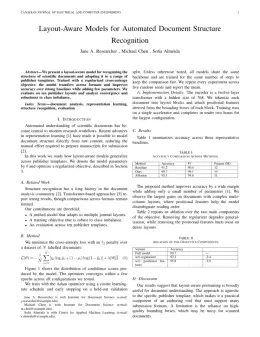
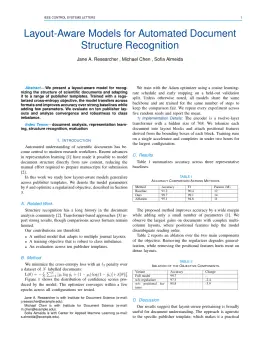
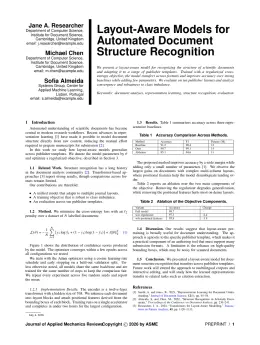
About the IEEE Access format
IEEE Access is a peer-reviewed journal published by IEEE, covering Advanced MIMO Systems Optimization, Microgrid Control and Optimization, IoT and Edge/Fog Computing. Over its lifetime it has published 110,277 papers, which have received 2,511,433 citations.
| Publisher | IEEE |
|---|
| Reference style | Numbered (IEEE) Numbered — [1], [2] in the text
[1] A. Smith, B. Jones, and C. Lee, "A representative article title," IEEE Access, vol. 12, no. 3, pp. 45–58, 2023.
Formats any DOI in IEEE Access style. No sign-up.
|
|---|
| Publishes research in | Advanced MIMO Systems Optimization Microgrid Control and Optimization IoT and Edge/Fog Computing Advanced Neural Network Applications Network Security and Intrusion Detection |
|---|
| ISSN | 2169-3536 |
|---|
| Citation impact (2-yr) | 5.61 |
|---|
| h-index | 369 |
|---|
| i10-index | 53,962 |
|---|
| Article processing charge | $1,850 |
|---|
| Open access | Yes — indexed in DOAJ |
|---|
| Top institutions publishing here | Chinese Academy of Sciences |
|---|
| Journal website | ieeexplore.ieee.org |
|---|
| You get | A submission-ready PDF and the editable LaTeX source — ready to submit. |
|---|
Papers published in IEEE Access per year
Citation impact of IEEE Access by publication year
Citations each year’s papers have accumulated so far — the most recent years are still building up.
Most-cited papers in IEEE Access
Millimeter Wave Mobile Communications for 5G Cellular: It Will Work!
Theodore S. Rappaport, Shu Sun, Rimma Mayzus et al. · 1 Jan 2013
The global bandwidth shortage facing wireless carriers has motivated the exploration of the underutilized millimeter wave (mm-wave) frequency spectrum for future broadband cellular communication networks. There is, however, little knowledge about cellular mm-wave propagation in densely populated indoor and outdoor environments. Obtaining this information is vital for the design and operation of future fifth generation…
Peeking Inside the Black-Box: A Survey on Explainable Artificial Intelligence (XAI)
Amina Adadi, Mohammed Berrada · 1 Jan 2018
At the dawn of the fourth industrial revolution, we are witnessing a fast and widespread adoption of artificial intelligence (AI) in our daily life, which contributes to accelerating the shift towards a more algorithmic society. However, even with such unprecedented advancements, a key impediment to the use of AI-based systems is that they often lack…
Blockchains and Smart Contracts for the Internet of Things
Konstantinos Christidis, Michael Devetsikiotis · 1 Jan 2016
Motivated by the recent explosion of interest around blockchains, we examine whether they make a good fit for the Internet of Things (IoT) sector. Blockchains allow us to have a distributed peer-to-peer network where non-trusting members can interact with each other without a trusted intermediary, in a verifiable manner. We review how this mechanism works…
Artificial Intelligence in Education: A Review
Lijia Chen, Pingping Chen, Zhijian Lin · 1 Jan 2020
The purpose of this study was to assess the impact of Artificial Intelligence (AI) on education. Premised on a narrative and framework for assessing AI identified from a preliminary analysis, the scope of the study was limited to the application and effects of AI in administration, instruction, and learning. A qualitative research approach, leveraging the…
Wireless Communications Through Reconfigurable Intelligent Surfaces
Ertuğrul Başar, Marco Di Renzo, Julien de Rosny et al. · 1 Jan 2019
The future of mobile communications looks exciting with the potential new use cases and challenging requirements of future 6th generation (6G) and beyond wireless networks. Since the beginning of the modern era of wireless communications, the propagation medium has been perceived as a randomly behaving entity between the transmitter and the receiver, which degrades the…