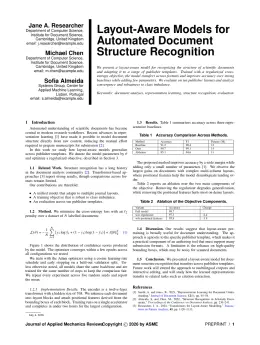
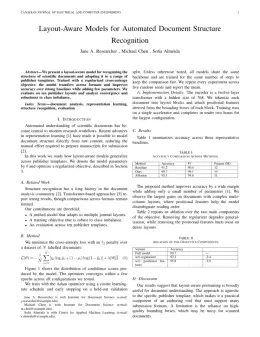
ASME

Journal of Fluids Engineering Template

Write in a clean editor, then format for Journal of Fluids Engineering in one click — DocuGuru applies the official ASME template with numbered references and exports a submission-ready PDF plus the editable LaTeX source. Free to start.

About the Journal of Fluids Engineering format

Journal of Fluids Engineering is a peer-reviewed journal published by ASME, covering Fluid Dynamics and Turbulent Flows, Fluid Dynamics and Vibration Analysis, Cavitation Phenomena in Pumps. Over its lifetime it has published 7,914 papers, which have received 191,365 citations.

PublisherASME
Reference styleNumbered (ASME)
Numbered — [1], [2] in the text
[1] Smith, A., Jones, B., and Lee, C., 2023, "A Representative Article Title," Journal of Fluids Engineering, 12(3), pp. 45–58.

Formats any DOI in Journal of Fluids Engineering style. No sign-up.

Publishes research inFluid Dynamics and Turbulent Flows Fluid Dynamics and Vibration Analysis Cavitation Phenomena in Pumps Hydraulic and Pneumatic Systems Wind and Air Flow Studies
ISSN0098-2202
Citation impact (2-yr)1.72
h-index156
i10-index3,703
Top institutions publishing herePennsylvania State University
You getA submission-ready PDF and the editable LaTeX source — ready to submit.

Papers published in Journal of Fluids Engineering per year

177
2014
171
2015
149
2016
191
2017
202
2018
189
2019
187
2020
215
2021
163
2022
127
2023
139
2024
131
2025

Citation impact of Journal of Fluids Engineering by publication year

3.7K
2014
4K
2015
2.7K
2016
3.1K
2017
3.1K
2018
2.7K
2019
2K
2020
2.1K
2021
1.2K
2022
754
2023
465
2024
114
2025

Citations each year’s papers have accumulated so far — the most recent years are still building up.

Most-cited papers in Journal of Fluids Engineering

Procedure for Estimation and Reporting of Uncertainty Due to Discretization in CFD Applications

1 Jan 2008

Since 1990, the Fluids Engineering Division of ASME has pursued activities concerning the detection, estimation and control of numerical uncertainty and/or error in computational fluid dynamics (CFD) studies. The first quality-control measures in this area were issued in 1986 (1986, “Editorial Policy Statement on Control of Numerical Accuracy,” ASME J. Fluids Eng., 108, p. 2)…

4,116 citations Cite SaveGo to paper →
Perspective: A Method for Uniform Reporting of Grid Refinement Studies

Patrick J. Roache · 1 Sep 1994

This paper proposes the use of a Grid Convergence Index (GCI) for the uniform reporting of grid refinement studies in Computational Fluid Dynamics. The method provides an objective asymptotic approach to quantification of uncertainty of grid convergence. The basic idea is to approximately relate the results from any grid refinement test to the expected results…

3,000 citations Cite SaveGo to paper →
Mathematical Basis and Validation of the Full Cavitation Model

A.K. Singhal, M. M. Athavale, Huiying Li et al. · 19 Aug 2002

Cavitating flows entail phase change and hence very large and steep density variations in the low pressure regions. These are also very sensitive to: (a) the formation and transport of vapor bubbles, (b) the turbulent fluctuations of pressure and velocity, and (c) the magnitude of noncondensible gases, which are dissolved or ingested in the operating…

1,608 citations Cite SaveGo to paper →
Numerical Modeling of Wind Turbine Wakes

Jens Nørkær Sørensen, Wen Zhong Shen · 28 May 2002

An aerodynamical model for studying three-dimensional flow fields about wind turbine rotors is presented. The developed algorithm combines a three-dimensional Navier-Stokes solver with a so-called actuator line technique in which the loading is distributed along lines representing the blade forces. The loading is determined iteratively using a blade-element approach and tabulated airfoil data. Computations are…

1,336 citations Cite SaveGo to paper →
The Fluid Mechanics of Microdevices—The Freeman Scholar Lecture

Mohamed Gad‐el‐Hak · 1 Mar 1999

Manufacturing processes that can create extremely small machines have been developed in recent years. Microelectromechanical systems (MEMS) refer to devices that have characteristic length of less than 1 mm but more than 1 micron, that combine electrical and mechanical components and that are fabricated using integrated circuit batch-processing techniques. Electrostatic, magnetic, pneumatic and thermal actuators,…

1,310 citations Cite SaveGo to paper →

Journal of Fluids Engineering template — frequently asked questions

How do I write a paper in the Journal of Fluids Engineering format?
In DocuGuru you write your manuscript in a normal editor — no LaTeX setup required — and select the Journal of Fluids Engineering template. When you export, DocuGuru compiles the paper into the official ASME format and hands you a submission-ready PDF along with the editable LaTeX source.
What reference style does Journal of Fluids Engineering use?
Journal of Fluids Engineering uses Numbered (ASME) references, shown as numbered [1], [2] markers in the text. DocuGuru formats every in-text citation and the reference list in this exact style automatically. A reference appears like this: [1] Smith, A., Jones, B., and Lee, C., 2023, "A Representative Article Title," Journal of Fluids Engineering, 12(3), pp. 45–58.
Do I need to know LaTeX to submit to Journal of Fluids Engineering?
No. DocuGuru generates the asmejour LaTeX class and compiles the PDF for you in the background, so you get a ASME-ready Journal of Fluids Engineering document without writing any LaTeX. If you do want it, the LaTeX source is included in the export.
Can I import an existing draft into the Journal of Fluids Engineering template?
Yes. Paste or upload your current manuscript — Word, LaTeX, Markdown, or plain text — and DocuGuru reflows it into the Journal of Fluids Engineering format with correct headings, figures, tables, and numbered citations.
What is Journal of Fluids Engineering?
ASME journal. It is a engineering and computer science journal, published by ASME.
Can I export a submission-ready Journal of Fluids Engineering PDF?
Yes — DocuGuru produces a PDF built with the official Journal of Fluids Engineering template (the asmejour class) that is ready to submit to ASME, together with the matching LaTeX source files.
How much does the Journal of Fluids Engineering template cost?
You can start writing in the Journal of Fluids Engineering template for free. Exporting the final submission-ready Journal of Fluids Engineering PDF and LaTeX source is part of DocuGuru's paid plans — see the app for current pricing.
Use the Journal of Fluids Engineering template