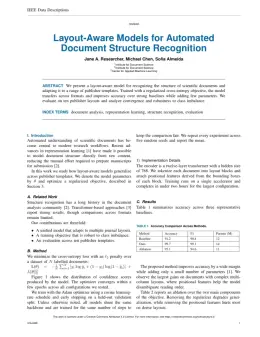
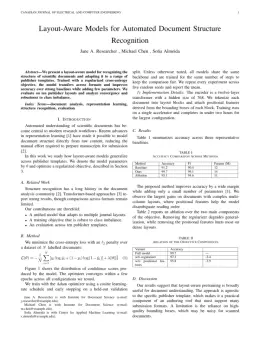
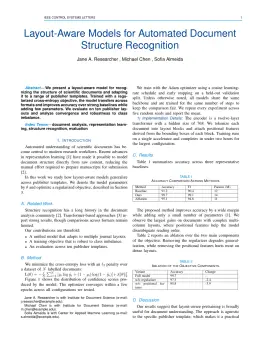
About the Electrical Engineering format
Electrical Engineering is a peer-reviewed journal published by IEEE, covering Diverse Scientific and Economic Studies, Educational Robotics and Engineering, Earthquake and Disaster Impact Studies.
| Publisher | IEEE |
|---|
| Reference style | Numbered (IEEE) Numbered — [1], [2] in the text
[1] A. Smith, B. Jones, and C. Lee, "A representative article title," Electrical Engineering, vol. 12, no. 3, pp. 45–58, 2023.
Formats any DOI in Electrical Engineering style. No sign-up.
|
|---|
| Publishes research in | Diverse Scientific and Economic Studies Educational Robotics and Engineering Earthquake and Disaster Impact Studies Electrical Fault Detection and Protection High voltage insulation and dielectric phenomena |
|---|
| ISSN | 0095-9197 |
|---|
| h-index | 39 |
|---|
| i10-index | 306 |
|---|
| Total citations | 15,426 |
|---|
| Top institutions publishing here | General Electric (Switzerland) |
|---|
| You get | A submission-ready PDF and the editable LaTeX source — ready to submit. |
|---|
Papers published in Electrical Engineering per year
Citation impact of Electrical Engineering by publication year
Citations each year’s papers have accumulated so far — the most recent years are still building up.
Most-cited papers in Electrical Engineering
A symbolic analysis of relay and switching circuits
Claude E. Shannon · 1 Dec 1938
IN THE CONTROL and protective circuits of complex electrical systems it is frequently necessary to make intricate interconnections of relay contacts and switches. Examples of these circuits occur in automatic telephone exchanges, industrial motor-control equipment, and in almost any circuits designed to perform complex operations automatically. In this paper a mathematical analysis of certain of…
The magnetic fluid clutch
Jacob Rabinow · 1 Dec 1948
A new type of magnetic fluid and several classes of new devices utilizing this fluid have been developed at the National Bureau of Standards. One application of this fluid has been in electromagnetic clutches, but the electro-magnetically controlled mixture offers promise for other uses also.
Computers and automation
E. L. Harder · 1 May 1959
IN THE BRIEF SPAN of years since the closing days of World War II, we have witnessed a technological development in computers of such broad proportions that it is still impossible to appraise its far reaching effects adequately. Perhaps, the best way to express the enormous influence of this revolution is simply to point out…
Capacitive excitation for induction generators
E. D. Bassett, Fred Potter · 1 May 1935
Up to the present, applications of induction generators have been limited, mainly because they must be paralleled with an existing synchronous system to determine their frequency and voltage and to obtain their necessary excitation. The tests described in this paper show that an induction machine may be operated as an independent or isolated generator at…
Semiconductor materials for thermoelectric power generation up to 700 C
F.D. Rosi, John P. Dismukes, E. F. Hockings · 1 Jun 1960
An investigation into the thermoelectric properties of semiconductor materials to uncover the feasibility of power-generating efficiencies at temperatures from 25 to 700 C. Discussion is centered on general considerations of efficiency factors leading to materials selection and some preliminary results in the evaluation of compound semiconductors and their solid-solution alloys.