Copernicus Publications

Advances in radio science Template

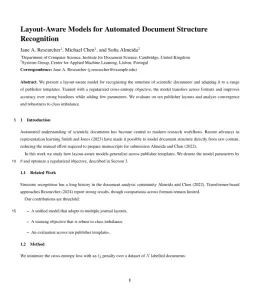
Write in a clean editor, then format for Advances in radio science in one click — DocuGuru applies the official Copernicus Publications template with author–year references and exports a submission-ready PDF plus the editable LaTeX source. Free to start.

About the Advances in radio science format

Advances in radio science is a peer-reviewed journal published by Copernicus Publications, covering Electromagnetic Compatibility and Measurements, Electromagnetic Compatibility and Noise Suppression, Ionosphere and magnetosphere dynamics.

PublisherCopernicus Publications
Reference styleAuthor–year (Copernicus)
Author–year — (Smith, 2023) in the text
Smith, A., Jones, B., and Lee, C.: A representative article title, Advances in radio science, 12, 45–58, 2023.

Formats any DOI in Advances in radio science style. No sign-up.

Publishes research inElectromagnetic Compatibility and Measurements Electromagnetic Compatibility and Noise Suppression Ionosphere and magnetosphere dynamics Microwave and Dielectric Measurement Techniques Radio Frequency Integrated Circuit Design
ISSN1684-9965
Citation impact (2-yr)1.35
h-index29
i10-index140
Total citations5,724
Article processing charge$226
Open accessYes
Top institutions publishing hereLeibniz University Hannover
Journal websitewww.adv-radio-sci.net
You getA submission-ready PDF and the editable LaTeX source — ready to submit.

Papers published in Advances in radio science per year

39
2014
33
2015
27
2016
36
2017
23
2018
31
2019
11
2020
24
2021
3
2022
28
2023
9
2024
11
2025

Citation impact of Advances in radio science by publication year

185
2014
121
2015
163
2016
197
2017
478
2018
152
2019
32
2020
85
2021
11
2022
84
2023
24
2024
9
2025

Citations each year’s papers have accumulated so far — the most recent years are still building up.

Most-cited papers in Advances in radio science

IRI the International Standard for the Ionosphere

D. Bilitza · 4 Sep 2018

Abstract. This paper gives a brief overview over the International Reference Ionosphere (IRI) project and model. IRI is recognized as the official standard for the ionosphere by the International Standardization Organization (ISO), the International Union of Radio Science (URSI), the Committee on Space Research (COSPAR), and the European Cooperation for Space Standardization (ECCS). Of great…

Influences of weather phenomena on automotive laser radar systems

R.H. Rasshofer, M. Spies, H. Spies · 29 Jul 2011

Abstract. Laser radar (lidar) sensors provide outstanding angular resolution along with highly accurate range measurements and thus they were proposed as a part of a high performance perception system for advanced driver assistant functions. Based on optical signal transmission and reception, laser radar systems are influenced by weather phenomena. This work provides an overview on…

Automotive Radar and Lidar Systems for Next Generation Driver Assistance Functions

R.H. Rasshofer, Klaus Gresser · 12 May 2005

Abstract. Automotive radar and lidar sensors represent key components for next generation driver assistance functions (Jones, 2001). Today, their use is limited to comfort applications in premium segment vehicles although an evolution process towards more safety-oriented functions is taking place. Radar sensors available on the market today suffer from low angular resolution and poor target…

Automotive radar – investigation of mutual interference mechanisms

M. Goppelt, Hans-Ludwig Blocher, Wolfgang Menzel · 30 Sep 2010

Abstract. In the past mutual interference between automotive radar sensors has not been regarded as a major problem. With an increasing number of such systems, however, this topic is receiving more and more attention. The investigation of mutual interference and countermeasures is therefore one topic of the joint project "Radar on Chip for Cars" (RoCC)…

Automated collection and dissemination of ionospheric data from the digisonde network

B. W. Reinisch, Ivan Galkin, G. Khmyrov et al. · 27 May 2005

Abstract. The growing demand for fast access to accurate ionospheric electron density profiles and ionospheric characteristics calls for efficient dissemination of data from the many ionosondes operating around the globe. The global digisonde network with over 70 stations takes advantage of the Internet to make many of these sounders remotely accessible for data transfer and…

Advances in radio science template — frequently asked questions

How do I write a paper in the Advances in radio science format?
In DocuGuru you write your manuscript in a normal editor — no LaTeX setup required — and select the Advances in radio science template. When you export, DocuGuru compiles the paper into the official Copernicus Publications format and hands you a submission-ready PDF along with the editable LaTeX source.
What reference style does Advances in radio science use?
Advances in radio science uses Author–year (Copernicus) references, shown as author–year markers such as (Smith, 2023) in the text. DocuGuru formats every in-text citation and the reference list in this exact style automatically. A reference appears like this: Smith, A., Jones, B., and Lee, C.: A representative article title, Advances in radio science, 12, 45–58, 2023.
Do I need to know LaTeX to submit to Advances in radio science?
No. DocuGuru generates the copernicus LaTeX class and compiles the PDF for you in the background, so you get a Copernicus Publications-ready Advances in radio science document without writing any LaTeX. If you do want it, the LaTeX source is included in the export.
Can I import an existing draft into the Advances in radio science template?
Yes. Paste or upload your current manuscript — Word, LaTeX, Markdown, or plain text — and DocuGuru reflows it into the Advances in radio science format with correct headings, figures, tables, and author–year citations.
Who publishes Advances in radio science?
Advances in radio science is a earth and environmental sciences journal published by Copernicus Publications. DocuGuru's Advances in radio science template matches Copernicus Publications's official submission format.
Can I export a submission-ready Advances in radio science PDF?
Yes — DocuGuru produces a PDF built with the official Advances in radio science template (the copernicus class) that is ready to submit to Copernicus Publications, together with the matching LaTeX source files.
How much does the Advances in radio science template cost?
You can start writing in the Advances in radio science template for free. Exporting the final submission-ready Advances in radio science PDF and LaTeX source is part of DocuGuru's paid plans — see the app for current pricing.
Use the Advances in radio science template