Cambridge University Press

Weed Science Template

Write in a clean editor, then format for Weed Science in one click — DocuGuru applies the official Cambridge University Press template with numbered references and exports a submission-ready PDF plus the editable LaTeX source. Free to start.

About the Weed Science format

Weed Science is a peer-reviewed journal published by Cambridge University Press, covering Weed Control and Herbicide Applications, Pesticide and Herbicide Environmental Studies, Allelopathy and phytotoxic interactions.

PublisherCambridge University Press
Reference styleNumbered
Numbered — [1], [2] in the text
[1] A. Smith, B. Jones, and C. Lee, A representative article title, Weed Science 12 (2023) 45–58.

Formats any DOI in the closest standard style — Weed Science has no published style definition, so this is an approximation. No sign-up.

Publishes research inWeed Control and Herbicide Applications Pesticide and Herbicide Environmental Studies Allelopathy and phytotoxic interactions Agronomic Practices and Intercropping Systems Diverse Scientific and Economic Studies
ISSN0043-1745
Citation impact (2-yr)1.95
h-index146
i10-index4,915
Total citations212,384
Top institutions publishing hereAgricultural Research Service
Journal websitewww.cambridge.org
You getA submission-ready PDF and the editable LaTeX source — ready to submit.

Papers published in Weed Science per year

99
2014
128
2015
94
2016
93
2017
87
2018
87
2019
113
2020
82
2021
72
2022
75
2023
105
2024
82
2025

Citation impact of Weed Science by publication year

2K
2014
4.4K
2015
1.8K
2016
2.1K
2017
1.9K
2018
1.4K
2019
1.5K
2020
970
2021
642
2022
502
2023
352
2024
89
2025

Citations each year’s papers have accumulated so far — the most recent years are still building up.

Most-cited papers in Weed Science

Reducing the Risks of Herbicide Resistance: Best Management Practices and Recommendations

Jason K. Norsworthy, Sarah Ward, David Shaw et al. · 1 Jan 2012

Herbicides are the foundation of weed control in commercial crop-production systems. However, herbicide-resistant (HR) weed populations are evolving rapidly as a natural response to selection pressure imposed by modern agricultural management activities. Mitigating the evolution of herbicide resistance depends on reducing selection through diversification of weed control techniques, minimizing the spread of resistance genes and…

1,058 citations Cite SaveGo to paper →
Resistance of weeds to ALS-inhibiting herbicides: what have we learned?

Patrick J. Tranel, Terry R. Wright · 1 Nov 2002

Herbicides that target the enzyme acetolactate synthase (ALS) are among the most widely used in the world. Unfortunately, these herbicides are also notorious for their ability to select resistant (R) weed populations. Now, there are more weed species that are resistant to ALS-inhibiting herbicides than to any other herbicide group. In most cases, resistance to…

Invasive weeds in rangelands: Species, impacts, and management

Joseph M. DiTomaso · 1 Mar 2000

Rangeland and pastures comprise about 42% of the total land area of the United States. About three-quarters of all domestic livestock depend upon grazing lands for survival. Many ranges have had domestic stock grazing for more than 100 years and, as a result, the plant composition has changed greatly from the original ecosystems. Western rangelands…

Cover crops and living mulches

Nathan L. Hartwig, Hans Ulrich Ammon · 1 Nov 2002

Cover crops and living mulches bring many benefits to crop production. Interest in winter annual cover crops such as winter rye and hairy vetch for ground cover and soil erosion control has been increasing in the last 30 yr in some areas. The integration of cover crops into a cropping system by relay cropping, overseeding,…

The Evolution and Genetics of Herbicide Resistance in Weeds

Marie Jasieniuk, Anita L. Brûlé‐Babel, Ian N. Morrison · 1 Mar 1996

The importance of various factors influencing the evolution of herbicide resistance in weeds is critically examined using population genetic models. The factors include gene mutation, initial frequency of resistance alleles, inheritance, weed fitness in the presence and absence of herbicide, mating system, and gene flow. Where weed infestations are heavy, the probability of selecting for…

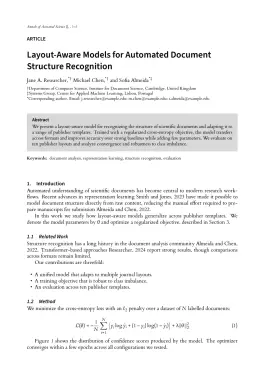
Weed Science template — frequently asked questions

How do I write a paper in the Weed Science format?
In DocuGuru you write your manuscript in a normal editor — no LaTeX setup required — and select the Weed Science template. When you export, DocuGuru compiles the paper into the official Cambridge University Press format and hands you a submission-ready PDF along with the editable LaTeX source.
What reference style does Weed Science use?
Weed Science uses Numbered references, shown as numbered [1], [2] markers in the text. DocuGuru formats every in-text citation and the reference list in this exact style automatically. A reference appears like this: [1] A. Smith, B. Jones, and C. Lee, A representative article title, Weed Science 12 (2023) 45–58.
Do I need to know LaTeX to submit to Weed Science?
No. DocuGuru generates the null LaTeX class and compiles the PDF for you in the background, so you get a Cambridge University Press-ready Weed Science document without writing any LaTeX. If you do want it, the LaTeX source is included in the export.
Can I import an existing draft into the Weed Science template?
Yes. Paste or upload your current manuscript — Word, LaTeX, Markdown, or plain text — and DocuGuru reflows it into the Weed Science format with correct headings, figures, tables, and numbered citations.
Who publishes Weed Science?
Weed Science is a multidisciplinary journal published by Cambridge University Press. DocuGuru's Weed Science template matches Cambridge University Press's official submission format.
Can I export a submission-ready Weed Science PDF?
Yes — DocuGuru produces a PDF built with the official Weed Science template (the null class) that is ready to submit to Cambridge University Press, together with the matching LaTeX source files.
How much does the Weed Science template cost?
You can start writing in the Weed Science template for free. Exporting the final submission-ready Weed Science PDF and LaTeX source is part of DocuGuru's paid plans — see the app for current pricing.
Use the Weed Science template