Cambridge University Press

Mineralogical Magazine Template

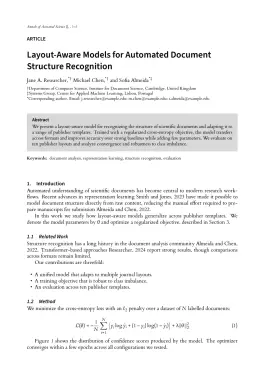
Write in a clean editor, then format for Mineralogical Magazine in one click — DocuGuru applies the official Cambridge University Press template with numbered references and exports a submission-ready PDF plus the editable LaTeX source. Free to start.

About the Mineralogical Magazine format

Mineralogical Magazine is a peer-reviewed journal published by Cambridge University Press, covering Geological and Geochemical Analysis, Crystal Structures and Properties, Geochemistry and Geologic Mapping.

PublisherCambridge University Press
Reference styleNumbered
Numbered — [1], [2] in the text
[1] A. Smith, B. Jones, and C. Lee, A representative article title, Mineralogical Magazine 12 (2023) 45–58.

Formats any DOI in the closest standard style — Mineralogical Magazine has no published style definition, so this is an approximation. No sign-up.

Publishes research inGeological and Geochemical Analysis Crystal Structures and Properties Geochemistry and Geologic Mapping Mineralogy and Gemology Studies High-pressure geophysics and materials
ISSN0026-461X
Citation impact (2-yr)0.78
h-index118
i10-index2,894
Total citations126,376
Top institutions publishing hereUniversity of Manchester
Journal websitewww.cambridge.org
You getA submission-ready PDF and the editable LaTeX source — ready to submit.

Papers published in Mineralogical Magazine per year

127
2014
148
2015
95
2016
170
2017
107
2018
83
2019
104
2020
98
2021
126
2022
90
2023
103
2024
132
2025

Citation impact of Mineralogical Magazine by publication year

2.1K
2014
1.9K
2015
1.7K
2016
2.4K
2017
994
2018
856
2019
731
2020
1.8K
2021
596
2022
265
2023
175
2024
46
2025

Citations each year’s papers have accumulated so far — the most recent years are still building up.

Most-cited papers in Mineralogical Magazine

Nomenclature of Amphiboles; Report of the Subcommittee on Amphiboles of the International Mineralogical Association Commission on New Minerals and Mineral Names

Bernard E. Leake, Alan R. Woolley, C.E.S. Arps et al. · 1 Apr 1997

Abstract The International Mineralogical Association's approved amphibole nomenclature has been revised in order to simplify it, make it more consistent with divisions generally at 50%, define prefixes and modifiers more precisely and include new amphibole species discovered and named since 1978, when the previous scheme was approved. The same reference axes form the basis of…

3,921 citations Cite SaveGo to paper →
Nomenclature of Amphiboles

Bernard E. Leake · 1 Dec 1978

An abstract is not available for this content so a preview has been provided. Please use the Get access link above for information on how to access this content.

2,060 citations Cite SaveGo to paper →
A general equation for estimating Fe<sup>3+</sup> concentrations in ferromagnesian silicates and oxides from microprobe analyses, using stoichiometric criteria

G. T. R. Droop · 1 Sep 1987

Abstract A simple general equation is presented for estimating the Fe 3+ concentrations in ferromagnesian oxide and silicate minerals from microprobe analyses. The equation has been derived using stoichiometric criteria assuming that iron is the only element present with variable valency and that oxygen is the only anion. In general, the number of Fe 3+…

1,851 citations Cite SaveGo to paper →
Unit cell refinement from powder diffraction data: the use of regression diagnostics

T. J. B. Holland, Simon A. T. Redfern · 1 Feb 1997

Abstract We discuss the use of regression diagnostics combined with nonlinear least-squares to refine cell parameters from powder diffraction data, presenting a method which minimizes residuals in the experimentally-determined quantity (usually 2θ hkl or energy, E hkl ). Regression diagnostics, particularly deletion diagnostics, are invaluable in detection of outliers and influential data which could be…

1,383 citations Cite SaveGo to paper →
Mineral replacement reactions: from macroscopic observations to microscopic mechanisms

Andrew Putnis · 24 Sep 2002

Abstract Mineral replacement reactions take place primarily by dissolution-reprecipitation processes. Processes such as cation exchange, chemical weathering, deuteric alteration, leaching, pseudomorphism, metasomatism, diagenesis and metamorphism are all linked by common features in which one mineral or mineral assemblage is replaced by a more stable assemblage. The aim of this paper is to review some of…

1,152 citations Cite SaveGo to paper →

Mineralogical Magazine template — frequently asked questions

How do I write a paper in the Mineralogical Magazine format?
In DocuGuru you write your manuscript in a normal editor — no LaTeX setup required — and select the Mineralogical Magazine template. When you export, DocuGuru compiles the paper into the official Cambridge University Press format and hands you a submission-ready PDF along with the editable LaTeX source.
What reference style does Mineralogical Magazine use?
Mineralogical Magazine uses Numbered references, shown as numbered [1], [2] markers in the text. DocuGuru formats every in-text citation and the reference list in this exact style automatically. A reference appears like this: [1] A. Smith, B. Jones, and C. Lee, A representative article title, Mineralogical Magazine 12 (2023) 45–58.
Do I need to know LaTeX to submit to Mineralogical Magazine?
No. DocuGuru generates the null LaTeX class and compiles the PDF for you in the background, so you get a Cambridge University Press-ready Mineralogical Magazine document without writing any LaTeX. If you do want it, the LaTeX source is included in the export.
Can I import an existing draft into the Mineralogical Magazine template?
Yes. Paste or upload your current manuscript — Word, LaTeX, Markdown, or plain text — and DocuGuru reflows it into the Mineralogical Magazine format with correct headings, figures, tables, and numbered citations.
Who publishes Mineralogical Magazine?
Mineralogical Magazine is a multidisciplinary journal published by Cambridge University Press. DocuGuru's Mineralogical Magazine template matches Cambridge University Press's official submission format.
Can I export a submission-ready Mineralogical Magazine PDF?
Yes — DocuGuru produces a PDF built with the official Mineralogical Magazine template (the null class) that is ready to submit to Cambridge University Press, together with the matching LaTeX source files.
How much does the Mineralogical Magazine template cost?
You can start writing in the Mineralogical Magazine template for free. Exporting the final submission-ready Mineralogical Magazine PDF and LaTeX source is part of DocuGuru's paid plans — see the app for current pricing.

Use the Mineralogical Magazine template