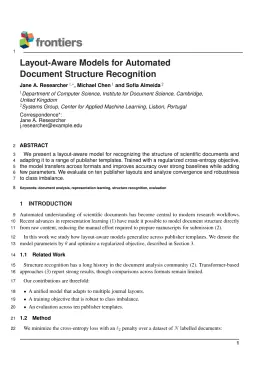
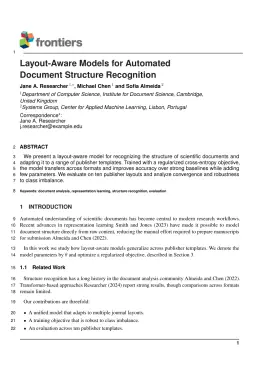
BMC (BioMed Central)

Translational Neurodegeneration Template

Write in a clean editor, then format for Translational Neurodegeneration in one click — DocuGuru applies the official BMC (BioMed Central) template with numbered references and exports a submission-ready PDF plus the editable LaTeX source. Free to start.

About the Translational Neurodegeneration format

Translational Neurodegeneration is a peer-reviewed journal published by BMC (BioMed Central), covering Parkinson's Disease Mechanisms and Treatments, Alzheimer's disease research and treatments, Neurological disorders and treatments. Over its lifetime it has published 619 papers, which have received 35,435 citations.

PublisherBMC (BioMed Central)
Reference styleNumbered (Vancouver)
Numbered — [1], [2] in the text
1. Smith A, Jones B, Lee C. A representative article title. Translational Neurodegeneration. 2023;12(3):45–58.

Formats any DOI in Translational Neurodegeneration style. No sign-up.

Publishes research inParkinson's Disease Mechanisms and Treatments Alzheimer's disease research and treatments Neurological disorders and treatments Amyotrophic Lateral Sclerosis Research Neuroinflammation and Neurodegeneration Mechanisms
ISSN2047-9158
Citation impact (2-yr)16.13
h-index91
i10-index472
Article processing charge$2,085
Open accessYes — indexed in DOAJ
Top institutions publishing hereShanghai Jiao Tong University
Journal websitetranslationalneurodegeneration.biomedcentral.com
You getA submission-ready PDF and the editable LaTeX source — ready to submit.

Papers published in Translational Neurodegeneration per year

27
2014
24
2015
23
2016
35
2017
35
2018
38
2019
45
2020
50
2021
58
2022
59
2023
68
2024
73
2025

Citation impact of Translational Neurodegeneration by publication year

1.3K
2014
2.8K
2015
1.8K
2016
3.4K
2017
2.4K
2018
2.7K
2019
5.7K
2020
2.6K
2021
4K
2022
2.7K
2023
1.9K
2024
677
2025

Citations each year’s papers have accumulated so far — the most recent years are still building up.

Most-cited papers in Translational Neurodegeneration

Neuroinflammation in neurodegenerative disorders: the roles of microglia and astrocytes

Hyuk Sung Kwon, Seong‐Ho Koh · 26 Nov 2020

Neuroinflammation is associated with neurodegenerative diseases, such as Alzheimer's disease, Parkinson's disease, and amyotrophic lateral sclerosis. Microglia and astrocytes are key regulators of inflammatory responses in the central nervous system. The activation of microglia and astrocytes is heterogeneous and traditionally categorized as neurotoxic (M1-phenotype microglia and A1-phenotype astrocytes) or neuroprotective (M2-phenotype microglia and A2-phenotype astrocytes).…

2,559 citations Cite SaveGo to paper →
Neuroinflammation in Parkinson’s disease and its potential as therapeutic target

Qinqin Wang, Yingjun Liu, Jiawei Zhou · 12 Oct 2015

Parkinson's disease (PD), the second most common age-associated neurodegenerative disorder, is characterized by the loss of dopaminergic (DA) neurons and the presence of α-synuclein-containing aggregates in the substantia nigra pars compacta (SNpc). Chronic neuroinflammation is one of the hallmarks of PD pathophysiology. Post-mortem analyses of human PD patients and experimental animal studies indicate that activation…

Protein misfolding in neurodegenerative diseases: implications and strategies

Patrick Sweeney, Hyunsun Park, Marc Baumann et al. · 13 Mar 2017

A hallmark of neurodegenerative proteinopathies is the formation of misfolded protein aggregates that cause cellular toxicity and contribute to cellular proteostatic collapse. Therapeutic options are currently being explored that target different steps in the production and processing of proteins implicated in neurodegenerative disease, including synthesis, chaperone-assisted folding and trafficking, and degradation via the proteasome and…

The endosomal-lysosomal system: from acidification and cargo sorting to neurodegeneration

Yong-Bo Hu, Eric B. Dammer, Ru‐Jing Ren et al. · 30 Sep 2015

The endosomal-lysosomal system is made up of a set of intracellular membranous compartments that dynamically interconvert, which is comprised of early endosomes, recycling endosomes, late endosomes, and the lysosome. In addition, autophagosomes execute autophagy, which delivers intracellular contents to the lysosome. Maturation of endosomes and/or autophagosomes into a lysosome creates an unique acidic environment within…

Alzheimer’s disease hypothesis and related therapies

Xiaoguang Du, Xinyi Wang, Meiyu Geng · 24 Jan 2018

Alzheimer's disease (AD) is a progressive neurodegenerative disorder and the most common cause for dementia. There are many hypotheses about AD, including abnormal deposit of amyloid β (Aβ) protein in the extracellular spaces of neurons, formation of twisted fibers of tau proteins inside neurons, cholinergic neuron damage, inflammation, oxidative stress, etc., and many anti-AD drugs…


Translational Neurodegeneration template — frequently asked questions

How do I write a paper in the Translational Neurodegeneration format?
In DocuGuru you write your manuscript in a normal editor — no LaTeX setup required — and select the Translational Neurodegeneration template. When you export, DocuGuru compiles the paper into the official BMC (BioMed Central) format and hands you a submission-ready PDF along with the editable LaTeX source.
What reference style does Translational Neurodegeneration use?
Translational Neurodegeneration uses Numbered (Vancouver) references, shown as numbered [1], [2] markers in the text. DocuGuru formats every in-text citation and the reference list in this exact style automatically. A reference appears like this: 1. Smith A, Jones B, Lee C. A representative article title. Translational Neurodegeneration. 2023;12(3):45–58.
Do I need to know LaTeX to submit to Translational Neurodegeneration?
No. DocuGuru generates the bmcart LaTeX class and compiles the PDF for you in the background, so you get a BMC (BioMed Central)-ready Translational Neurodegeneration document without writing any LaTeX. If you do want it, the LaTeX source is included in the export.
Can I import an existing draft into the Translational Neurodegeneration template?
Yes. Paste or upload your current manuscript — Word, LaTeX, Markdown, or plain text — and DocuGuru reflows it into the Translational Neurodegeneration format with correct headings, figures, tables, and numbered citations.
What is Translational Neurodegeneration?
BMC / BioMed Central journal. It is a life sciences and medicine journal, published by BMC (BioMed Central).
Can I export a submission-ready Translational Neurodegeneration PDF?
Yes — DocuGuru produces a PDF built with the official Translational Neurodegeneration template (the bmcart class) that is ready to submit to BMC (BioMed Central), together with the matching LaTeX source files.
How much does the Translational Neurodegeneration template cost?
You can start writing in the Translational Neurodegeneration template for free. Exporting the final submission-ready Translational Neurodegeneration PDF and LaTeX source is part of DocuGuru's paid plans — see the app for current pricing.
Use the Translational Neurodegeneration template