AIP Publishing

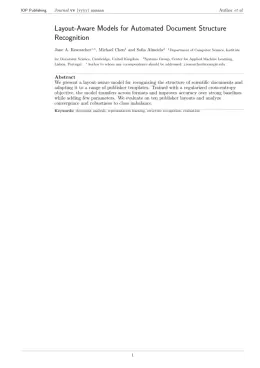
APL Machine Learning Template

Write in a clean editor, then format for APL Machine Learning in one click — DocuGuru applies the official AIP Publishing template with numbered references and exports a submission-ready PDF plus the editable LaTeX source. Free to start.

About the APL Machine Learning format

APL Machine Learning is a peer-reviewed journal published by AIP Publishing, covering Machine Learning in Materials Science, Advanced Memory and Neural Computing, Neural Networks and Reservoir Computing. Over its lifetime it has published 259 papers, which have received 1,633 citations.

PublisherAIP Publishing
Reference styleNumbered (AIP)
Numbered — [1], [2] in the text
[1] A. Smith, B. Jones, and C. Lee, APL Machine Learning 12, 45 (2023).

Formats any DOI in APL Machine Learning style. No sign-up.

Publishes research inMachine Learning in Materials Science Advanced Memory and Neural Computing Neural Networks and Reservoir Computing Ferroelectric and Negative Capacitance Devices Model Reduction and Neural Networks
ISSN2770-9019
Citation impact (2-yr)4.1
h-index18
i10-index42
Open accessYes — indexed in DOAJ
Top institutions publishing hereThe University of Tokyo
You getA submission-ready PDF and the editable LaTeX source — ready to submit.

Papers published in APL Machine Learning per year

74
2023
81
2024
77
2025

Citation impact of APL Machine Learning by publication year

875
2023
625
2024
131
2025

Citations each year’s papers have accumulated so far — the most recent years are still building up.

Most-cited papers in APL Machine Learning

In-memory computing with emerging memory devices: Status and outlook

Piergiulio Mannocci, Matteo Farronato, Nicola Lepri et al. · 14 Feb 2023

In-memory computing (IMC) has emerged as a new computing paradigm able to alleviate or suppress the memory bottleneck, which is the major concern for energy efficiency and latency in modern digital computing. While the IMC concept is simple and promising, the details of its implementation cover a broad range of problems and solutions, including various…

Brain-inspired learning in artificial neural networks: A review

Samuel Schmidgall, Rojin Ziaei, Jascha Achterberg et al. · 9 May 2024

Artificial neural networks (ANNs) have emerged as an essential tool in machine learning, achieving remarkable success across diverse domains, including image and speech generation, game playing, and robotics. However, there exist fundamental differences between ANNs’ operating mechanisms and those of the biological brain, particularly concerning learning processes. This paper presents a comprehensive review of current…

Deep language models for interpretative and predictive materials science

Yiwen Hu, Markus J. Buehler · 14 Feb 2023

Machine learning (ML) has emerged as an indispensable methodology to describe, discover, and predict complex physical phenomena that efficiently help us learn underlying functional rules, especially in cases when conventional modeling approaches cannot be applied. While conventional feedforward neural networks are typically limited to performing tasks related to static patterns in data, recursive models can…

Using the IBM analog in-memory hardware acceleration kit for neural network training and inference

Manuel Le Gallo, Corey Lammie, Julian Büchel et al. · 28 Nov 2023

Analog In-Memory Computing (AIMC) is a promising approach to reduce the latency and energy consumption of Deep Neural Network (DNN) inference and training. However, the noisy and non-linear device characteristics and the non-ideal peripheral circuitry in AIMC chips require adapting DNNs to be deployed on such hardware to achieve equivalent accuracy to digital computing. In…

X-LoRA: Mixture of low-rank adapter experts, a flexible framework for large language models with applications in protein mechanics and molecular design

Eric L. Buehler, Markus J. Buehler · 24 May 2024

We report a mixture of expert strategy to create fine-tuned large language models using a deep layer-wise token-level approach based on low-rank adaptation (LoRA). Starting with a set of pre-trained LoRA adapters, our gating strategy uses the hidden states to dynamically mix adapted layers, allowing the resulting X-LoRA model to draw upon different capabilities and…

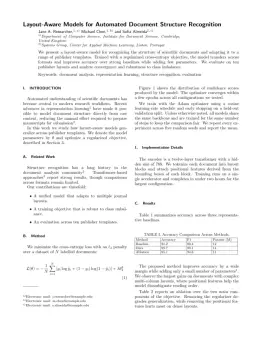
APL Machine Learning template — frequently asked questions

How do I write a paper in the APL Machine Learning format?
In DocuGuru you write your manuscript in a normal editor — no LaTeX setup required — and select the APL Machine Learning template. When you export, DocuGuru compiles the paper into the official AIP Publishing format and hands you a submission-ready PDF along with the editable LaTeX source.
What reference style does APL Machine Learning use?
APL Machine Learning uses Numbered (AIP) references, shown as numbered [1], [2] markers in the text. DocuGuru formats every in-text citation and the reference list in this exact style automatically. A reference appears like this: [1] A. Smith, B. Jones, and C. Lee, APL Machine Learning 12, 45 (2023).
Do I need to know LaTeX to submit to APL Machine Learning?
No. DocuGuru generates the revtex4-2 LaTeX class and compiles the PDF for you in the background, so you get a AIP Publishing-ready APL Machine Learning document without writing any LaTeX. If you do want it, the LaTeX source is included in the export.
Can I import an existing draft into the APL Machine Learning template?
Yes. Paste or upload your current manuscript — Word, LaTeX, Markdown, or plain text — and DocuGuru reflows it into the APL Machine Learning format with correct headings, figures, tables, and numbered citations.
What is APL Machine Learning?
AIP Publishing journal (REVTeX 4.2). It is a physics journal, published by AIP Publishing.
Can I export a submission-ready APL Machine Learning PDF?
Yes — DocuGuru produces a PDF built with the official APL Machine Learning template (the revtex4-2 class) that is ready to submit to AIP Publishing, together with the matching LaTeX source files.
How much does the APL Machine Learning template cost?
You can start writing in the APL Machine Learning template for free. Exporting the final submission-ready APL Machine Learning PDF and LaTeX source is part of DocuGuru's paid plans — see the app for current pricing.
Use the APL Machine Learning template