AGU (American Geophysical Union)

Paleoceanography and Paleoclimatology Template

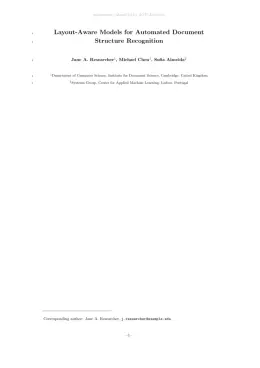
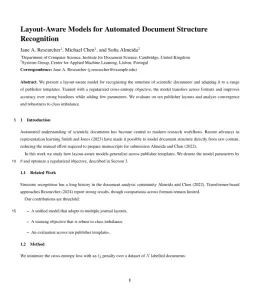
Write in a clean editor, then format for Paleoceanography and Paleoclimatology in one click — DocuGuru applies the official AGU (American Geophysical Union) template with author–year references and exports a submission-ready PDF plus the editable LaTeX source. Free to start.

About the Paleoceanography and Paleoclimatology format

Paleoceanography and Paleoclimatology is a peer-reviewed journal published by AGU (American Geophysical Union), covering Geology and Paleoclimatology Research, Isotope Analysis in Ecology, Paleontology and Stratigraphy of Fossils. Over its lifetime it has published 1,245 papers, which have received 18,321 citations.

PublisherAGU (American Geophysical Union)
Reference styleAuthor–year (APA)
Author–year — (Smith, 2023) in the text
Smith, A., Jones, B., & Lee, C. (2023). A representative article title. Paleoceanography and Paleoclimatology, 12(3), 45–58.

Formats any DOI in Paleoceanography and Paleoclimatology style. No sign-up.

Publishes research inGeology and Paleoclimatology Research Isotope Analysis in Ecology Paleontology and Stratigraphy of Fossils Methane Hydrates and Related Phenomena Geological formations and processes
ISSN2572-4517
Citation impact (2-yr)1.8
h-index57
i10-index522
Article processing charge$3,700
Top institutions publishing hereUniversity of Bremen
Journal websiteonlinelibrary.wiley.com
You getA submission-ready PDF and the editable LaTeX source — ready to submit.

Papers published in Paleoceanography and Paleoclimatology per year

122
2018
154
2019
152
2020
171
2021
121
2022
132
2023
134
2024
168
2025

Citation impact of Paleoceanography and Paleoclimatology by publication year

3.3K
2018
4.6K
2019
4.1K
2020
2.9K
2021
1.5K
2022
1.1K
2023
482
2024
210
2025

Citations each year’s papers have accumulated so far — the most recent years are still building up.

Most-cited papers in Paleoceanography and Paleoclimatology

The Miocene: The Future of the Past

Margret Steinthorsdottir, Helen K. Coxall, Agatha M. de Boer et al. · 24 Dec 2020

Abstract The Miocene epoch (23.03–5.33 Ma) was a time interval of global warmth, relative to today. Continental configurations and mountain topography transitioned toward modern conditions, and many flora and fauna evolved into the same taxa that exist today. Miocene climate was dynamic: long periods of early and late glaciation bracketed a ∼2 Myr greenhouse interval—the…

BAYSPLINE: A New Calibration for the Alkenone Paleothermometer

Jessica E. Tierney, Martin P. Tingley · 6 Feb 2018

Abstract The alkenone‐based U proxy is a cornerstone of paleoclimatology, providing insight into the temperature history of the Earth's surface ocean. Although the relationship between U and sea surface temperatures (SSTs) is robust and well supported by experimental data, there remain outstanding issues regarding the seasonality of production of alkenones and the response of U…

Global Extent of Early Eocene Hyperthermal Events: A New Pacific Benthic Foraminiferal Isotope Record From Shatsky Rise (ODP Site 1209)

Thomas Westerhold, Ursula Röhl, Barbara Donner et al. · 22 May 2018

Abstract Studying the dynamics of past global warming events during the late Paleocene to middle Eocene informs our understanding of Earth's carbon cycle behavior under elevated atmospheric pCO 2 conditions. Due to sparse data coverage, the spatial character of numerous hyperthermal events during this period is still poorly constrained. Here we present a high‐resolution, benthic…

A Rapid, Deterministic Age‐Depth Modeling Routine for Geological Sequences With Inherent Depth Uncertainty

Bryan C Lougheed, Stephen Obrochta · 1 Jan 2019

Abstract Traditional approaches to age‐depth modeling typically assume no uncertainty for the depth value of dated intervals. However, such an assumption may not be fully valid in the case of poor coring recovery or significant sediment deformation, as well as in the case of a large subsampling interval. In consideration of these issues, we present…

Nonthermal Influences on Mg/Ca in Planktonic Foraminifera: A Review of Culture Studies and Application to the Last Glacial Maximum

William R. Gray, David Evans · 15 Feb 2019

Abstract Planktonic foraminiferal Mg/Ca is one of the most widely applied sea surface temperature proxies. While the influence of salinity on Mg/Ca has led the accuracy of Mg/Ca‐temperatures to be questioned, the effect of seawater carbonate chemistry (pH) is seldom accounted for down‐core. Using published data sets, we review controls on Mg/Ca in laboratory cultures…

Paleoceanography and Paleoclimatology template — frequently asked questions

How do I write a paper in the Paleoceanography and Paleoclimatology format?
In DocuGuru you write your manuscript in a normal editor — no LaTeX setup required — and select the Paleoceanography and Paleoclimatology template. When you export, DocuGuru compiles the paper into the official AGU (American Geophysical Union) format and hands you a submission-ready PDF along with the editable LaTeX source.
What reference style does Paleoceanography and Paleoclimatology use?
Paleoceanography and Paleoclimatology uses Author–year (APA) references, shown as author–year markers such as (Smith, 2023) in the text. DocuGuru formats every in-text citation and the reference list in this exact style automatically. A reference appears like this: Smith, A., Jones, B., & Lee, C. (2023). A representative article title. Paleoceanography and Paleoclimatology, 12(3), 45–58.
Do I need to know LaTeX to submit to Paleoceanography and Paleoclimatology?
No. DocuGuru generates the agujournal2025 LaTeX class and compiles the PDF for you in the background, so you get a AGU (American Geophysical Union)-ready Paleoceanography and Paleoclimatology document without writing any LaTeX. If you do want it, the LaTeX source is included in the export.
Can I import an existing draft into the Paleoceanography and Paleoclimatology template?
Yes. Paste or upload your current manuscript — Word, LaTeX, Markdown, or plain text — and DocuGuru reflows it into the Paleoceanography and Paleoclimatology format with correct headings, figures, tables, and author–year citations.
What is Paleoceanography and Paleoclimatology?
AGU journal. It is a earth and environmental sciences journal, published by AGU (American Geophysical Union).
Can I export a submission-ready Paleoceanography and Paleoclimatology PDF?
Yes — DocuGuru produces a PDF built with the official Paleoceanography and Paleoclimatology template (the agujournal2025 class) that is ready to submit to AGU (American Geophysical Union), together with the matching LaTeX source files.
How much does the Paleoceanography and Paleoclimatology template cost?
You can start writing in the Paleoceanography and Paleoclimatology template for free. Exporting the final submission-ready Paleoceanography and Paleoclimatology PDF and LaTeX source is part of DocuGuru's paid plans — see the app for current pricing.
Use the Paleoceanography and Paleoclimatology template