AGU (American Geophysical Union)

Journal of Geophysical Research: Planets Template

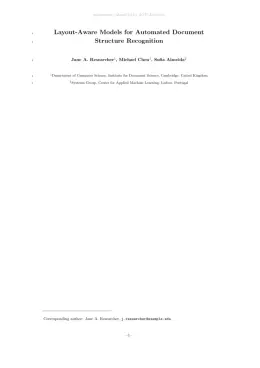
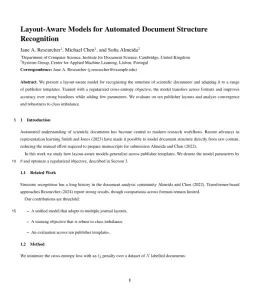
Write in a clean editor, then format for Journal of Geophysical Research: Planets in one click — DocuGuru applies the official AGU (American Geophysical Union) template with author–year references and exports a submission-ready PDF plus the editable LaTeX source. Free to start.

About the Journal of Geophysical Research: Planets format

Journal of Geophysical Research: Planets is a peer-reviewed journal published by AGU (American Geophysical Union), covering Planetary Science and Exploration, Astro and Planetary Science, Geology and Paleoclimatology Research. Over its lifetime it has published 3,282 papers, which have received 76,562 citations.

PublisherAGU (American Geophysical Union)
Reference styleAuthor–year (APA)
Author–year — (Smith, 2023) in the text
Smith, A., Jones, B., & Lee, C. (2023). A representative article title. Journal of Geophysical Research: Planets, 12(3), 45–58.

Formats any DOI in Journal of Geophysical Research: Planets style. No sign-up.

Publishes research inPlanetary Science and Exploration Astro and Planetary Science Geology and Paleoclimatology Research Space Science and Extraterrestrial Life Space Exploration and Technology
ISSN2169-9097
Citation impact (2-yr)2.59
h-index112
i10-index1,704
Article processing charge$3,700
Top institutions publishing herePlanetary Science Institute
Journal websiteagupubs.onlinelibrary.wiley.com
You getA submission-ready PDF and the editable LaTeX source — ready to submit.

Papers published in Journal of Geophysical Research: Planets per year

167
2014
140
2015
148
2016
178
2017
210
2018
207
2019
298
2020
258
2021
308
2022
274
2023
288
2024
407
2025

Citation impact of Journal of Geophysical Research: Planets by publication year

8.9K
2014
5.9K
2015
6.1K
2016
7.5K
2017
6.9K
2018
5.6K
2019
8.3K
2020
5.2K
2021
5.1K
2022
2.8K
2023
1.5K
2024
756
2025

Citations each year’s papers have accumulated so far — the most recent years are still building up.

Most-cited papers in Journal of Geophysical Research: Planets

Hydrous minerals on Mars as seen by the CRISM and OMEGA imaging spectrometers: Updated global view

John Carter, F. Poulet, Jean‐Pierre Bibring et al. · 13 Dec 2012

The surface of Mars has preserved the record of early environments in which its basaltic crust was altered by liquid water. These aqueous environments have survived in the form of hydrological morphologies and alteration minerals, including clays and hydrated salts. Because these minerals probe on Earth aqueous environments compatible with biotic activity, understanding their formation…

Space weathering on airless bodies

C. M. Pieters, S. K. Noble · 9 Sep 2016

Space weathering refers to alteration that occurs in the space environment with time. Lunar samples, and to some extent meteorites, have provided a benchmark for understanding the processes and products of space weathering. Lunar soils are derived principally from local materials but have accumulated a range of optically active opaque particles (OAOpq) that include nanophase…

Organic molecules in the Sheepbed Mudstone, Gale Crater, Mars

Caroline Freissinet, D. P. Glavin, P. R. Mahaffy et al. · 1 Mar 2015

Abstract The Sample Analysis at Mars (SAM) instrument on board the Mars Science Laboratory Curiosity rover is designed to conduct inorganic and organic chemical analyses of the atmosphere and the surface regolith and rocks to help evaluate the past and present habitability potential of Mars at Gale Crater. Central to this task is the development…

Revised CRISM spectral parameters and summary products based on the currently detected mineral diversity on Mars

C. E. Viviano, F. P. Seelos, S. L. Murchie et al. · 1 Jun 2014

Abstract The investigation of hyperspectral data from the Mars Reconnaissance Orbiter Compact Reconnaissance Imaging Spectrometer for Mars (CRISM) and the Observatoire pour la Minéralogie, L'Eau, les Glaces et l'Activitié (OMEGA) on Mars Express has revealed an increasingly diverse suite of minerals present on the Martian surface. A revised set of 60 spectral parameters derived from…

Evidence for perchlorates and the origin of chlorinated hydrocarbons detected by SAM at the Rocknest aeolian deposit in Gale Crater

D. P. Glavin, Caroline Freissinet, Kristen Miller et al. · 1 Oct 2013

A single scoop of the Rocknest aeolian deposit was sieved (< 150 µm), and four separate sample portions, each with a mass of ~50 mg, were delivered to individual cups inside the Sample Analysis at Mars (SAM) instrument by the Mars Science Laboratory rover's sample acquisition system. The samples were analyzed separately by the SAM…

Journal of Geophysical Research: Planets template — frequently asked questions

How do I write a paper in the Journal of Geophysical Research: Planets format?
In DocuGuru you write your manuscript in a normal editor — no LaTeX setup required — and select the Journal of Geophysical Research: Planets template. When you export, DocuGuru compiles the paper into the official AGU (American Geophysical Union) format and hands you a submission-ready PDF along with the editable LaTeX source.
What reference style does Journal of Geophysical Research: Planets use?
Journal of Geophysical Research: Planets uses Author–year (APA) references, shown as author–year markers such as (Smith, 2023) in the text. DocuGuru formats every in-text citation and the reference list in this exact style automatically. A reference appears like this: Smith, A., Jones, B., & Lee, C. (2023). A representative article title. Journal of Geophysical Research: Planets, 12(3), 45–58.
Do I need to know LaTeX to submit to Journal of Geophysical Research: Planets?
No. DocuGuru generates the agujournal2025 LaTeX class and compiles the PDF for you in the background, so you get a AGU (American Geophysical Union)-ready Journal of Geophysical Research: Planets document without writing any LaTeX. If you do want it, the LaTeX source is included in the export.
Can I import an existing draft into the Journal of Geophysical Research: Planets template?
Yes. Paste or upload your current manuscript — Word, LaTeX, Markdown, or plain text — and DocuGuru reflows it into the Journal of Geophysical Research: Planets format with correct headings, figures, tables, and author–year citations.
What is Journal of Geophysical Research: Planets?
AGU journal. It is a earth and environmental sciences journal, published by AGU (American Geophysical Union).
Can I export a submission-ready Journal of Geophysical Research: Planets PDF?
Yes — DocuGuru produces a PDF built with the official Journal of Geophysical Research: Planets template (the agujournal2025 class) that is ready to submit to AGU (American Geophysical Union), together with the matching LaTeX source files.
How much does the Journal of Geophysical Research: Planets template cost?
You can start writing in the Journal of Geophysical Research: Planets template for free. Exporting the final submission-ready Journal of Geophysical Research: Planets PDF and LaTeX source is part of DocuGuru's paid plans — see the app for current pricing.
Use the Journal of Geophysical Research: Planets template