American Chemical Society

ACS Materials Au Template

Write in a clean editor, then format for ACS Materials Au in one click — DocuGuru applies the official American Chemical Society template with superscript references and exports a submission-ready PDF plus the editable LaTeX source. Free to start.

About the ACS Materials Au format

ACS Materials Au is a peer-reviewed journal published by American Chemical Society, covering Electrocatalysts for Energy Conversion, Advanced Photocatalysis Techniques, History and advancements in chemistry. Over its lifetime it has published 452 papers, which have received 6,244 citations.

PublisherAmerican Chemical Society
Reference styleSuperscript numbered (ACS)
Superscript — small raised numerals in the text
(1) Smith, A.; Jones, B.; Lee, C. A Representative Article Title. ACS Materials Au 2023, 12, 45–58.

Formats any DOI in ACS Materials Au style. No sign-up.

Publishes research inElectrocatalysts for Energy Conversion Advanced Photocatalysis Techniques History and advancements in chemistry Academic Writing and Publishing Perovskite Materials and Applications
ISSN2694-2461
Citation impact (2-yr)4.83
h-index40
i10-index155
Article processing charge$5,000
Open accessYes — indexed in DOAJ
Top institutions publishing hereCentre National de la Recherche Scientifique
Journal websitepubs.acs.org
You getA submission-ready PDF and the editable LaTeX source — ready to submit.

Papers published in ACS Materials Au per year

1
2007
1
2011
1
2012
40
2021
72
2022
83
2023
74
2024
109
2025

Citation impact of ACS Materials Au by publication year

0
2007
4
2011
1
2012
942
2021
2K
2022
1.9K
2023
732
2024
393
2025

Citations each year’s papers have accumulated so far — the most recent years are still building up.

Most-cited papers in ACS Materials Au

Lipid-Based Nanoparticles for Drug/Gene Delivery: An Overview of the Production Techniques and Difficulties Encountered in Their Industrial Development

Meenu Mehta, Thuỳ Anh Bùi, Xinpu Yang et al. · 21 Aug 2023

Over the past decade, the therapeutic potential of nanomaterials as novel drug delivery systems complementing conventional pharmacology has been widely acknowledged. Among these nanomaterials, lipid-based nanoparticles (LNPs) have shown remarkable pharmacological performance and promising therapeutic outcomes, thus gaining substantial interest in preclinical and clinical research. In this review, we introduce the main types of LNPs…

Encapsulation and Stability Testing of Perovskite Solar Cells for Real Life Applications

Yantao Wang, Ishaq Ahmad, Tik‐Lun Leung et al. · 12 Jan 2022

With the progress in the development of perovskite solar cells, increased efforts have been devoted to enhancing their stability. With more devices being able to survive harsher stability testing conditions, such as damp heat or outdoor testing, there is increased interest in encapsulation techniques suitable for this type of tests, since both device architecture compatible…

Roles of Graphene Oxide in Heterogeneous Photocatalysis

Kang‐Qiang Lu, Yue‐Hua Li, Zi‐Rong Tang et al. · 9 Aug 2021

Graphene oxide (GO) has been widely utilized as the precursor of graphene (GR) to fabricate GR-based hybrid photocatalysts for solar-to-chemical energy conversion. However, until now, the properties and roles that GO played in heterogeneous photocatalysis have remained relatively elusive. In this Review, we start with a brief discussion of synthesis and structure of GO. Then,…

Recent Development of Atmospheric Water Harvesting Materials: A Review

An Feng, Nawshad Akther, Xiaofei Duan et al. · 27 Jun 2022

The lack of freshwater has been threatening many people who are living in Africa, the Middle East, and Oceania, while the discovery of freshwater harvesting technology is considered a promising solution. Recent advances in structured surface materials, metal-organic frameworks, hygroscopic inorganic compounds (and derivative materials), and functional hydrogels have demonstrated their potential as platform technologies…

Transition Metal Chalcogenides as a Versatile and Tunable Platform for Catalytic CO<sub>2</sub> and N<sub>2</sub> Electroreduction

Giorgio Giuffredi, Tristan Asset, Yuanchao Liu et al. · 24 May 2021

to complex carbon products. For the NRR instead, the resemblance of transition metal chalcogenides to the active centers of nitrogenase enzymes represents a powerful nature-mimicking approach for the design of catalysts with enhanced performance, although strategies to hinder the HER must be integrated in the catalytic architecture.

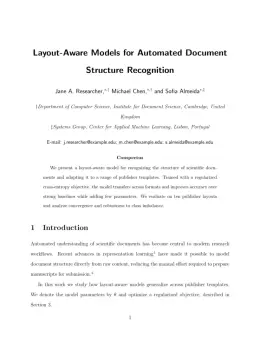
ACS Materials Au template — frequently asked questions

How do I write a paper in the ACS Materials Au format?
In DocuGuru you write your manuscript in a normal editor — no LaTeX setup required — and select the ACS Materials Au template. When you export, DocuGuru compiles the paper into the official American Chemical Society format and hands you a submission-ready PDF along with the editable LaTeX source.
What reference style does ACS Materials Au use?
ACS Materials Au uses Superscript numbered (ACS) references, shown as superscript numerals in the text. DocuGuru formats every in-text citation and the reference list in this exact style automatically. A reference appears like this: (1) Smith, A.; Jones, B.; Lee, C. A Representative Article Title. ACS Materials Au 2023, 12, 45–58.
Do I need to know LaTeX to submit to ACS Materials Au?
No. DocuGuru generates the achemso LaTeX class and compiles the PDF for you in the background, so you get a American Chemical Society-ready ACS Materials Au document without writing any LaTeX. If you do want it, the LaTeX source is included in the export.
Can I import an existing draft into the ACS Materials Au template?
Yes. Paste or upload your current manuscript — Word, LaTeX, Markdown, or plain text — and DocuGuru reflows it into the ACS Materials Au format with correct headings, figures, tables, and superscript citations.
What is ACS Materials Au?
ACS journal (achemso). It is a chemistry journal, published by American Chemical Society.
Can I export a submission-ready ACS Materials Au PDF?
Yes — DocuGuru produces a PDF built with the official ACS Materials Au template (the achemso class) that is ready to submit to American Chemical Society, together with the matching LaTeX source files.
How much does the ACS Materials Au template cost?
You can start writing in the ACS Materials Au template for free. Exporting the final submission-ready ACS Materials Au PDF and LaTeX source is part of DocuGuru's paid plans — see the app for current pricing.
Use the ACS Materials Au template