American Chemical Society

ACS Applied Polymer Materials Template

Write in a clean editor, then format for ACS Applied Polymer Materials in one click — DocuGuru applies the official American Chemical Society template with superscript references and exports a submission-ready PDF plus the editable LaTeX source. Free to start.

About the ACS Applied Polymer Materials format

ACS Applied Polymer Materials is a peer-reviewed journal published by American Chemical Society, covering Advanced Sensor and Energy Harvesting Materials, Polymer composites and self-healing, Conducting polymers and applications. Over its lifetime it has published 7,847 papers, which have received 103,321 citations.

PublisherAmerican Chemical Society
Reference styleSuperscript numbered (ACS)
Superscript — small raised numerals in the text
(1) Smith, A.; Jones, B.; Lee, C. A Representative Article Title. ACS Applied Polymer Materials 2023, 12, 45–58.

Formats any DOI in ACS Applied Polymer Materials style. No sign-up.

Publishes research inAdvanced Sensor and Energy Harvesting Materials Polymer composites and self-healing Conducting polymers and applications biodegradable polymer synthesis and properties Synthesis and properties of polymers
ISSN2637-6105
Citation impact (2-yr)4.9
h-index84
i10-index3,342
Top institutions publishing hereChinese Academy of Sciences
Journal websitepubs.acs.org
You getA submission-ready PDF and the editable LaTeX source — ready to submit.

Papers published in ACS Applied Polymer Materials per year

1
1980
1
1999
1
2002
18
2018
461
2019
654
2020
692
2021
960
2022
1K
2023
1.4K
2024
1.6K
2025

Citation impact of ACS Applied Polymer Materials by publication year

0
1980
0
1999
0
2002
878
2018
14.2K
2019
18.9K
2020
16.6K
2021
17.1K
2022
14.9K
2023
13.1K
2024
5.2K
2025

Citations each year’s papers have accumulated so far — the most recent years are still building up.

Most-cited papers in ACS Applied Polymer Materials

Photopolymerization in 3D Printing

Ali Bagheri, Jianyong Jin · 20 Feb 2019

The field of 3D printing is continuing its rapid development in both academic and industrial research environments. The development of 3D printing technologies has opened new implementations in rapid prototyping, tooling, dentistry, microfluidics, biomedical devices, tissue engineering, drug delivery, etc. Among different 3D printing techniques, photopolymerization-based process (such as stereolithography and digital light processing) offers…

1,387 citations Cite SaveGo to paper →
Polarons, Bipolarons, And Absorption Spectroscopy of PEDOT

Igor Zozoulenko, Amritpal Singh, Sandeep Kumar Singh et al. · 11 Dec 2018

Electronic structure and optical absorption spectra of poly(3,4-ethylenedioxythiophene) (PEDOT) for different oxidation levels were studied using density functional theory (DFT) and time-dependent DFT. It is shown, that the DFT-based predictions for the polaronic and bipolaronic states and the nature of corresponding optical transitions are qualitatively different from the widely used traditional picture based on semi-empirical…

Why is Recycling of Postconsumer Plastics so Challenging?

Bryan D. Vogt, Kristoffer K. Stokes, Sanat K. Kumar · 23 Aug 2021

The ubiquitous use of plastics has been driven by their combination of low cost and properties, but these attributes directly challenge waste management schemes for plastic recycling. Some postconsumer recycling programs are now nearly 50 years old, but a significant fraction of plastics still finds landfills or other dumping strategies at their end of life.…

Temperature-Responsive Multilayer Films of Micelle-Based Composites for Controlled Release of a Third-Generation EGFR Inhibitor

Li Xu, Hailong Wang, Zihan Chu et al. · 17 Jan 2020

Lung cancer is a complicated long-term disease, which is extremely difficult to cure. A traditional single drug delivery system cannot achieve desired long-term controlled release of therapeutic compounds. Our previous studies have found that temperature-responsive micelles demonstrated high loading efficiency and a long-term controlled release rate, which allows them to be an efficient drug delivery…

Importance of Polymer Rheology on Material Extrusion Additive Manufacturing: Correlating Process Physics to Print Properties

Arit Das, Eric L. Gilmer, Saeid Biria et al. · 8 Feb 2021

Recent advances in the field of additive manufacturing (AM) or 3D printing, have garnered serious interest for its potential to substitute time-consuming and costly subtractive and formative manufacturing techniques. Material extrusion (MatEx), employing filament and pellet-based feedstocks, is an AM technique for fabricating three-dimensional objects dictated by a computer-aided design (CAD) file in a layer-by-layer…

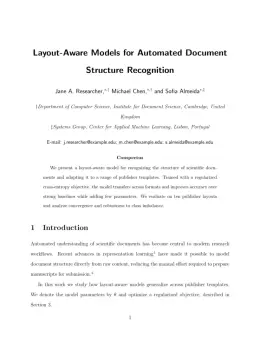
ACS Applied Polymer Materials template — frequently asked questions

How do I write a paper in the ACS Applied Polymer Materials format?
In DocuGuru you write your manuscript in a normal editor — no LaTeX setup required — and select the ACS Applied Polymer Materials template. When you export, DocuGuru compiles the paper into the official American Chemical Society format and hands you a submission-ready PDF along with the editable LaTeX source.
What reference style does ACS Applied Polymer Materials use?
ACS Applied Polymer Materials uses Superscript numbered (ACS) references, shown as superscript numerals in the text. DocuGuru formats every in-text citation and the reference list in this exact style automatically. A reference appears like this: (1) Smith, A.; Jones, B.; Lee, C. A Representative Article Title. ACS Applied Polymer Materials 2023, 12, 45–58.
Do I need to know LaTeX to submit to ACS Applied Polymer Materials?
No. DocuGuru generates the achemso LaTeX class and compiles the PDF for you in the background, so you get a American Chemical Society-ready ACS Applied Polymer Materials document without writing any LaTeX. If you do want it, the LaTeX source is included in the export.
Can I import an existing draft into the ACS Applied Polymer Materials template?
Yes. Paste or upload your current manuscript — Word, LaTeX, Markdown, or plain text — and DocuGuru reflows it into the ACS Applied Polymer Materials format with correct headings, figures, tables, and superscript citations.
What is ACS Applied Polymer Materials?
ACS journal (achemso). It is a chemistry journal, published by American Chemical Society.
Can I export a submission-ready ACS Applied Polymer Materials PDF?
Yes — DocuGuru produces a PDF built with the official ACS Applied Polymer Materials template (the achemso class) that is ready to submit to American Chemical Society, together with the matching LaTeX source files.
How much does the ACS Applied Polymer Materials template cost?
You can start writing in the ACS Applied Polymer Materials template for free. Exporting the final submission-ready ACS Applied Polymer Materials PDF and LaTeX source is part of DocuGuru's paid plans — see the app for current pricing.
Use the ACS Applied Polymer Materials template