American Chemical Society

ACS Applied Electronic Materials Template

Write in a clean editor, then format for ACS Applied Electronic Materials in one click — DocuGuru applies the official American Chemical Society template with superscript references and exports a submission-ready PDF plus the editable LaTeX source. Free to start.

About the ACS Applied Electronic Materials format

ACS Applied Electronic Materials is a peer-reviewed journal published by American Chemical Society, covering Advanced Sensor and Energy Harvesting Materials, Conducting polymers and applications, Advanced Memory and Neural Computing. Over its lifetime it has published 5,509 papers, which have received 71,078 citations.

PublisherAmerican Chemical Society
Reference styleSuperscript numbered (ACS)
Superscript — small raised numerals in the text
(1) Smith, A.; Jones, B.; Lee, C. A Representative Article Title. ACS Applied Electronic Materials 2023, 12, 45–58.

Formats any DOI in ACS Applied Electronic Materials style. No sign-up.

Publishes research inAdvanced Sensor and Energy Harvesting Materials Conducting polymers and applications Advanced Memory and Neural Computing 2D Materials and Applications Perovskite Materials and Applications
ISSN2637-6113
Citation impact (2-yr)4.59
h-index83
i10-index2,200
Top institutions publishing hereChinese Academy of Sciences
Journal websitepubs.acs.org
You getA submission-ready PDF and the editable LaTeX source — ready to submit.

Papers published in ACS Applied Electronic Materials per year

15
2018
366
2019
517
2020
599
2021
681
2022
756
2023
927
2024
1.1K
2025

Citation impact of ACS Applied Electronic Materials by publication year

268
2018
9.7K
2019
13.4K
2020
13.9K
2021
11.5K
2022
9.9K
2023
7.3K
2024
3.8K
2025

Citations each year’s papers have accumulated so far — the most recent years are still building up.

Most-cited papers in ACS Applied Electronic Materials

All-Oxide NiO/Ga<sub>2</sub>O<sub>3</sub> p–n Junction for Self-Powered UV Photodetector

Yachao Wang, Chao Wu, Daoyou Guo et al. · 10 Jun 2020

Recently, Ga2O3-based self-powered ultraviolet photodetectors have aroused great interest due to their potential applications in civil, medical, and environmental monitoring fields. So far, most p–n junction photodetectors are fabricated with p-type semiconductors like GaN and SiC, which are usually nonoxide materials. As a result, the p-type semiconductors are oxidized and the conductive properties degenerated when…

Recent Studies on the Humidity Sensor: A Mini Review

Burcu Arman Kuzubaşoğlu · 28 Sep 2022

For the time being, a number of humidity measurement instruments made of a variety of different materials and operating on a number of different principles are accessible. There are numerous ways that may be utilized to categorize them. I begin by discussing the most commonly used designs for flexible humidity sensors. Following that, the section…

Near-Unity Photoluminescence Quantum Yield in Blue-Emitting Cs<sub>3</sub>Cu<sub>2</sub>Br<sub>5–<i>x</i></sub>I<sub><i>x</i></sub> (0 ≤ <i>x</i> ≤ 5)

Rachel Roccanova, Aymen Yangui, Hariharan Nhalil et al. · 11 Mar 2019

Recently, interest in developing efficient, low-cost, nontoxic, and stable metal halide emitters that can be incorporated into solid-state lighting technologies has taken hold. Here we report nontoxic, stable, and highly efficient blue-light-emitting Cs3Cu2Br5–xIx (0 ≤ x ≤ 5). Room-temperature photoluminescence measurements show bright blue emission in the 456 to 443 nm range with near-unity quantum…

An Ultra-Broadband Near-Infrared Cr<sup>3+</sup>-Activated Gallogermanate Mg<sub>3</sub>Ga<sub>2</sub>GeO<sub>8</sub> Phosphor as Light Sources for Food Analysis

Cuiping Wang, Xiaoming Wang, Yang Zhou et al. · 31 May 2019

A detailed nondestructive analytical method for quantitative food analysis was established by using a self-fabricated NIR-LED light source combined with Mg3Ga2GeO8 (MGGO) phosphor and a blue LED chip in one package, which can be integrated into smartphones. The phosphor of MGGO:Cr3+ exhibits ultra-broadband NIR emission in the range of 650–1200 nm, which matches well with…

Research Progress of High-Sensitivity Perovskite Photodetectors: A Review of Photodetectors: Noise, Structure, and Materials

Guoxin Li, Yukun Wang, Lixiang Huang et al. · 4 Apr 2022

In recent years, perovskite materials have been widely used in optoelectronic components due to a series of advantages such as a high light absorption coefficient, high carrier mobility, long carrier diffusion length, shallow defect level, and high crystallinity. The photodetector is an important photoelectric device that can convert light radiation signals into electrical signals, so…

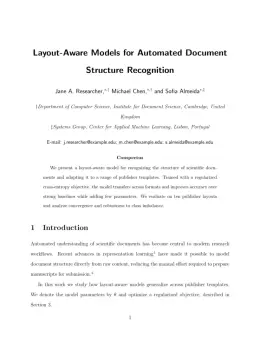
ACS Applied Electronic Materials template — frequently asked questions

How do I write a paper in the ACS Applied Electronic Materials format?
In DocuGuru you write your manuscript in a normal editor — no LaTeX setup required — and select the ACS Applied Electronic Materials template. When you export, DocuGuru compiles the paper into the official American Chemical Society format and hands you a submission-ready PDF along with the editable LaTeX source.
What reference style does ACS Applied Electronic Materials use?
ACS Applied Electronic Materials uses Superscript numbered (ACS) references, shown as superscript numerals in the text. DocuGuru formats every in-text citation and the reference list in this exact style automatically. A reference appears like this: (1) Smith, A.; Jones, B.; Lee, C. A Representative Article Title. ACS Applied Electronic Materials 2023, 12, 45–58.
Do I need to know LaTeX to submit to ACS Applied Electronic Materials?
No. DocuGuru generates the achemso LaTeX class and compiles the PDF for you in the background, so you get a American Chemical Society-ready ACS Applied Electronic Materials document without writing any LaTeX. If you do want it, the LaTeX source is included in the export.
Can I import an existing draft into the ACS Applied Electronic Materials template?
Yes. Paste or upload your current manuscript — Word, LaTeX, Markdown, or plain text — and DocuGuru reflows it into the ACS Applied Electronic Materials format with correct headings, figures, tables, and superscript citations.
What is ACS Applied Electronic Materials?
ACS journal (achemso). It is a chemistry journal, published by American Chemical Society.
Can I export a submission-ready ACS Applied Electronic Materials PDF?
Yes — DocuGuru produces a PDF built with the official ACS Applied Electronic Materials template (the achemso class) that is ready to submit to American Chemical Society, together with the matching LaTeX source files.
How much does the ACS Applied Electronic Materials template cost?
You can start writing in the ACS Applied Electronic Materials template for free. Exporting the final submission-ready ACS Applied Electronic Materials PDF and LaTeX source is part of DocuGuru's paid plans — see the app for current pricing.
Use the ACS Applied Electronic Materials template