ACM

ACM SIGEVOlution Template

Write in a clean editor, then format for ACM SIGEVOlution in one click — DocuGuru applies the official ACM template with numbered references and exports a submission-ready PDF plus the editable LaTeX source. Free to start.

About the ACM SIGEVOlution format

ACM SIGEVOlution is a peer-reviewed journal published by ACM, covering Evolutionary Algorithms and Applications, Metaheuristic Optimization Algorithms Research, Artificial Intelligence in Games.

PublisherACM
Reference styleNumbered (ACM)
Numbered — [1], [2] in the text
[1] Ada Smith, Ben Jones, and Cara Lee. 2023. A representative article title. ACM SIGEVOlution 12, 3, Article 45 (2023).

Formats any DOI in ACM SIGEVOlution style. No sign-up.

Publishes research inEvolutionary Algorithms and Applications Metaheuristic Optimization Algorithms Research Artificial Intelligence in Games Advanced Multi-Objective Optimization Algorithms Scientific Computing and Data Management
ISSN1931-8499
Citation impact (2-yr)0.22
h-index14
i10-index18
Total citations900
Top institutions publishing hereUniversity of Stirling
Journal websitewww.sigevolution.org
You getA submission-ready PDF and the editable LaTeX source — ready to submit.

Papers published in ACM SIGEVOlution per year

12
2014
11
2015
24
2016
27
2017
20
2018
14
2019
9
2020
15
2021
9
2022
11
2023
12
2024
13
2025

Citation impact of ACM SIGEVOlution by publication year

166
2014
24
2015
8
2016
36
2017
5
2018
4
2019
13
2020
67
2021
17
2022
7
2023
1
2024
3
2025

Citations each year’s papers have accumulated so far — the most recent years are still building up.

Most-cited papers in ACM SIGEVOlution

Unshackling evolution

Nick Cheney, Robert MacCurdy, Jeff Clune et al. · 1 Aug 2014

In 1994, Karl Sims' evolved virtual creatures showed the potential of evolutionary algorithms to produce natural, complex morphologies and behaviors [30]. One might assume that nearly 20 years of improvements in computational speed and evolutionary algorithms would produce far more impressive organisms, yet the creatures evolved in the field of artificial life today are not…

Pyevolve

Christian S. Perone · 18 Nov 2009

Pyevolve is an open-source framework for genetic algorithms. The initial long-term goal of the project was to create a complete and multi-platform framework for genetic algorithms in pure Python. However, the most recent developmental versions currently support also Genetic Programming (GP)[3]; accordingly, Pyevolve now aims at becoming a pure Python framework for evolutionary algorithms.

Evolving 3D objects with a generative encoding inspired by developmental biology

Jeff Clune, Hod Lipson · 1 Nov 2011

This paper introduces an algorithm for evolving 3D objects with a generative encoding that abstracts how biological morphologies are produced. Evolving interesting 3D objects is useful in many disciplines, including artistic design (e.g. sculpture), engineering (e.g. robotics, architecture, or product design), and biology (e.g. for investigating morphological evolution). A critical element in evolving 3D objects…

GEVA

Michael O’Neill, Erik Hemberg, Conor Gilligan et al. · 1 Jul 2008

We are delighted to announce the release of GEVA [1], an open source software implementation of Grammatical Evolution (GE) in Java. Grammatical Evolution in Java (GEVA) was developed at UCD's Natural Computing Research & Applications group (http://ncra.ucd.ie).

Nevergrad

Pauline Bennet, Carola Doerr, A. Moreau et al. · 1 Apr 2021

Nevergrad is an open source platform for black-box optimization. Join the user group! And if you like Nevergrad, please support us by adding a star on GitHub (https://github.com/facebookresearch/nevergrad).

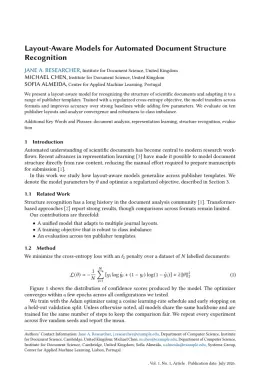
ACM SIGEVOlution template — frequently asked questions

How do I write a paper in the ACM SIGEVOlution format?
In DocuGuru you write your manuscript in a normal editor — no LaTeX setup required — and select the ACM SIGEVOlution template. When you export, DocuGuru compiles the paper into the official ACM format and hands you a submission-ready PDF along with the editable LaTeX source.
What reference style does ACM SIGEVOlution use?
ACM SIGEVOlution uses Numbered (ACM) references, shown as numbered [1], [2] markers in the text. DocuGuru formats every in-text citation and the reference list in this exact style automatically. A reference appears like this: [1] Ada Smith, Ben Jones, and Cara Lee. 2023. A representative article title. ACM SIGEVOlution 12, 3, Article 45 (2023).
Do I need to know LaTeX to submit to ACM SIGEVOlution?
No. DocuGuru generates the acmart LaTeX class and compiles the PDF for you in the background, so you get a ACM-ready ACM SIGEVOlution document without writing any LaTeX. If you do want it, the LaTeX source is included in the export.
Can I import an existing draft into the ACM SIGEVOlution template?
Yes. Paste or upload your current manuscript — Word, LaTeX, Markdown, or plain text — and DocuGuru reflows it into the ACM SIGEVOlution format with correct headings, figures, tables, and numbered citations.
Who publishes ACM SIGEVOlution?
ACM SIGEVOlution is a engineering and computer science journal published by ACM. DocuGuru's ACM SIGEVOlution template matches ACM's official submission format.
Can I export a submission-ready ACM SIGEVOlution PDF?
Yes — DocuGuru produces a PDF built with the official ACM SIGEVOlution template (the acmart class) that is ready to submit to ACM, together with the matching LaTeX source files.
How much does the ACM SIGEVOlution template cost?
You can start writing in the ACM SIGEVOlution template for free. Exporting the final submission-ready ACM SIGEVOlution PDF and LaTeX source is part of DocuGuru's paid plans — see the app for current pricing.
Use the ACM SIGEVOlution template