ACM

ACM Inroads Template

Write in a clean editor, then format for ACM Inroads in one click — DocuGuru applies the official ACM template with numbered references and exports a submission-ready PDF plus the editable LaTeX source. Free to start.

About the ACM Inroads format

ACM Inroads is a peer-reviewed journal published by ACM, covering Teaching and Learning Programming, Information Systems Education and Curriculum Development, Online Learning and Analytics.

PublisherACM
Reference styleNumbered (ACM)
Numbered — [1], [2] in the text
[1] Ada Smith, Ben Jones, and Cara Lee. 2023. A representative article title. ACM Inroads 12, 3, Article 45 (2023).

Formats any DOI in ACM Inroads style. No sign-up.

Publishes research inTeaching and Learning Programming Information Systems Education and Curriculum Development Online Learning and Analytics Experimental Learning in Engineering Mathematics, Computing, and Information Processing
ISSN2153-2184
Citation impact (2-yr)0.93
h-index40
i10-index153
Total citations9,488
Top institutions publishing hereGrinnell College
Journal websiteportal.acm.org
You getA submission-ready PDF and the editable LaTeX source — ready to submit.

Papers published in ACM Inroads per year

82
2014
97
2015
91
2016
81
2017
99
2018
67
2019
48
2020
40
2021
40
2022
43
2023
42
2024
41
2025

Citation impact of ACM Inroads by publication year

568
2014
589
2015
576
2016
420
2017
281
2018
359
2019
427
2020
141
2021
108
2022
146
2023
69
2024
16
2025

Citations each year’s papers have accumulated so far — the most recent years are still building up.

Most-cited papers in ACM Inroads

Bringing computational thinking to K-12

Valerie Barr, Chris Stephenson · 25 Feb 2011

The process of increasing student exposure to computational thinking in K-12 is complex, requiring systemic change, teacher engagement, and development of signifi cant resources. Collaboration with the computer science education community is vital to this effort.

1,662 citations Cite SaveGo to paper →
Computational thinking for youth in practice

Irene Lee, Fred Martin, Jill Denner et al. · 25 Feb 2011

Computational thinking (CT) has been described as the use of abstraction, automation, and analysis in problem-solving [3]. We examine how these ways of thinking take shape for middle and high school youth in a set of NSF-supported programs. We discuss opportunities and challenges in both in-school and after-school contexts. Based on these observations, we present…

Global software development and collaboration

John Noll, Sarah Beecham, Ita Richardson · 1 Sep 2010

While organisations recognise the advantages offered by global software development, many socio-technical barriers affect successful collaboration in this inter-cultural environment. In this paper, we present a review of the global software development literature where we highlight collaboration problems experienced by a cross-section of organisations in twenty-six studies. We also look at the literature to answer…

Failure rates in introductory programming

Jens Bennedsen, Michael E. Caspersen · 25 Apr 2019

research-article Share on Failure rates in introductory programming: 12 years later Authors: Jens Bennedsen Aarhus University Aarhus UniversityView Profile , Michael E. Caspersen It-Vest - Networking Universities It-Vest - Networking UniversitiesView Profile Authors Info & Claims ACM InroadsVolume 10Issue 2June 2019 pp 30–36https://doi.org/10.1145/3324888Published:25 April 2019Publication History 71citation1,700DownloadsMetricsTotal Citations71Total Downloads1,700Last 12 Months359Last 6 weeks42 Get Citation…

Broadening artificial intelligence education in K-12

Gary K. W. Wong, Shuai Ma, Pierre Dillenbourg et al. · 13 Feb 2020

Moving from steam and waterpower, electricity and assembly lines, and computerization, to the adoption of cyber-physical systems, the Internet of Things and the Internet of Systems executed as intelligent machines, the world now dives into a new era called by some the Fourth Industrial Revolution. New discussions are conducted regarding what implications this has for…

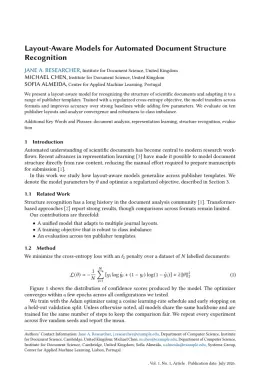
ACM Inroads template — frequently asked questions

How do I write a paper in the ACM Inroads format?
In DocuGuru you write your manuscript in a normal editor — no LaTeX setup required — and select the ACM Inroads template. When you export, DocuGuru compiles the paper into the official ACM format and hands you a submission-ready PDF along with the editable LaTeX source.
What reference style does ACM Inroads use?
ACM Inroads uses Numbered (ACM) references, shown as numbered [1], [2] markers in the text. DocuGuru formats every in-text citation and the reference list in this exact style automatically. A reference appears like this: [1] Ada Smith, Ben Jones, and Cara Lee. 2023. A representative article title. ACM Inroads 12, 3, Article 45 (2023).
Do I need to know LaTeX to submit to ACM Inroads?
No. DocuGuru generates the acmart LaTeX class and compiles the PDF for you in the background, so you get a ACM-ready ACM Inroads document without writing any LaTeX. If you do want it, the LaTeX source is included in the export.
Can I import an existing draft into the ACM Inroads template?
Yes. Paste or upload your current manuscript — Word, LaTeX, Markdown, or plain text — and DocuGuru reflows it into the ACM Inroads format with correct headings, figures, tables, and numbered citations.
Who publishes ACM Inroads?
ACM Inroads is a engineering and computer science journal published by ACM. DocuGuru's ACM Inroads template matches ACM's official submission format.
Can I export a submission-ready ACM Inroads PDF?
Yes — DocuGuru produces a PDF built with the official ACM Inroads template (the acmart class) that is ready to submit to ACM, together with the matching LaTeX source files.
How much does the ACM Inroads template cost?
You can start writing in the ACM Inroads template for free. Exporting the final submission-ready ACM Inroads PDF and LaTeX source is part of DocuGuru's paid plans — see the app for current pricing.
Use the ACM Inroads template