Wiley

Wildlife Letters Template

Write in a clean editor, then format for Wildlife Letters in one click — DocuGuru applies the official Wiley template with author–year references and exports a submission-ready PDF plus the editable LaTeX source. Free to start.

About the Wildlife Letters format

Wildlife Letters is a peer-reviewed journal published by Wiley, covering Wildlife Ecology and Conservation, Species Distribution and Climate Change, Diverse Scientific and Economic Studies.

PublisherWiley
Reference styleAuthor–year (Chicago)
Author–year — (Smith, 2023) in the text
Smith, Ada, Ben Jones, and Cara Lee. 2023. "A Representative Article Title." Wildlife Letters 12 (3): 45–58.

Formats any DOI in Wildlife Letters style. No sign-up.

Publishes research inWildlife Ecology and Conservation Species Distribution and Climate Change Diverse Scientific and Economic Studies Animal Ecology and Behavior Studies Wildlife-Road Interactions and Conservation
ISSN2832-5869
Citation impact (2-yr)0.91
h-index8
i10-index6
Total citations205
Open accessYes
Top institutions publishing hereNortheast Forestry University
You getA submission-ready PDF and the editable LaTeX source — ready to submit.

Papers published in Wildlife Letters per year

28
2023
31
2024
37
2025

Citation impact of Wildlife Letters by publication year

124
2023
45
2024
28
2025

Citations each year’s papers have accumulated so far — the most recent years are still building up.

Most-cited papers in Wildlife Letters

The mass mortality of Asia's native pigs induced by African swine fever

Matthew Scott Luskin, Jonathan H. Moore, Calebe Pereira Mendes et al. · 1 Mar 2023

Abstract Asia's wild pigs are ecosystem engineers and a key food for predators and people. The arrival of African swine fever (ASF) in 2018 induced near‐100% fatality in domestic pigs and decimated the Chinese pork industry in 2020 but outcomes for wild pigs have been delayed and unclear. Here we report on the mass mortality…

A review to the methods of personality measurements in wild animals

Jiming Cheng, Huimin He, Min Zhang et al. · 1 Sep 2023

Abstract One of the challenges in the study of animal personalities is to select a suitable method to measure personality. Here, we reviewed the three common methods (traits rating, behavioral coding, and experimentation) used in animal personality measurement in wild animals. For each method, we summarized its experimental animals and conditions, advantages, and disadvantages in…

Clustered conflicts in disturbed lowlands characterize human–tiger interactions in Aceh, Indonesia

Joe J. Figel, Renaldi Safriansyah, Said Fauzan Baabud et al. · 1 Jun 2023

Abstract Conflict with humans is a severe threat to critically endangered Sumatran tigers Panthera tigris sumatrae . To better inform human‐tiger conflict (HTC) management in Aceh, Sumatra, we analysed 96 cases of HTC reported to, and verified by, local government authorities between 2017 and 2021. Livestock depredation (49%) and people reporting fear or anxiety upon…

Mesopredators in forest edges

Matthew Scott Luskin, Lindsey Arnold, Adia R. Sovie et al. · 1 Sep 2023

Abstract Fragments and edges account for most remaining forest habitats globally. Apex predators and megaherbivores often decline in these degraded habitats while smaller generalist omnivores can persist or thrive in forest edges, especially if they can utilize nonnative resources (“cross‐boundary food subsidies”). Outcomes for small‐medium carnivores (mesopredators) remain unclear or idiosyncratic. We tested responses of…

The fine‐scale movement pattern of Amur tiger (<i>Panthera tigris altaica</i>) responds to winter habitat permeability

Ying Wang, Wannian Cheng, Yanhui Guan et al. · 31 Aug 2023

Abstract The number of Amur tigers living in protected regions is increasing, and China has achieved significant progress in this regard, especially at the Sino‐Russia border region around Hunchun where most of the Amur tigers are found in China. However, there is a need to increase the dispersal of Amur tigers further from the border…

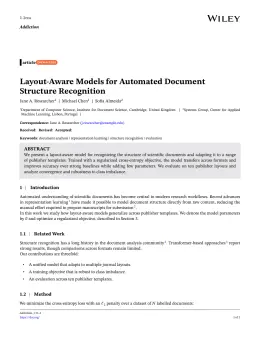
Wildlife Letters template — frequently asked questions

How do I write a paper in the Wildlife Letters format?
In DocuGuru you write your manuscript in a normal editor — no LaTeX setup required — and select the Wildlife Letters template. When you export, DocuGuru compiles the paper into the official Wiley format and hands you a submission-ready PDF along with the editable LaTeX source.
What reference style does Wildlife Letters use?
Wildlife Letters uses Author–year (Chicago) references, shown as author–year markers such as (Smith, 2023) in the text. DocuGuru formats every in-text citation and the reference list in this exact style automatically. A reference appears like this: Smith, Ada, Ben Jones, and Cara Lee. 2023. "A Representative Article Title." Wildlife Letters 12 (3): 45–58.
Do I need to know LaTeX to submit to Wildlife Letters?
No. DocuGuru generates the USG LaTeX class and compiles the PDF for you in the background, so you get a Wiley-ready Wildlife Letters document without writing any LaTeX. If you do want it, the LaTeX source is included in the export.
Can I import an existing draft into the Wildlife Letters template?
Yes. Paste or upload your current manuscript — Word, LaTeX, Markdown, or plain text — and DocuGuru reflows it into the Wildlife Letters format with correct headings, figures, tables, and author–year citations.
Who publishes Wildlife Letters?
Wildlife Letters is a multidisciplinary journal published by Wiley. DocuGuru's Wildlife Letters template matches Wiley's official submission format.
Can I export a submission-ready Wildlife Letters PDF?
Yes — DocuGuru produces a PDF built with the official Wildlife Letters template (the USG class) that is ready to submit to Wiley, together with the matching LaTeX source files.
How much does the Wildlife Letters template cost?
You can start writing in the Wildlife Letters template for free. Exporting the final submission-ready Wildlife Letters PDF and LaTeX source is part of DocuGuru's paid plans — see the app for current pricing.
Use the Wildlife Letters template