Wiley

Separation Science Plus Template

Write in a clean editor, then format for Separation Science Plus in one click — DocuGuru applies the official Wiley template with author–year references and exports a submission-ready PDF plus the editable LaTeX source. Free to start.

About the Separation Science Plus format

Separation Science Plus is a peer-reviewed journal published by Wiley, covering Analytical Chemistry and Chromatography, Analytical Methods in Pharmaceuticals, Analytical chemistry methods development.

PublisherWiley
Reference styleAuthor–year (Chicago)
Author–year — (Smith, 2023) in the text
Smith, Ada, Ben Jones, and Cara Lee. 2023. "A Representative Article Title." Separation Science Plus 12 (3): 45–58.

Formats any DOI in Separation Science Plus style. No sign-up.

Publishes research inAnalytical Chemistry and Chromatography Analytical Methods in Pharmaceuticals Analytical chemistry methods development Pesticide Residue Analysis and Safety Antibiotics Pharmacokinetics and Efficacy
ISSN2573-1815
Citation impact (2-yr)2.6
h-index21
i10-index115
Total citations4,020
Article processing charge$3,140
Top institutions publishing hereGITAM University
Journal websiteonlinelibrary.wiley.com
You getA submission-ready PDF and the editable LaTeX source — ready to submit.

Papers published in Separation Science Plus per year

138
2018
111
2019
115
2020
84
2021
131
2022
155
2023
163
2024
198
2025

Citation impact of Separation Science Plus by publication year

610
2018
432
2019
556
2020
167
2021
509
2022
500
2023
714
2024
448
2025

Citations each year’s papers have accumulated so far — the most recent years are still building up.

Most-cited papers in Separation Science Plus

Chirality: An inescapable concept for the pharmaceutical, bio‐pharmaceutical, food, and cosmetic industries

Jony Susanna Kandula, V. V. S. Prasanna Kumari Rayala, P. Radhakrishnanand · 7 Feb 2023

Abstract Chirality resides in diverse fields such as pharmaceuticals, food, bio‐pharmaceuticals, and cosmetics. Drugs used in treating various disease conditions, the majority of the plant secondary metabolites, various chemicals used in cosmetics, and distinct flavoring agents used in food industries exhibit chirality. In this context, there is an obligation to extend the analysis to chiral…

A simple high‐performance liquid chromatography method development for Carbidopa and Levodopa impurities: Evaluation of risk assessment before method validation by Quality by Design approach

Velusamy B. Subramanian, Naresh Konduru, Naresh Kumar Katari et al. · 26 Oct 2020

Abstract The current study is to develop a simple high‐performance liquid chromatography method for Carbidopa and Levodopa impurities' simultaneous determination with the combination of Entacapone in solid oral dosage forms. The estimation of impurities are critical in a combination product due to the more number of impurities. The presence of impurities in drug products affects…

Detection of cannabinoids and cannabinoid metabolites using gas chromatography with vacuum ultraviolet spectroscopy

Allegra Leghissa, Jonathan Smuts, Changling Qiu et al. · 1 Jan 2018

Abstract Relatively new technology vacuum ultraviolet absorption spectroscopic (120–240 nm) detection for gas chromatography, was evaluated and shown to successfully differentiate cannabinoids, their metabolites, and derivatives thereof. The possibility to deconvolute co‐eluting peaks due to additivity of overlapping absorbance spectra of the analytes was also demonstrated. This feature allows the use of faster temperature ramps,…

Molecularly imprinted cryogel columns for Concanavalin A purification from jack bean extract

Duygu Çimen, Nilay Bereli, Müge Andaç et al. · 1 Jun 2018

Abstract Concanavalin A, one of most studied lectins for the purification of glycoproteins and sugars, is selected as a model protein. In this study, a Concanavalin A imprinted poly(hydroxyethyl methacrylate) supermacroporous cryogel was prepared for the purification of Concanavalin from jack bean extract. N ‐Methacryloyl‐ l ‐histidine methyl ester with nickel(II) ions was used as…

Natural Deep Eutectic Solvents in Extraction Science: Progress, Challenges, and Future Prospects

Krunal J. Suthar · 1 Jun 2025

ABSTRACT Natural deep eutectic solvents (NADES) have emerged as eco‐friendly and sustainable alternatives to conventional solvents in extraction science. Their distinctive properties, such as high biocompatibility, tunable physicochemical characteristics, and environmental safety, position them as effective extractants in separation sciences. This review critically examines advances in separation science, challenges, and future prospects of NADES in…

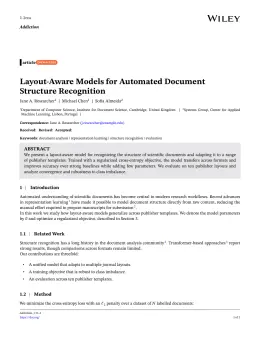
Separation Science Plus template — frequently asked questions

How do I write a paper in the Separation Science Plus format?
In DocuGuru you write your manuscript in a normal editor — no LaTeX setup required — and select the Separation Science Plus template. When you export, DocuGuru compiles the paper into the official Wiley format and hands you a submission-ready PDF along with the editable LaTeX source.
What reference style does Separation Science Plus use?
Separation Science Plus uses Author–year (Chicago) references, shown as author–year markers such as (Smith, 2023) in the text. DocuGuru formats every in-text citation and the reference list in this exact style automatically. A reference appears like this: Smith, Ada, Ben Jones, and Cara Lee. 2023. "A Representative Article Title." Separation Science Plus 12 (3): 45–58.
Do I need to know LaTeX to submit to Separation Science Plus?
No. DocuGuru generates the USG LaTeX class and compiles the PDF for you in the background, so you get a Wiley-ready Separation Science Plus document without writing any LaTeX. If you do want it, the LaTeX source is included in the export.
Can I import an existing draft into the Separation Science Plus template?
Yes. Paste or upload your current manuscript — Word, LaTeX, Markdown, or plain text — and DocuGuru reflows it into the Separation Science Plus format with correct headings, figures, tables, and author–year citations.
Who publishes Separation Science Plus?
Separation Science Plus is a multidisciplinary journal published by Wiley. DocuGuru's Separation Science Plus template matches Wiley's official submission format.
Can I export a submission-ready Separation Science Plus PDF?
Yes — DocuGuru produces a PDF built with the official Separation Science Plus template (the USG class) that is ready to submit to Wiley, together with the matching LaTeX source files.
How much does the Separation Science Plus template cost?
You can start writing in the Separation Science Plus template for free. Exporting the final submission-ready Separation Science Plus PDF and LaTeX source is part of DocuGuru's paid plans — see the app for current pricing.
Use the Separation Science Plus template