Wiley

Phytochemical Analysis Template

Write in a clean editor, then format for Phytochemical Analysis in one click — DocuGuru applies the official Wiley template with author–year references and exports a submission-ready PDF plus the editable LaTeX source. Free to start.

About the Phytochemical Analysis format

Phytochemical Analysis is a peer-reviewed journal published by Wiley, covering Traditional Chinese Medicine Analysis, Phytochemistry and Biological Activities, Natural product bioactivities and synthesis.

PublisherWiley
Reference styleAuthor–year (Chicago)
Author–year — (Smith, 2023) in the text
Smith, Ada, Ben Jones, and Cara Lee. 2023. "A Representative Article Title." Phytochemical Analysis 12 (3): 45–58.

Formats any DOI in Phytochemical Analysis style. No sign-up.

Publishes research inTraditional Chinese Medicine Analysis Phytochemistry and Biological Activities Natural product bioactivities and synthesis Phytochemicals and Antioxidant Activities Chromatography in Natural Products
ISSN0958-0344
Citation impact (2-yr)3.61
h-index99
i10-index1,714
Total citations71,077
Article processing charge$3,970
Top institutions publishing hereChinese Academy of Sciences
Journal websiteonlinelibrary.wiley.com
You getA submission-ready PDF and the editable LaTeX source — ready to submit.

Papers published in Phytochemical Analysis per year

62
2014
52
2015
68
2016
83
2017
79
2018
94
2019
125
2020
81
2021
106
2022
120
2023
191
2024
116
2025

Citation impact of Phytochemical Analysis by publication year

2K
2014
1.2K
2015
1K
2016
1.9K
2017
1.8K
2018
2K
2019
2K
2020
1K
2021
1K
2022
835
2023
928
2024
243
2025

Citations each year’s papers have accumulated so far — the most recent years are still building up.

Most-cited papers in Phytochemical Analysis

Screening of Plant Extracts for Antioxidant Activity: a Comparative Study on Three Testing Methods

Irina Koleva, Teris A. van Beek, J.P.H. Linssen et al. · 1 Jan 2002

Three methods widely employed in the evaluation of antioxidant activity, namely 2,2'-diphenyl-1-picrylhydrazyl (DPPH) radical scavenging method, static headspace gas chromatography (HS-GC) and beta-carotene bleaching test (BCBT), have been compared with regard to their application in the screening of plant extracts. The strengths and limitations of each method have been illustrated by testing a number of…

1,784 citations Cite SaveGo to paper →
Recent extraction techniques for natural products: microwave‐assisted extraction and pressurised solvent extraction

Béatrice Kaufmann, Philippe Christen · 1 Mar 2002

In the last 10 years there has been an increased interest in using techniques involving microwave-assisted extraction and pressurised solvent extraction in analytical laboratories. This review gives a brief overview of both methods, and reports on their application to the extraction of natural products. The influence of parameters such as the nature of the solvent…

A Rapid and effective method for RNA extraction from different tissues of grapevine and other woody plants

Giorgio Gambino, Irene Perrone, Ivana Gribaudo · 10 Jul 2008

INTRODUCTION: RNA quality and integrity are critical for many studies in plant molecular biology. High-quality RNA extraction from grapevine and other woody plants is problematic due to the presence of polysaccharides, polyphenolics and other compounds that bind or co-precipitate with the RNA. OBJECTIVE: To develop an optimised cetyltrimethylammonium bromide (CTAB)-based protocol, to reduce the time…

Testing of antifungal natural products: methodologies, comparability of results and assay choice

Franz Hadaček, Harald Greger · 1 May 2000

Antifungal testing of filamentous fungi generally suffers from incomparability of results. In order to illustrate this problem, the polyacetylene falcarindiol and the naphthoquinone juglone, two known antifungal natural products, were assayed in various dilution and diffusion bioassays against three selected microfungi, Botrytis cinerea, Cladosporium herbarum and Fusarium avenaceum. Broth microdilution, based on the 96-well microtitre…

Validated methods for the quantification of biologically active constituents of poplar‐type propolis

Milena Popova, Vassya Bankova, Daniela Butovska et al. · 1 Jul 2004

The validation of rapid, low-cost spectrophotometric procedures for the quantification of the three main groups of bioactive substances (flavones and flavonols, flavanones and dihydroflavonols, and total phenolics) in poplar-type propolis has been performed. A spectrophotometric assay based on the formation of an aluminium chloride complex was applied for the quantification of total flavones and flavonols…

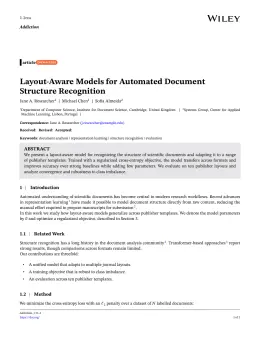
Phytochemical Analysis template — frequently asked questions

How do I write a paper in the Phytochemical Analysis format?
In DocuGuru you write your manuscript in a normal editor — no LaTeX setup required — and select the Phytochemical Analysis template. When you export, DocuGuru compiles the paper into the official Wiley format and hands you a submission-ready PDF along with the editable LaTeX source.
What reference style does Phytochemical Analysis use?
Phytochemical Analysis uses Author–year (Chicago) references, shown as author–year markers such as (Smith, 2023) in the text. DocuGuru formats every in-text citation and the reference list in this exact style automatically. A reference appears like this: Smith, Ada, Ben Jones, and Cara Lee. 2023. "A Representative Article Title." Phytochemical Analysis 12 (3): 45–58.
Do I need to know LaTeX to submit to Phytochemical Analysis?
No. DocuGuru generates the USG LaTeX class and compiles the PDF for you in the background, so you get a Wiley-ready Phytochemical Analysis document without writing any LaTeX. If you do want it, the LaTeX source is included in the export.
Can I import an existing draft into the Phytochemical Analysis template?
Yes. Paste or upload your current manuscript — Word, LaTeX, Markdown, or plain text — and DocuGuru reflows it into the Phytochemical Analysis format with correct headings, figures, tables, and author–year citations.
Who publishes Phytochemical Analysis?
Phytochemical Analysis is a multidisciplinary journal published by Wiley. DocuGuru's Phytochemical Analysis template matches Wiley's official submission format.
Can I export a submission-ready Phytochemical Analysis PDF?
Yes — DocuGuru produces a PDF built with the official Phytochemical Analysis template (the USG class) that is ready to submit to Wiley, together with the matching LaTeX source files.
How much does the Phytochemical Analysis template cost?
You can start writing in the Phytochemical Analysis template for free. Exporting the final submission-ready Phytochemical Analysis PDF and LaTeX source is part of DocuGuru's paid plans — see the app for current pricing.
Use the Phytochemical Analysis template