Wiley

physica status solidi (RRL) - Rapid Research Letters Template

Write in a clean editor, then format for physica status solidi (RRL) - Rapid Research Letters in one click — DocuGuru applies the official Wiley template with author–year references and exports a submission-ready PDF plus the editable LaTeX source. Free to start.

About the physica status solidi (RRL) - Rapid Research Letters format

physica status solidi (RRL) - Rapid Research Letters is a peer-reviewed journal published by Wiley, covering 2D Materials and Applications, Semiconductor materials and devices, Chalcogenide Semiconductor Thin Films.

PublisherWiley
Reference styleAuthor–year (Chicago)
Author–year — (Smith, 2023) in the text
Smith, Ada, Ben Jones, and Cara Lee. 2023. "A Representative Article Title." physica status solidi (RRL) - Rapid Research Letters 12 (3): 45–58.

Formats any DOI in physica status solidi (RRL) - Rapid Research Letters style. No sign-up.

Publishes research in2D Materials and Applications Semiconductor materials and devices Chalcogenide Semiconductor Thin Films Graphene research and applications ZnO doping and properties
ISSN1862-6254
Citation impact (2-yr)1.76
h-index90
i10-index1,493
Total citations58,898
Top institutions publishing hereChinese Academy of Sciences
Journal websiteonlinelibrary.wiley.com
You getA submission-ready PDF and the editable LaTeX source — ready to submit.

Papers published in physica status solidi (RRL) - Rapid Research Letters per year

238
2014
220
2015
215
2016
227
2017
242
2018
269
2019
243
2020
315
2021
239
2022
247
2023
227
2024
276
2025

Citation impact of physica status solidi (RRL) - Rapid Research Letters by publication year

5K
2014
3.2K
2015
5K
2016
3K
2017
2.9K
2018
4.2K
2019
2.8K
2020
3.6K
2021
1.5K
2022
1.1K
2023
662
2024
372
2025

Citations each year’s papers have accumulated so far — the most recent years are still building up.

Most-cited papers in physica status solidi (RRL) - Rapid Research Letters

Effects of heavy alkali elements in Cu(In,Ga)Se<sub>2</sub>solar cells with efficiencies up to 22.6%

Philip Jackson, Roland Wüerz, Dimitrios Hariskos et al. · 12 Jul 2016

We report on the use and effect of the alkali elements rubidium and caesium in the place of sodium and potassium in the alkali post deposition treatment (PDT) as applied to Cu(In,Ga)Se 2 (CIGS) solar cell absorbers. In order to study the effects of the different alkali elements, we have produced a large number of…

1,470 citations Cite SaveGo to paper →
Properties of Cu(In,Ga)Se<sub>2</sub> solar cells with new record efficiencies up to 21.7%

Philip Jackson, Dimitrios Hariskos, Roland Wüerz et al. · 23 Dec 2014

We report on a new thin-film Cu(In,Ga)Se2 (CIGS) solar cell record efficiency of 21.7%. In order to better understand this newest development, we describe the specific solar cell data as obtained from I–V measurement and diode analysis, quantum efficiency and secondary neutral mass spectrometry measurements. We hope that such a description will help to exploit…

Colossal dielectric constant in high entropy oxides

David Bérardan, Sylvain Franger, Diana Dragoé et al. · 1 Mar 2016

Entropic contributions to the stability of solids are very well understood and the mixing entropy has been used for forming various solids, for instance such as inverse spinels, see Nawrotsky et al., J. Inorg. Nucl. Chem. 29, 2701 (1967) [1]. A particular development was related to high entropy alloys by Yeh et al., Adv. Eng.…

Compositional investigation of potassium doped Cu(In,Ga)Se<sub>2</sub>solar cells with efficiencies up to 20.8%

Philip Jackson, Dimitrios Hariskos, Roland Wüerz et al. · 19 Feb 2014

Abstract We report on the interaction between intentional potassium doping of thin film Cu(In,Ga)Se 2 (CIGS) solar cells, CIGS absorber composition, and device efficiency. Up to now high efficiency CIGS solar cells could not be produced with a gallium/(gallium + indium) ratio higher than 35%. The new doping process step does not only increase solar…

Floquet topological insulators

Jérôme Cayssol, Balázs Dóra, Ferenc Simon et al. · 28 Jan 2013

Abstract magnified image Topological insulators represent unique phases of matter with insulating bulk and conducting edge or surface states, immune to small perturbations such as backscattering due to disorder. This stems from their peculiar band structure, which provides topological protections. While conventional tools (pressure, doping etc.) to modify the band structure are available, time periodic…

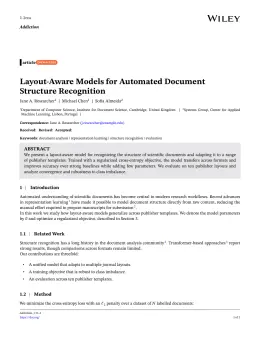
physica status solidi (RRL) - Rapid Research Letters template — frequently asked questions

How do I write a paper in the physica status solidi (RRL) - Rapid Research Letters format?
In DocuGuru you write your manuscript in a normal editor — no LaTeX setup required — and select the physica status solidi (RRL) - Rapid Research Letters template. When you export, DocuGuru compiles the paper into the official Wiley format and hands you a submission-ready PDF along with the editable LaTeX source.
What reference style does physica status solidi (RRL) - Rapid Research Letters use?
physica status solidi (RRL) - Rapid Research Letters uses Author–year (Chicago) references, shown as author–year markers such as (Smith, 2023) in the text. DocuGuru formats every in-text citation and the reference list in this exact style automatically. A reference appears like this: Smith, Ada, Ben Jones, and Cara Lee. 2023. "A Representative Article Title." physica status solidi (RRL) - Rapid Research Letters 12 (3): 45–58.
Do I need to know LaTeX to submit to physica status solidi (RRL) - Rapid Research Letters?
No. DocuGuru generates the USG LaTeX class and compiles the PDF for you in the background, so you get a Wiley-ready physica status solidi (RRL) - Rapid Research Letters document without writing any LaTeX. If you do want it, the LaTeX source is included in the export.
Can I import an existing draft into the physica status solidi (RRL) - Rapid Research Letters template?
Yes. Paste or upload your current manuscript — Word, LaTeX, Markdown, or plain text — and DocuGuru reflows it into the physica status solidi (RRL) - Rapid Research Letters format with correct headings, figures, tables, and author–year citations.
Who publishes physica status solidi (RRL) - Rapid Research Letters?
physica status solidi (RRL) - Rapid Research Letters is a multidisciplinary journal published by Wiley. DocuGuru's physica status solidi (RRL) - Rapid Research Letters template matches Wiley's official submission format.
Can I export a submission-ready physica status solidi (RRL) - Rapid Research Letters PDF?
Yes — DocuGuru produces a PDF built with the official physica status solidi (RRL) - Rapid Research Letters template (the USG class) that is ready to submit to Wiley, together with the matching LaTeX source files.
How much does the physica status solidi (RRL) - Rapid Research Letters template cost?
You can start writing in the physica status solidi (RRL) - Rapid Research Letters template for free. Exporting the final submission-ready physica status solidi (RRL) - Rapid Research Letters PDF and LaTeX source is part of DocuGuru's paid plans — see the app for current pricing.
Use the physica status solidi (RRL) - Rapid Research Letters template