Wiley

Journal of Biochemical and Molecular Toxicology Template

Write in a clean editor, then format for Journal of Biochemical and Molecular Toxicology in one click — DocuGuru applies the official Wiley template with author–year references and exports a submission-ready PDF plus the editable LaTeX source. Free to start.

About the Journal of Biochemical and Molecular Toxicology format

Journal of Biochemical and Molecular Toxicology is a peer-reviewed journal published by Wiley, covering Genomics, phytochemicals, and oxidative stress, MicroRNA in disease regulation, Cancer-related molecular mechanisms research.

PublisherWiley
Reference styleAuthor–year (Chicago)
Author–year — (Smith, 2023) in the text
Smith, Ada, Ben Jones, and Cara Lee. 2023. "A Representative Article Title." Journal of Biochemical and Molecular Toxicology 12 (3): 45–58.

Formats any DOI in Journal of Biochemical and Molecular Toxicology style. No sign-up.

Publishes research inGenomics, phytochemicals, and oxidative stress MicroRNA in disease regulation Cancer-related molecular mechanisms research Circular RNAs in diseases Drug-Induced Hepatotoxicity and Protection
ISSN1095-6670
Citation impact (2-yr)2.7
h-index83
i10-index1,800
Total citations65,320
Article processing charge$4,020
Top institutions publishing hereAtatürk University
Journal websiteonlinelibrary.wiley.com
You getA submission-ready PDF and the editable LaTeX source — ready to submit.

Papers published in Journal of Biochemical and Molecular Toxicology per year

102
2014
96
2015
108
2016
149
2017
168
2018
173
2019
271
2020
299
2021
319
2022
350
2023
336
2024
574
2025

Citation impact of Journal of Biochemical and Molecular Toxicology by publication year

1.8K
2014
1.6K
2015
1.9K
2016
3.8K
2017
3.7K
2018
3.3K
2019
4.9K
2020
5.4K
2021
3.5K
2022
2.9K
2023
1.9K
2024
1.3K
2025

Citations each year’s papers have accumulated so far — the most recent years are still building up.

Most-cited papers in Journal of Biochemical and Molecular Toxicology

Diabetes, oxidative stress, and antioxidants: A review

Alice Maritim, Ruth A. Sanders, J. B. Watkins · 1 Jan 2003

Increasing evidence in both experimental and clinical studies suggests that oxidative stress plays a major role in the pathogenesis of both types of diabetes mellitus. Free radicals are formed disproportionately in diabetes by glucose oxidation, nonenzymatic glycation of proteins, and the subsequent oxidative degradation of glycated proteins. Abnormally high levels of free radicals and the…

3,127 citations Cite SaveGo to paper →
Imbalanced GSH/ROS and sequential cell death

Ting Liu, Li Sun, Yubin Zhang et al. · 2 Nov 2021

Reactive oxygen species (ROS) are produced in cells during metabolic processes. Excessive intracellular ROS may react with large biomolecules, such as DNA, RNA, proteins, and small biomolecules, that is, glutathione (GSH) and unsaturated fatty acids. GSH has physiological functions, including free radical scavenging, anti-oxidation, and electrophile elimination. The disruption of ROS/GSH balance results in the…

Mechanisms of cadmium-mediated acute hepatotoxicity

Lora E. Rikans, Tetsuo Yamano · 1 Jan 2000

The mechanism of cadmium-mediated acute hepatotoxicity has been the subject of numerous investigations and although some uncertainties persist, sufficient evidence has emerged to provide a reasonable account of the toxic process. Acute hepatotoxicity involves two pathways, one for the initial injury produced by direct effects of cadmium and the other for the subsequent injury produced…

Ontogeny of human hepatic cytochromes P450

Ronald N. Hines · 1 Aug 2007

Significant changes in drug-metabolizing enzyme (DME) expression occur during ontogeny. Such changes can have a profound effect on therapeutic efficacy in the fetus and child, as well as the risk for adverse drug reactions. To gain a better understanding of DME ontogeny, enzyme contents for six key cytochromes P450 were measured in 240 human liver…

Accumulation and Endocrine Disrupting Effects of the Flame Retardant Mixture Firemaster<sup>®</sup> 550 in Rats: An Exploratory Assessment

Heather B. Patisaul, Simon C. Roberts, Natalie Mabrey et al. · 8 Nov 2012

Firemaster® 550 (FM 550), a fire-retardant mixture used in foam-based products, was recently identified as a common contaminant in household dust. The chemical structures of its principle components suggest they have endocrine disrupting activity, but nothing is known about their physiological effects at environmentally relevant exposure levels. The goal of this exploratory study was to…

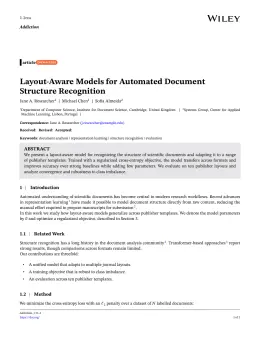
Journal of Biochemical and Molecular Toxicology template — frequently asked questions

How do I write a paper in the Journal of Biochemical and Molecular Toxicology format?
In DocuGuru you write your manuscript in a normal editor — no LaTeX setup required — and select the Journal of Biochemical and Molecular Toxicology template. When you export, DocuGuru compiles the paper into the official Wiley format and hands you a submission-ready PDF along with the editable LaTeX source.
What reference style does Journal of Biochemical and Molecular Toxicology use?
Journal of Biochemical and Molecular Toxicology uses Author–year (Chicago) references, shown as author–year markers such as (Smith, 2023) in the text. DocuGuru formats every in-text citation and the reference list in this exact style automatically. A reference appears like this: Smith, Ada, Ben Jones, and Cara Lee. 2023. "A Representative Article Title." Journal of Biochemical and Molecular Toxicology 12 (3): 45–58.
Do I need to know LaTeX to submit to Journal of Biochemical and Molecular Toxicology?
No. DocuGuru generates the USG LaTeX class and compiles the PDF for you in the background, so you get a Wiley-ready Journal of Biochemical and Molecular Toxicology document without writing any LaTeX. If you do want it, the LaTeX source is included in the export.
Can I import an existing draft into the Journal of Biochemical and Molecular Toxicology template?
Yes. Paste or upload your current manuscript — Word, LaTeX, Markdown, or plain text — and DocuGuru reflows it into the Journal of Biochemical and Molecular Toxicology format with correct headings, figures, tables, and author–year citations.
Who publishes Journal of Biochemical and Molecular Toxicology?
Journal of Biochemical and Molecular Toxicology is a multidisciplinary journal published by Wiley. DocuGuru's Journal of Biochemical and Molecular Toxicology template matches Wiley's official submission format.
Can I export a submission-ready Journal of Biochemical and Molecular Toxicology PDF?
Yes — DocuGuru produces a PDF built with the official Journal of Biochemical and Molecular Toxicology template (the USG class) that is ready to submit to Wiley, together with the matching LaTeX source files.
How much does the Journal of Biochemical and Molecular Toxicology template cost?
You can start writing in the Journal of Biochemical and Molecular Toxicology template for free. Exporting the final submission-ready Journal of Biochemical and Molecular Toxicology PDF and LaTeX source is part of DocuGuru's paid plans — see the app for current pricing.
Use the Journal of Biochemical and Molecular Toxicology template