Wiley

eJHaem Template

Write in a clean editor, then format for eJHaem in one click — DocuGuru applies the official Wiley template with author–year references and exports a submission-ready PDF plus the editable LaTeX source. Free to start.

About the eJHaem format

eJHaem is a peer-reviewed journal published by Wiley, covering Lymphoma Diagnosis and Treatment, Acute Myeloid Leukemia Research, Chronic Lymphocytic Leukemia Research.

PublisherWiley
Reference styleAuthor–year (Chicago)
Author–year — (Smith, 2023) in the text
Smith, Ada, Ben Jones, and Cara Lee. 2023. "A Representative Article Title." eJHaem 12 (3): 45–58.

Formats any DOI in eJHaem style. No sign-up.

Publishes research inLymphoma Diagnosis and Treatment Acute Myeloid Leukemia Research Chronic Lymphocytic Leukemia Research Multiple Myeloma Research and Treatments Myeloproliferative Neoplasms: Diagnosis and Treatment
ISSN2688-6146
Citation impact (2-yr)1.21
h-index23
i10-index132
Total citations5,486
Open accessYes
Top institutions publishing hereUniversity College London
Journal websiteonlinelibrary.wiley.com
You getA submission-ready PDF and the editable LaTeX source — ready to submit.

Papers published in eJHaem per year

1
1995
1
1998
1
2003
1
2008
1
2009
1
2010
146
2020
217
2021
265
2022
200
2023
240
2024
248
2025

Citation impact of eJHaem by publication year

0
1995
0
1998
0
2003
3
2008
2
2009
0
2010
843
2020
1.6K
2021
1.2K
2022
872
2023
538
2024
181
2025

Citations each year’s papers have accumulated so far — the most recent years are still building up.

Most-cited papers in eJHaem

CAR T cell therapy in solid tumors: A review of current clinical trials

Urvi Patel, John L. Abernathy, Bipin N. Savani et al. · 7 Dec 2021

Chimeric antigen receptor (CAR) T cell therapy has made tremendous strides in the arena of hematological malignancies with approved therapies in certain leukemias, lymphomas, and recently myeloma with overall highly favorable response rates. While numerous clinical studies are still ongoing for hematological malignancies, research is developing to translate the feasibility of CAR T therapy in…

Overview of approved CAR‐T therapies, ongoing clinical trials, and its impact on clinical practice

Salyka Sengsayadeth, Bipin N. Savani, Olalekan O. Oluwole et al. · 24 Nov 2021

In recent years, we have seen rapid expansion of chimeric antigen receptor T-cell (CAR-T) therapies in multiple malignancies. CAR-T therapy has profoundly altered the treatment landscape of non-Hodgkin lymphoma, B-cell acute lymphoblastic leukemia, and multiple myeloma. Currently available CD19 and B-cell maturation antigen-directed CAR-T therapies have shown high overall response rate and durable remissions in…

Iron, neuro‐bioavailability and depression

Christian Berthou, Jean Paul Iliou, Denis Barba · 5 Dec 2021

Medical management of iron deficiency (ID) requires to consider its consequences in biochemical and physiological plural functions, beyond heme/hemoglobin disrupted synthesis. Fatigue, muscle weakness, reduced exercise capacity, changes in thymia and modified emotional behaviors are the commonest symptoms integrated in the history of ID, dependent or not of the hemoglobin concentration. The relationship between depression…

SMOOTH INTERPOLATION TO SCATTERED 3D DATA.

Gerald Farin · 1 Dec 1983

Hyperkalemia, an elevated blood potassium concentration exceeding 5.0 mEq/L, is associated with adverse outcomes and is frequently observed in hospitalized patients. Drug-induced hyperkalemia accounts for a significant proportion of cases, with heparin, commonly used for venous thrombosis prevention, suspected to contribute, though less recognized than other heparin-related side effects. Both unfractionated heparin (UFH) and low…

Role of bridging therapy during chimeric antigen receptor T cell therapy

Shakthi Bhaskar, Bhagirathbhai Dholaria, Salyka Sengsayadeth et al. · 19 Nov 2021

Chimeric antigen receptor (CAR) T-cell therapy has been approved for use in several relapsed/refractory hematologic malignancies and has significantly improved outcomes for these diseases. A number of different CAR T products are now being used in clinical practice and have demonstrated excellent outcomes to those in clinical trials. However, increased real-world use of CAR T…

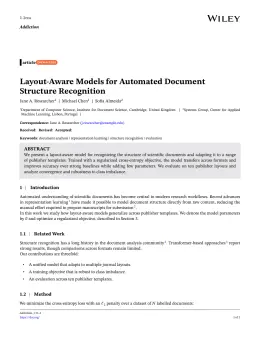
eJHaem template — frequently asked questions

How do I write a paper in the eJHaem format?
In DocuGuru you write your manuscript in a normal editor — no LaTeX setup required — and select the eJHaem template. When you export, DocuGuru compiles the paper into the official Wiley format and hands you a submission-ready PDF along with the editable LaTeX source.
What reference style does eJHaem use?
eJHaem uses Author–year (Chicago) references, shown as author–year markers such as (Smith, 2023) in the text. DocuGuru formats every in-text citation and the reference list in this exact style automatically. A reference appears like this: Smith, Ada, Ben Jones, and Cara Lee. 2023. "A Representative Article Title." eJHaem 12 (3): 45–58.
Do I need to know LaTeX to submit to eJHaem?
No. DocuGuru generates the USG LaTeX class and compiles the PDF for you in the background, so you get a Wiley-ready eJHaem document without writing any LaTeX. If you do want it, the LaTeX source is included in the export.
Can I import an existing draft into the eJHaem template?
Yes. Paste or upload your current manuscript — Word, LaTeX, Markdown, or plain text — and DocuGuru reflows it into the eJHaem format with correct headings, figures, tables, and author–year citations.
Who publishes eJHaem?
eJHaem is a multidisciplinary journal published by Wiley. DocuGuru's eJHaem template matches Wiley's official submission format.
Can I export a submission-ready eJHaem PDF?
Yes — DocuGuru produces a PDF built with the official eJHaem template (the USG class) that is ready to submit to Wiley, together with the matching LaTeX source files.
How much does the eJHaem template cost?
You can start writing in the eJHaem template for free. Exporting the final submission-ready eJHaem PDF and LaTeX source is part of DocuGuru's paid plans — see the app for current pricing.
Use the eJHaem template