
61 citations
Go to paper →
Wiley
Crops & Soils Template
Write in a clean editor, then format for Crops & Soils in one click — DocuGuru applies the official Wiley template with author–year references and exports a submission-ready PDF plus the editable LaTeX source. Free to start.
About the Crops & Soils format
Crops & Soils is a peer-reviewed journal published by Wiley, covering Soil Carbon and Nitrogen Dynamics, Agronomic Practices and Intercropping Systems, Crop Yield and Soil Fertility.
| Publisher | Wiley |
|---|---|
| Reference style | Author–year (Chicago) Author–year — (Smith, 2023) in the text Smith, Ada, Ben Jones, and Cara Lee. 2023. "A Representative Article Title." Crops & Soils 12 (3): 45–58.
Formats any DOI in Crops & Soils style. No sign-up. |
| Publishes research in | Soil Carbon and Nitrogen Dynamics Agronomic Practices and Intercropping Systems Crop Yield and Soil Fertility Soil and Water Nutrient Dynamics Weed Control and Herbicide Applications |
| ISSN | 0162-5098 |
| Citation impact (2-yr) | 0.4 |
| h-index | 13 |
| i10-index | 23 |
| Total citations | 1,228 |
| Article processing charge | $1,150 |
| Top institutions publishing here | Washington State University |
| Journal website | onlinelibrary.wiley.com |
| You get | A submission-ready PDF and the editable LaTeX source — ready to submit. |
Papers published in Crops & Soils per year
Citation impact of Crops & Soils by publication year
Citations each year’s papers have accumulated so far — the most recent years are still building up.
Most-cited papers in Crops & Soils
While it is desirable for the chemicals to control weeds during the season of application, it is not desirable for them to persist and affect subsequent crop growth. Factors that determine the length of time herbicides persist fall into three categories: soil factors, climatic conditions, and herbicidal properties. Factors from each category strongly interact with…
58 citations
Cite
SaveGo to paper →
Cover crop use is being widely promoted throughout the entire United States because of the potential benefits related to protecting and improving the soil. However, in semiarid environments such as the western and central Great Plains (where water is the single most limiting factor to crop production), cover crop water use may result in significant…
31 citations
Cite
SaveGo to paper →
Though iron deficiency symptoms can be visually apparent in most crops, the underlying reasoning for reduced uptake or availability can be more complex. Dedicating time to understanding the soil‐plant environment in each distinctive soil where you suspect iron to be limiting productivity is well worth it. Earn 1 CEU in Nutrient Management by reading this…
29 citations
Cite
SaveGo to paper →
Very acidic soil pH conditions have begun to appear in crop fields throughout the semi‐arid regions of the Great Plains. This is, in part, due to N fertilization. Sound N fertilizer and residue management and tailored crop rotations can slow down and prevent soil acidification. Earn 0.5 CEUs in Soil & Water Management by reading…
26 citations
Cite
SaveGo to paper →
Related journal templates
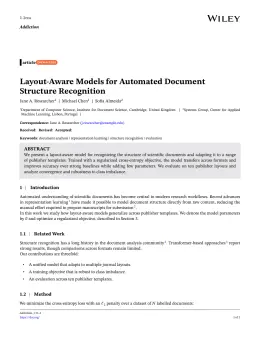
Crops & Soils template — frequently asked questions
How do I write a paper in the Crops & Soils format?
In DocuGuru you write your manuscript in a normal editor — no LaTeX setup required — and select the Crops & Soils template. When you export, DocuGuru compiles the paper into the official Wiley format and hands you a submission-ready PDF along with the editable LaTeX source.
What reference style does Crops & Soils use?
Crops & Soils uses Author–year (Chicago) references, shown as author–year markers such as (Smith, 2023) in the text. DocuGuru formats every in-text citation and the reference list in this exact style automatically. A reference appears like this: Smith, Ada, Ben Jones, and Cara Lee. 2023. "A Representative Article Title." Crops & Soils 12 (3): 45–58.
Do I need to know LaTeX to submit to Crops & Soils?
No. DocuGuru generates the USG LaTeX class and compiles the PDF for you in the background, so you get a Wiley-ready Crops & Soils document without writing any LaTeX. If you do want it, the LaTeX source is included in the export.
Can I import an existing draft into the Crops & Soils template?
Yes. Paste or upload your current manuscript — Word, LaTeX, Markdown, or plain text — and DocuGuru reflows it into the Crops & Soils format with correct headings, figures, tables, and author–year citations.
Who publishes Crops & Soils?
Crops & Soils is a multidisciplinary journal published by Wiley. DocuGuru's Crops & Soils template matches Wiley's official submission format.
Can I export a submission-ready Crops & Soils PDF?
Yes — DocuGuru produces a PDF built with the official Crops & Soils template (the USG class) that is ready to submit to Wiley, together with the matching LaTeX source files.
How much does the Crops & Soils template cost?
You can start writing in the Crops & Soils template for free. Exporting the final submission-ready Crops & Soils PDF and LaTeX source is part of DocuGuru's paid plans — see the app for current pricing.